Animal Tissues Chart Manufacturer,Supplier and Exporter in India
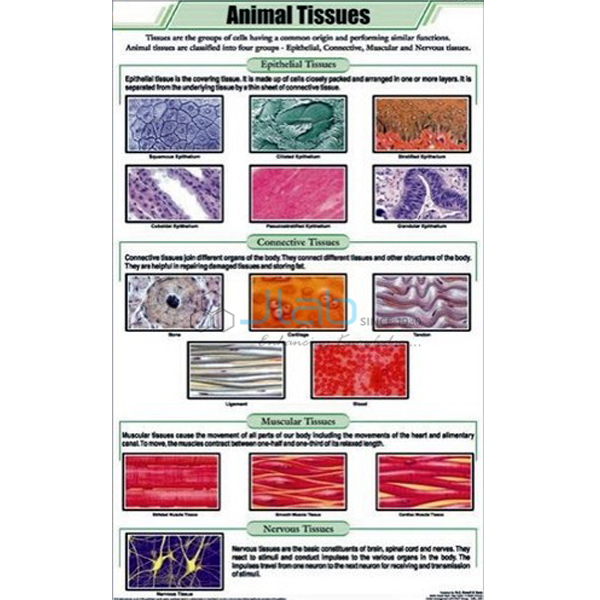
Product Code : EL-ZC-9311
Jlab Export is a leading Animal Tissues Chart Manufacturer,and suppliers in India
Animal Tissues Chart (code EL-ZC-9311) is a 58 x 90 cm wall chart for teaching the main types of animal tissue in school science and college zoology. It is printed in full colour on art paper, laminated on both sides with thick plastic film and fitted with plastic rollers for hanging; the text is English only. JLab (Jain Laboratory Instruments Pvt Ltd, Ambala, India) supplies it to schools, colleges and dealers.
Get a quote: use the Add To Cart enquiry button below, or send your quantity and destination through the contact page.
Specifications
| Parameter | Detail |
|---|---|
| Chart topic | Animal tissues |
| Size | 58 x 90 cm (about 22.8 x 35.4 in) |
| Printing | Full colour on art paper |
| Lamination | Both sides, thick plastic film |
| Fittings | Plastic rollers |
| Language | English only |
| Quality check | Each chart is visually inspected before dispatch |
| Pack quantity | Each (sold individually) |
| Minimum order quantity | 10 units |
| Dispatch time | Usually 7–10 working days |
| Product code | EL-ZC-9311 |
| Supplied by | Jain Laboratory Instruments Pvt Ltd (JLab), Ambala, India |
What Is the Animal Tissues Chart Used For?
A tissue is a group of similar cells that share an origin and do one job together. In class 9 science and again in the class 11 chapter on structural organisation in animals, students learn the four basic animal tissues. Epithelial tissue covers the body and lines its cavities and tubes, with squamous, cuboidal, columnar and ciliated forms as well as glandular epithelium. Connective tissue binds and supports, ranging from loose areolar and fat-storing adipose tissue to tendons, ligaments, cartilage, bone and blood, which is a fluid connective tissue. Muscle tissue is skeletal (striated and voluntary), smooth (unstriated and involuntary) or cardiac, found only in the heart, and nervous tissue is made of neurons with their supporting neuroglia.
Each tissue type looks very different under the microscope, so a large reference chart helps students recognise what they see on prepared slides during histology practicals and draw it correctly in their record books. Keep it beside the microscope bench or the board; the laminated surface wipes clean, and the rollers let it be rolled away between terms. As the listing does not describe the artwork, ask JLab for a larger image if you need to check which tissues are illustrated.
What to Specify When Ordering
- Quantity — 10 units minimum, every chart supplied separately.
- Slides and models — prepared tissue slides or a bone tissue model can be quoted with the chart for practical classes.
- Plant tissues — add the plant tissues chart if you teach both kingdoms side by side.
- Shipping details — delivery city and country, and for export the port and terms such as FOB or CIF.
Frequently Asked Questions
What does the Animal Tissues Chart teach?
It teaches the main kinds of animal tissue and how they differ in structure and job. The listing does not describe the artwork in detail; the product photograph shows the chart, and JLab can send a larger image on request.
What size is the chart?
It is 58 x 90 cm, about 22.8 x 35.4 inches, printed in full colour on art paper, with thick plastic lamination on both sides and plastic rollers.
What are the four basic animal tissues?
Epithelial, connective, muscular and nervous tissue. Organs are built from several of them working together; the stomach wall, for example, contains epithelium, connective tissue, smooth muscle and nerves.
Why is blood called a connective tissue?
Because, like other connective tissues, it consists of cells in a large amount of non-living matrix — the fluid plasma — and it links different parts of the body by carrying materials between them.
What is the minimum order and delivery lead time?
The minimum order is 10 units, packed as single charts. Dispatch usually takes 7–10 working days after each chart is checked by eye; shipping time for export orders varies with the destination.
Who supplies the chart?
JLab (Jain Laboratory Instruments Pvt Ltd), Ambala, Haryana, India, supplies the Animal Tissues Chart and provides quotations directly.
Supplier
JLab is the trading name of Jain Laboratory Instruments Pvt Ltd, a laboratory equipment business incorporated in 2017 and based on Hargolal Road, Ambala, Haryana. Alongside the equipment in its own range, JLab supplies zoology charts like this one to schools, colleges, dealers and importers, gives each chart a visual check before it leaves and handles repeat orders without middlemen. JLab exports worldwide and ships to buyers in every region — for example Australia in Oceania, Eswatini in Southern Africa, Romania in Eastern Europe, Belgium in Western Europe and Brazil in South America. Tender buyers will find more on the JLab lab tenders page.
Tissue Charts, Slides and Models
- Plant Tissues Chart — the matching botany chart on the tissues of flowering plants.
- Human Blood Chart — a chart from the same zoology series on blood, the fluid connective tissue.
- Nerve Tissue — a prepared borosilicate glass slide supplied in a plastic box.
- Histology Nerve Cell Prepared Slide — for identifying neurons, their cell processes and glial cells.
- Bone Tissue Model — shows spongy and compact bone and blood vessels, in PVC on a base.
See all titles in the Zoology Chart range or the full Charts range.
Request a Quote
Ask JLab for a quotation with the Add To Cart enquiry button on this page, or send the number of charts (minimum 10 units), any slides or models you want with them and the delivery city and country through the contact page.
Last updated: 3 October 2026