Earthworm - III Digestion, Skin and Excretion Chart Manufacturer,Supplier and Exporter in India
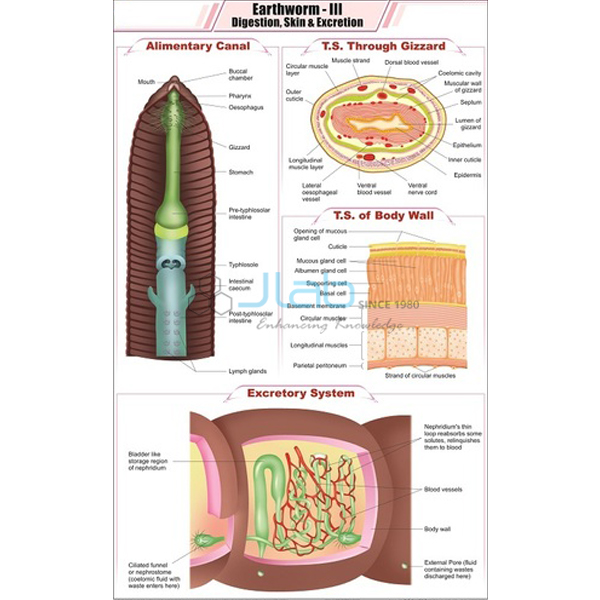
Product Code : EL-ZC-9339
Jlab Export is a leading Earthworm - III Digestion, Skin and Excretion Chart Manufacturer,and suppliers in India
Earthworm - III Digestion, Skin and Excretion Chart (code EL-ZC-9339) completes the three-chart earthworm set: a 58 x 90 cm wall chart on how the earthworm digests its food, what its body wall is made of and how it removes wastes, for class 11 biology and college zoology. It is printed in full colour on art paper, laminated on both sides and fitted with plastic rollers, in English only. JLab (Jain Laboratory Instruments Pvt Ltd, Ambala, India) supplies it to schools, colleges and dealers.
Get a quote: use the Add To Cart enquiry button below, or send your quantity and destination through the contact page.
Specifications
| Parameter | Detail |
|---|---|
| Chart topic | Earthworm: digestion, skin and excretion |
| Size | 58 x 90 cm (about 22.8 x 35.4 in) |
| Printing | Full colour on art paper |
| Lamination | Both sides, thick plastic film |
| Fittings | Plastic rollers |
| Language | English only |
| Quality check | Each chart is visually inspected before dispatch |
| Pack quantity | Each (sold individually) |
| Minimum order quantity | 10 units |
| Dispatch time | Usually 7–10 working days |
| Product code | EL-ZC-9339 |
| Supplied by | Jain Laboratory Instruments Pvt Ltd (JLab), Ambala, India |
What Is the Earthworm Digestion and Excretion Chart Used For?
An earthworm feeds on decaying leaves and organic matter mixed with soil, and its alimentary canal is a straight tube from mouth to anus. Food passes from the mouth and buccal cavity into a muscular pharynx and a narrow oesophagus, then into the muscular gizzard, which grinds soil particles and leaf fragments, and on through the stomach to the long intestine. Calciferous glands in the stomach neutralise the humic acid in humus, and a fold of the intestine’s upper wall projecting into the cavity — the typhlosole — increases the area for absorption. The undigested soil leaves as castings, which is how earthworms enrich and loosen the soil and why they are called the farmer’s friends.
The body wall has a thin non-cellular cuticle over an epidermis whose gland cells secrete mucus, keeping the skin moist for breathing and easing movement through soil; beneath it lie circular and longitudinal muscle layers and the lining of the body cavity. Excretion is carried out by nephridia — small coiled tubules arranged segment by segment, of three kinds in Pheretima (septal, integumentary and pharyngeal) — and a nephridium may begin as a funnel, the nephrostome, that collects fluid from the body cavity. Nephridia regulate the volume and composition of the body fluids. Pair the chart with the other two titles for the complete type study, or use it in a vermicomposting project. The laminated surface wipes clean. The listing does not describe the artwork, so ask JLab for a larger image to check which structures are labelled.
What to Specify When Ordering
- Quantity — minimum 10 units, each chart sold separately.
- The whole set — Earthworm - I (external morphology and reproduction) and Earthworm - II (circulation, respiration and nervous system).
- Single-sheet option — the larger polyart Earthworm chart, if one chart on the animal is enough.
- Delivery — your city and country, and for export the port and delivery terms (for example FOB or CIF).
Frequently Asked Questions
What does the Earthworm - III chart cover?
As its title says, the earthworm’s digestion, skin and excretion. The listing does not describe the panels in detail; the product photograph shows the chart, and JLab can send a larger image before you order.
What size and finish is the chart?
It is 58 x 90 cm (about 22.8 x 35.4 inches), printed in full colour on art paper, laminated on both sides with thick plastic film and fitted with plastic rollers, with English text only.
What does the earthworm’s gizzard do?
It is a thick, muscular part of the gut that grinds the soil particles and decaying leaves the worm swallows, much as teeth would.
What is the typhlosole?
An inward fold of the upper wall of the intestine. It increases the surface available for absorbing digested food.
How does an earthworm get rid of wastes?
Through nephridia, small coiled tubules found segment by segment, which remove wastes and regulate the volume and composition of the body fluids.
Why are earthworms called farmers’ friends?
Their burrows loosen and aerate the soil, helping roots and water to penetrate, and their castings return organic matter to it; they are also used to turn waste into vermicompost.
What is the minimum order and dispatch time?
Ten units, sold individually. Charts usually leave within 7–10 working days after each one is checked by eye; export orders need transit time as well.
Who supplies this chart?
JLab, the trading name of Jain Laboratory Instruments Pvt Ltd of Ambala, Haryana, India, supplies the Earthworm - III chart and quotes for it directly.
Supplier
JLab is the trading name of Jain Laboratory Instruments Pvt Ltd, based on Hargolal Road, Ambala, Haryana, and incorporated in 2017. Alongside the laboratory apparatus it produces, the company supplies printed zoology charts like this one to schools, colleges, dealers and importers, inspects each chart visually before dispatch and handles follow-up orders itself. JLab exports worldwide and serves buyers in every region — Kyrgyzstan in Central Asia, Tunisia in North Africa, Brunei in Southeast Asia, Madagascar in East Africa and Bahrain in the Middle East among them. For tenders, see the JLab lab tenders page.
Complete the Earthworm Study
- Earthworm - I External Morphology and Reproduction Chart — the first chart of the set.
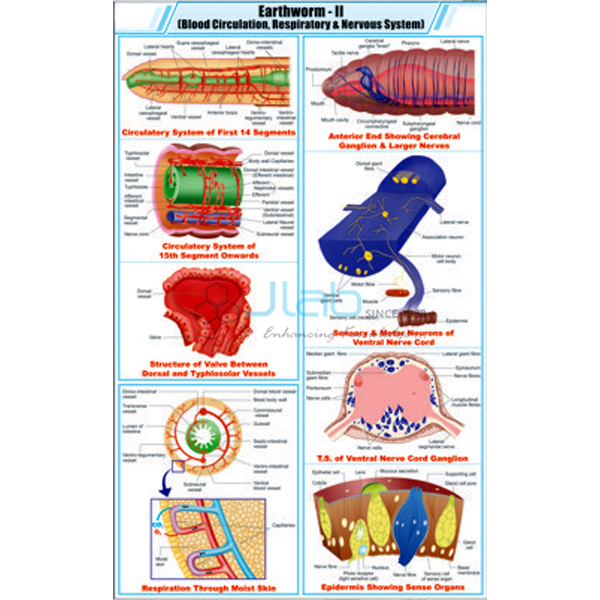
- Earthworm - II Blood Circulation, Respiratory and Nervous System Chart — the second chart of the set.
- Earthworm — a laminated polyart earthworm chart for schools and laboratories.
- Hand Lens — a bi-convex glass lens in a metal rim for examining live worms and castings.
- Animal Tissues Chart — the main types of animal tissue, from the same series.
- Animal Kingdom Classification Chart — where the annelids sit among the animal phyla, also from this series.
See every title in the Zoology Chart series or the full Charts range.
Request a Quote
Get a quotation through the Add To Cart enquiry button on this page, or send the number of charts (minimum 10 units), whether you want the full earthworm set, and the delivery city and country via the contact page.
Last updated: 3 October 2026