Hydra Chart Manufacturer,Supplier and Exporter in India
Product Code : EL-ZC-9323
Jlab Export is a leading Hydra Chart Manufacturer,and suppliers in India
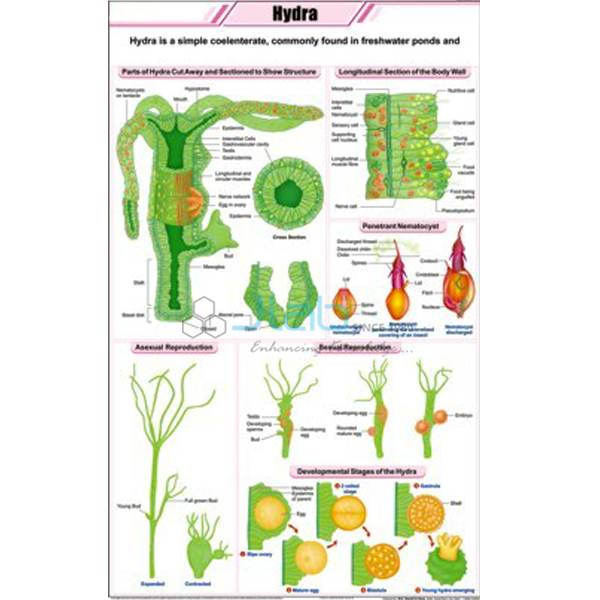
Hydra Chart (code EL-ZC-9323) is a 58 x 90 cm wall chart on Hydra, the small freshwater cnidarian used as the type example of the coelenterates and of budding and regeneration, for school and college zoology. It is printed in full colour on art paper, laminated on both sides with thick plastic film and fitted with plastic rollers, with English text only. JLab (Jain Laboratory Instruments Pvt Ltd, Ambala, India) supplies it to schools, colleges and dealers.
Specifications
| Parameter | Detail |
|---|---|
| Chart topic | Hydra |
| Size | 58 x 90 cm (about 22.8 x 35.4 in) |
| Printing | Full colour on art paper |
| Lamination | Both sides, thick plastic film |
| Fittings | Plastic rollers |
| Language | English only |
| Quality check | Each chart is visually inspected before dispatch |
| Pack quantity | Each (sold individually) |
| Minimum order quantity | 10 units |
| Dispatch time | Usually 7–10 working days |
| Product code | EL-ZC-9323 |
| Supplied by | Jain Laboratory Instruments Pvt Ltd (JLab), Ambala, India |
What Is the Hydra Chart Used For?
Hydra appears twice in the school syllabus. In the class 11 chapter on the animal kingdom it represents the phylum Coelenterata (Cnidaria): a tube-shaped animal fixed by a basal disc, with a mouth ringed by tentacles, radial symmetry, a body wall of just two cell layers — ectoderm and endoderm with a jelly-like mesoglea between them — and a single-opening gastrovascular cavity in which food is digested. Its tentacles carry stinging cells, the cnidoblasts, whose nematocysts paralyse small prey and protect the animal. In the class 10 chapter on reproduction, Hydra is the example of budding, where a new individual grows out from the parent's body and then separates, and of regeneration, since a small piece of Hydra can regrow a whole animal.
Living Hydra are small and contract when disturbed, so students often find them hard to study. A large chart gives the class a clear reference for labelling the body parts and for discussing tissue-level organisation before or after a practical with specimens or slides. Hang it from its rollers and wipe the laminated surface clean when needed. The listing does not describe the artwork, so ask JLab for a larger image if you need to check what is drawn.
What to Specify When Ordering
- Quantity — the minimum order is 10 units, and every chart is supplied separately.
- Hydra model — a three-dimensional model can be added for the same lesson.
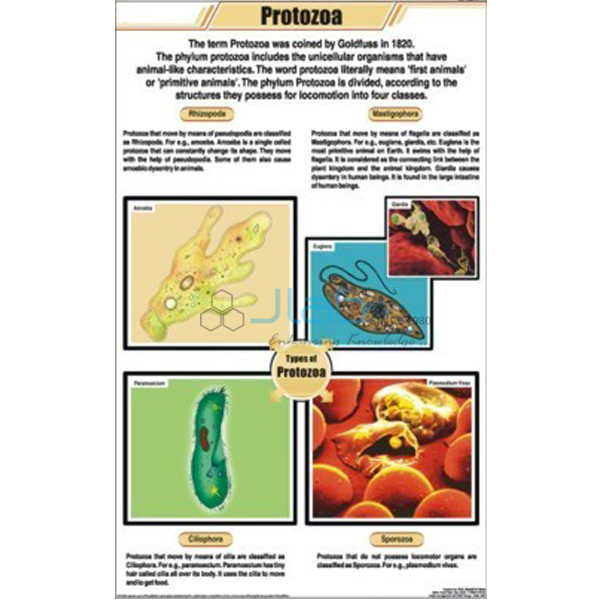
- Series charts — the animal kingdom, tapeworm and protozoa titles for a wider invertebrate set.
- Delivery — destination city and country, and port and delivery terms (for example FOB or CIF) for export.
Frequently Asked Questions
What is the Hydra Chart meant to teach?
It is meant for lessons on the body plan of Hydra and how it feeds and reproduces. The listing does not describe the artwork; the product photograph shows the chart, and JLab can send a larger image on request.
What size is the chart and how is it finished?
It is 58 x 90 cm (about 22.8 x 35.4 inches), printed in full colour on art paper, laminated on both sides with thick plastic film and fitted with plastic rollers.
How does Hydra reproduce?
Mainly by budding: a small outgrowth develops into a young Hydra and detaches from the parent. It can also regenerate a complete body from a fragment, and it reproduces sexually by forming eggs and sperm.
What are nematocysts?
They are tiny stinging capsules inside the cnidoblast cells of the tentacles. When triggered they shoot out a thread that can inject toxin into prey or an attacker — the feature that gives the phylum Cnidaria its name.
Who supplies this chart?
The chart is supplied by Jain Laboratory Instruments Pvt Ltd (JLab) of Ambala, Haryana, India, which quotes directly.
Supplier
JLab is the trading name of Jain Laboratory Instruments Pvt Ltd, a laboratory and classroom equipment company incorporated in 2017 and based on Hargolal Road, Ambala, Haryana. Alongside its own equipment it supplies zoology charts such as this one to schools, colleges, dealers and importers, makes a visual check of every chart before it leaves and handles repeat orders directly. JLab exports worldwide and serves buyers in every region — for example Eswatini in Southern Africa, Turkmenistan in Central Asia, Portugal in Southern Europe, the USA in North America and Rwanda in East Africa. Tender details are on the JLab lab tenders page.
Related Invertebrate Charts and Models
- Hydra — a model showing the external and internal structure of Hydra, including budding.
- Animal Kingdom Classification Chart — shows where the coelenterates fit among the animal phyla.
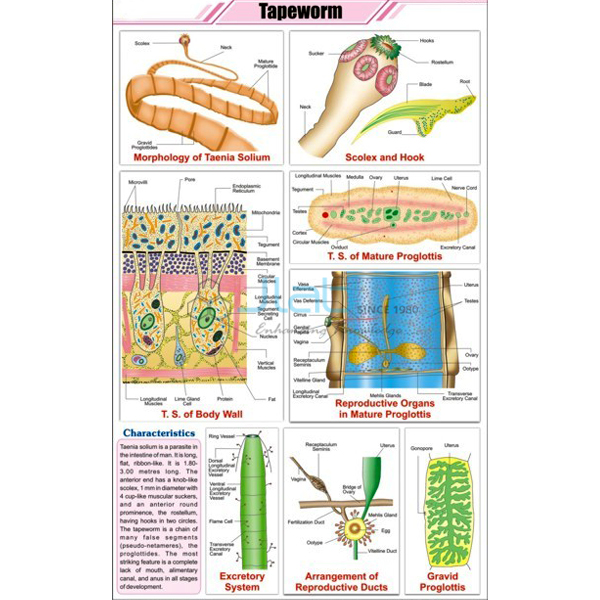
- Tapeworm Chart — a flatworm, the next step up in body organisation.
- Paramoecium Chart — a single-celled freshwater organism for comparison.
- Animal Tissues Chart — the four basic tissue types of more complex animals, for comparison with Hydra's two cell layers.
See all titles in the Zoology Chart range or the full Charts range.
Request a Quote
For a direct quotation from JLab, use the Add To Cart enquiry button on this page, or send the quantity (minimum 10 units), any models or companion charts and your delivery city and country through the contact page.
Last updated: 3 October 2026