Radio Telescope Manufacturer,Supplier and Exporter in India
Product Code : EL-ZC-2928
Jlab Export is a leading Radio Telescope Manufacturer,and suppliers in India
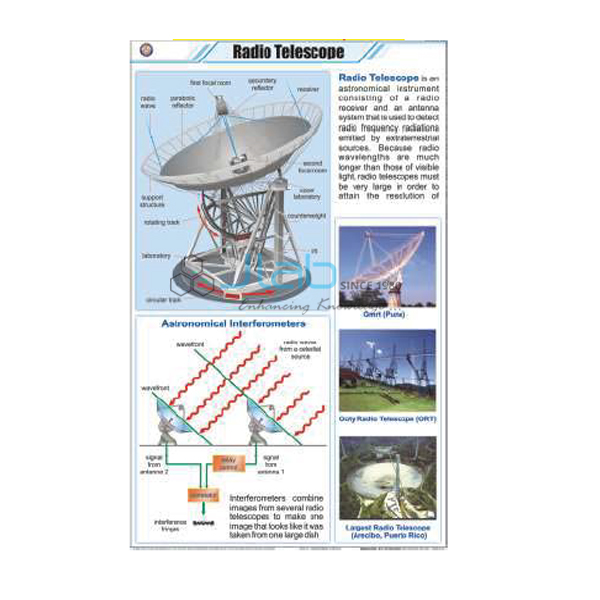
Radio Telescope (code EL-ZC-2928) is a printed physics wall chart on the radio telescope, the instrument astronomers use to collect radio waves from space, for science lessons in schools and colleges. The 58 x 90 cm chart is printed in full colour on coated art paper, laminated on both sides with heat-sealable polyester film and fitted with plastic rollers for hanging. JLab (Jain Laboratory Instruments Pvt Ltd, Ambala, India) supplies it to schools, colleges and dealers.
Specifications
| Parameter | Detail |
|---|---|
| Chart topic | Radio telescope |
| Size (overall) | 58 x 90 cm (about 22.8 x 35.4 in) |
| Size when rolled | 58 x 4 x 2 cm |
| Weight | 228 g |
| Paper | Art paper (coated paper, 130 gsm), printed in full colour |
| Printing | Offset printing using CTP (computer-to-plate) technology |
| Lamination | Both sides, 30 micron heat-sealable polyester film |
| Fittings | Plastic rollers for wall hanging |
| Surface | Markable and washable |
| Language | English only |
| Quality check | Each chart is visually inspected before dispatch |
| Pack quantity | Each (sold individually) |
| Minimum order quantity | 10 units |
| Dispatch time | Usually 7–10 working days |
| Product code | EL-ZC-2928 |
| Supplied by | Jain Laboratory Instruments Pvt Ltd (JLab), Ambala, India |
What Is the Radio Telescope Chart Used For?
A radio telescope does with radio waves what an optical telescope does with light. A large antenna, usually a curved parabolic dish, reflects the faint radio waves arriving from space onto a receiver at its focus, and the signal is amplified and processed into maps of the sky. Because radio wavelengths are far longer than those of visible light, the dish has to be very large to separate fine detail, which is why astronomers also link several separated antennas so that together they work like one much bigger instrument. Radio waves pass through the atmosphere and through cloud, so observing can go on day and night; sources include the Sun, pulsars, quasars and the cold hydrogen gas between the stars. India's Giant Metrewave Radio Telescope near Pune and the Ooty Radio Telescope in Tamil Nadu make good local examples.
The chart suits the class 12 physics chapters on electromagnetic waves and optical instruments, astronomy clubs and first-year college lessons, and it hangs well beside an optical telescope chart so students can compare the two kinds of instrument. Because the surface is markable and washable, teachers can add labels or notes during a lesson and wipe them off afterwards. The listing does not describe the individual panels, so ask JLab for a preview image if you need to match the content to a syllabus.
What to Specify When Ordering
- Quantity — the minimum order is 10 units, supplied as single charts.
- Other titles — add the telescope and X-ray charts or other physics charts to the same enquiry if you are equipping a whole physics or astronomy room.
- Language — the chart is listed in English only; ask before ordering if you need another language.
- Delivery and paperwork — destination city and country (or port), preferred delivery terms such as FOB or CIF, and any tender reference.
Frequently Asked Questions
What does the Radio Telescope chart cover?
It explains how a radio telescope gathers and focuses radio waves from space. The listing does not detail each panel; the product photograph on this page shows the chart, and JLab can send a larger preview image before you order.
What are the size, weight and finish?
The chart is 58 x 90 cm overall (about 22.8 x 35.4 inches) and weighs 228 g. It is offset-printed in full colour on 130 gsm coated art paper, laminated on both sides with 30 micron heat-sealable polyester and fitted with plastic rollers; rolled up, it measures 58 x 4 x 2 cm.
Can students write on the chart?
Yes, the laminated surface is listed as markable and washable, so it can be annotated in class and cleaned afterwards. Try a new marker on a corner first before writing across the artwork.
Why do radio telescopes need such large dishes?
The finest detail a telescope can resolve depends on the wavelength it receives divided by the width of its collecting area. Radio waves are many times longer than light waves, so a radio dish must be very wide, or several dishes must be combined, to reach useful resolving power.
What should an export enquiry include?
Give the quantity, the destination country and port or city, your preferred delivery terms (for example FOB or CIF), any packing or labelling needs, and a tender reference if there is one.
Who supplies this chart?
JLab, the trading name of Jain Laboratory Instruments Pvt Ltd in Ambala, Haryana, India, supplies it as part of a printed physics chart series and sends quotations directly to schools, colleges, dealers and importers.
Supplier
JLab is the trading name of Jain Laboratory Instruments Pvt Ltd, a science teaching equipment company incorporated in 2017 and based on Hargolal Road, Ambala, Haryana. Next to the laboratory apparatus it produces, JLab supplies this radio telescope chart and the other titles of its printed physics chart series, so optics models and the charts that explain them can go on one order. Every chart is checked by eye before it is packed, and repeat orders are handled by the same team. The company is registered under CIN U29309HR2017PTC069123 and GSTIN 06AADCJ9848D1ZE. JLab exports worldwide and ships to buyers in every region — for example Tajikistan in Central Asia, Chad in Central Africa, Colombia in South America, Moldova in Eastern Europe and Taiwan in East Asia. Institutions buying by tender can see the JLab lab tenders page.
Related Physics Charts and Telescope Models
- Telescope — the physics wall chart on optical telescopes, in the same 58 x 90 cm format.
- X-Ray — a 58 x 90 cm physics wall chart on X-rays, for lessons on the electromagnetic spectrum and modern physics.
- Astronomical Telescope — a simple working model with lenses mounted in tubes that produces an inverted image.
- Terrestrial Telescope — a model with three convex lenses acting as objective, inverter and eyepiece.
- Telescope and Microscope Kit — a kit for observing celestial objects and microscopic organisms.
- Solar Spectrum Chart JLab — a wall chart of the visible solar spectrum showing the prominent Fraunhofer lines.
See more titles in the Physics Charts range or the full Charts range.
Request a Quote
Quotes come directly from JLab. Use the Add To Cart enquiry button on this page, or send the number of charts you need (minimum 10 units), any other titles, and your delivery city and country through the contact page.
Last updated: 4 October 2026