Protozoa Chart Manufacturer,Supplier and Exporter in India
Product Code : EL-ZC-9319
Jlab Export is a leading Protozoa Chart Manufacturer,and suppliers in India
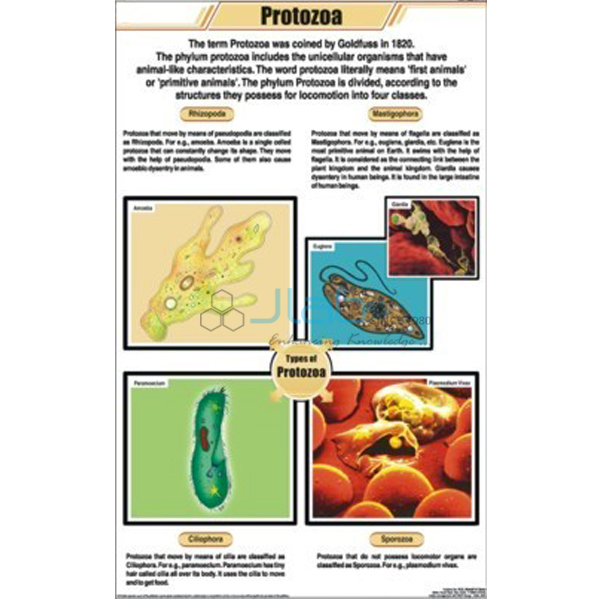
Protozoa Chart (code EL-ZC-9319) is a 58 x 90 cm zoology wall chart on protozoa — the single-celled, animal-like organisms such as Amoeba, Paramoecium and Plasmodium — for class 11 biology and college microbiology and zoology. It is printed in full colour on art paper, laminated on both sides with thick plastic film and fitted with plastic rollers; text is in English only. JLab (Jain Laboratory Instruments Pvt Ltd, Ambala, India) supplies it to schools, colleges and dealers.
Get a quote: use the Add To Cart enquiry button below, or send your quantity and destination through the contact page.
Specifications
| Parameter | Detail |
|---|---|
| Chart topic | Protozoa |
| Size | 58 x 90 cm (about 22.8 x 35.4 in) |
| Printing | Full colour on art paper |
| Lamination | Both sides, thick plastic film |
| Fittings | Plastic rollers |
| Language | English only |
| Quality check | Each chart is visually inspected before dispatch |
| Pack quantity | Each (sold individually) |
| Minimum order quantity | 10 units |
| Dispatch time | Usually 7–10 working days |
| Product code | EL-ZC-9319 |
| Supplied by | Jain Laboratory Instruments Pvt Ltd (JLab), Ambala, India |
How Does It Compare with Other JLab Protozoa Charts?
| Chart | Size | Material and finish | Other listed details |
|---|---|---|---|
| This chart (EL-ZC-9319) | 58 x 90 cm | Art paper, full colour; laminated both sides with thick plastic film | Plastic rollers; English only |
| Protozoa | 75 x 100 cm | Polyart; laminated | Listed for use in schools and laboratories; fittings and language not stated |
Choose this chart for a standard-size, roller-mounted classroom chart in English; the polyart version suits buyers who want a larger 75 x 100 cm sheet — confirm its fittings and language with JLab.
What Is the Protozoa Chart Used For?
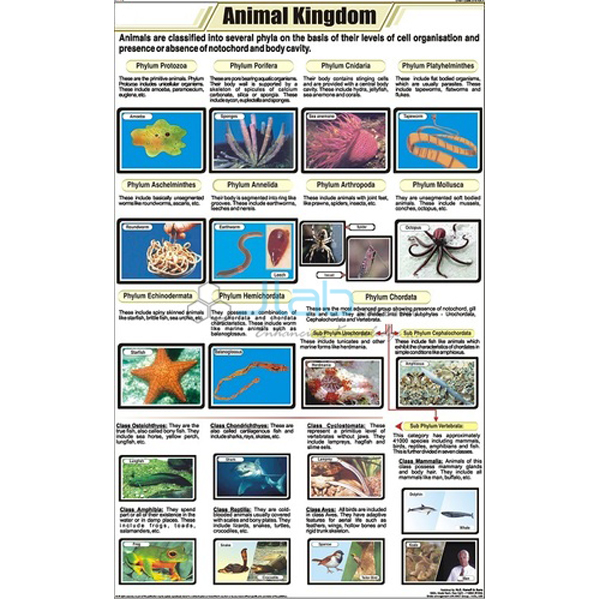
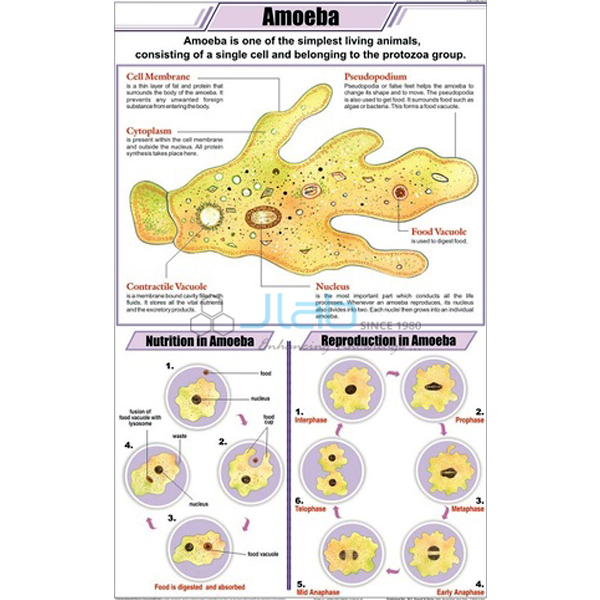
Protozoa are single-celled eukaryotes that feed like animals, either as predators or as parasites, and the five-kingdom system taught in class 11 places them in Kingdom Protista. Textbooks sort them into four groups by how they move: amoeboid protozoans such as Amoeba, which creep and capture food with pseudopodia; flagellated protozoans such as Trypanosoma, the cause of sleeping sickness; ciliated protozoans such as Paramoecium, covered in beating cilia that also sweep food into a gullet; and sporozoans such as Plasmodium, the malaria parasite, which has an infectious spore-like stage. Most reproduce by binary fission, while Plasmodium divides by multiple fission.
A protozoa chart gives the class a map of the group before students look at pond-water or culture samples under the microscope, and it connects later lessons on diseases such as amoebic dysentery and malaria. Hang it near the microscope bench; the laminated surface wipes clean. The listing does not describe the artwork, so ask JLab for a larger image if you need to check which organisms are drawn.
What to Specify When Ordering
- Format — this 58 x 90 cm roller chart or the larger polyart protozoa chart.
- Quantity — minimum 10 units, supplied as single charts.
- Single-organism charts — the Amoeba, Paramoecium and malaria parasite charts from the same series go well with it.
- Delivery — city and country, plus port and delivery terms (for example FOB or CIF) for export.
Frequently Asked Questions
What does the Protozoa Chart cover?
It covers the protozoa as a group — single-celled organisms that move and feed like tiny animals. The listing does not describe the artwork; the product photograph shows the chart, and JLab can supply a larger image.
What size and material is it?
It is 58 x 90 cm (about 22.8 x 35.4 inches), printed in full colour on art paper, laminated on both sides with thick plastic film and fitted with plastic rollers.
How are protozoa classified?
Mainly by how they move: amoeboid forms use pseudopodia, flagellates use one or more flagella, ciliates use many short cilia, and sporozoans have no locomotory organelles in their main stage and live as parasites.
Are protozoa animals?
They used to be treated as a phylum of the animal kingdom, but because they are single-celled eukaryotes they are now placed in Kingdom Protista. They are still described as animal-like because they take in food rather than make it.
What is the minimum order and dispatch time?
The minimum is 10 units, sold one by one. Charts usually go out within 7–10 working days after a visual check; for exports, add transit time to the destination.
Who supplies this chart?
JLab, the trading name of Jain Laboratory Instruments Pvt Ltd in Ambala, Haryana, India, supplies the Protozoa Chart and quotes for it directly.
Supplier
JLab is the trading name of Jain Laboratory Instruments Pvt Ltd, incorporated in 2017 and based on Hargolal Road, Ambala, Haryana, a company that equips science laboratories in schools, colleges and research institutions. It supplies biology teaching aids such as this chart in addition to its own equipment range, selling to schools, colleges, dealers and importers, checking each chart by eye before dispatch and handling repeat orders itself. JLab exports worldwide and ships to buyers in every region — for example Singapore in Southeast Asia, Slovakia in Eastern Europe, South Korea in East Asia, Mauritius in East Africa and Jordan in the Middle East. Tender purchasers can visit the JLab lab tenders page.
Protozoan Charts, Slides and Models
- Amoeba Chart — the amoeboid protozoan in detail, from the same series.
- Paramoecium Chart — a ciliated protozoan, from the same series.
- Malaria Parasite Chart — a chart on Plasmodium, the sporozoan that causes malaria.
- Protozoa Amoeba Prepared Slide — a prepared slide for viewing Amoeba under the microscope.
- Euglena — an enlarged model on a base with a numbered English key card.
See all titles in the Zoology Chart range or the full Charts range.
Request a Quote
Request a quotation from JLab with the Add To Cart enquiry button on this page, or send the format and number of charts (minimum 10 units), any related charts or slides and your delivery city and country through the contact page.
Last updated: 3 October 2026