Harmful Insects Chart Manufacturer,Supplier and Exporter in India
Product Code : EL-ZC-9332
Jlab Export is a leading Harmful Insects Chart Manufacturer,and suppliers in India
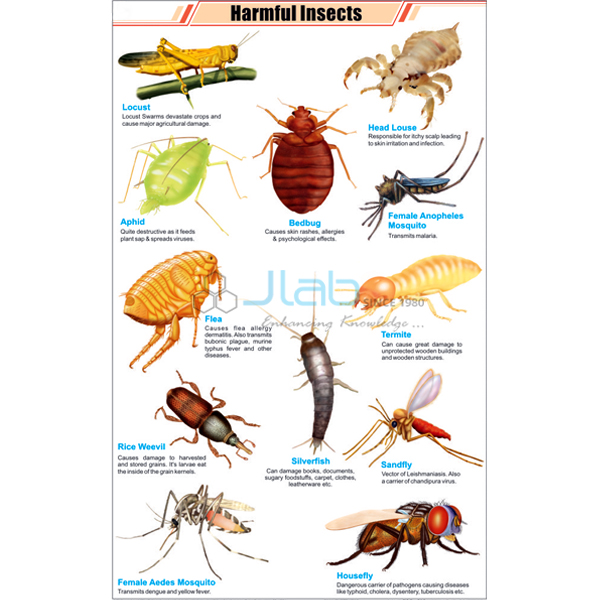
Harmful Insects Chart (code EL-ZC-9332) is a 58 x 90 cm wall chart on insects that harm people, crops and stored goods — pests and carriers of disease — for school science, agriculture and zoology lessons. It is printed in full colour on art paper, laminated on both sides and fitted with plastic rollers, in English only. JLab (Jain Laboratory Instruments Pvt Ltd, Ambala, India) supplies it to schools, colleges and dealers.
Get a quote: use the Add To Cart enquiry button below, or send your quantity and destination through the contact page.
Specifications
| Parameter | Detail |
|---|---|
| Chart topic | Harmful insects |
| Size | 58 x 90 cm (about 22.8 x 35.4 in) |
| Printing | Full colour on art paper |
| Lamination | Both sides, thick plastic film |
| Fittings | Plastic rollers |
| Language | English only |
| Quality check | Each chart is visually inspected before dispatch |
| Pack quantity | Each (sold individually) |
| Minimum order quantity | 10 units |
| Dispatch time | Usually 7–10 working days |
| Product code | EL-ZC-9332 |
| Supplied by | Jain Laboratory Instruments Pvt Ltd (JLab), Ambala, India |
What Is the Harmful Insects Chart Used For?
Insects belong to Arthropoda, the animal phylum with the most species, and a fairly small number of species cause most of the damage people notice. Crop pests include locusts, whose swarms strip whole fields, and aphids, which suck plant sap and spread plant viruses; the rice weevil attacks stored grain, termites damage wooden buildings and furniture, and silverfish eat paper and book bindings. Other insects matter for health: female Anopheles mosquitoes carry the malaria parasite and Aedes the dengue virus, the housefly carries germs on its legs and body to uncovered food, the sandfly transmits kala-azar, rat fleas spread plague, and head lice and bedbugs feed on human blood.
In class 8 science the chart supports the lessons on protecting crops and stored grain from pests and on microorganisms and their carriers; in class 12 it backs up the chapter on human health and disease, where controlling vectors — removing breeding sites, covering food, keeping surroundings clean — is the main line of prevention. Teachers often hang it beside the Beneficial Insects Chart so students see both sides of the insect world. The laminated surface wipes clean, which suits a busy biology lab or agriculture room. The listing does not describe the artwork, so ask JLab for a larger image to see which insects are drawn.
What to Specify When Ordering
- Quantity — minimum 10 units; charts are sold one by one.
- Matching chart — the Beneficial Insects Chart from the same series covers pollinators, silk and honey producers and natural pest controllers.
- Field-work kit — an Insect Collecting Net and an Insect Storage Box turn the lesson into a collection project.
- Delivery — the delivery city and country, with port and delivery terms (for example FOB or CIF) for export.
Frequently Asked Questions
What does the Harmful Insects Chart cover?
Insects that harm crops, stored goods and human health. The listing does not name the insects drawn; the product photograph shows the chart, and JLab can send a larger image before you order.
What size and finish is the chart?
58 x 90 cm (about 22.8 x 35.4 inches), printed in full colour on art paper, laminated on both sides with thick plastic film and fitted with plastic rollers. It is available in English only.
Which insects spread human diseases?
The most familiar carriers are female Anopheles mosquitoes (malaria), Aedes mosquitoes (dengue and chikungunya), Culex mosquitoes (filariasis), houseflies (germs of diseases such as cholera and typhoid on uncovered food), sandflies (kala-azar) and rat fleas (plague).
How do insects damage crops and stored food?
Some chew leaves and stems, as locusts do; others suck sap and pass on plant viruses, like aphids; and weevils and similar pests feed inside stored grain.
Is there a matching chart on useful insects?
Yes. The Beneficial Insects Chart is the companion title in the same zoology series, with the same size, print and fittings.
What is the minimum order and dispatch time?
The minimum is 10 units, sold individually. Dispatch usually takes 7–10 working days after a visual check of every chart; export shipments need transit time on top.
Who supplies this chart?
JLab — Jain Laboratory Instruments Pvt Ltd, Ambala, Haryana, India — supplies the Harmful Insects Chart and quotes for it directly.
Supplier
JLab is the trading name of Jain Laboratory Instruments Pvt Ltd, incorporated in 2017 and based on Hargolal Road, Ambala, Haryana. Alongside its own laboratory equipment, the company resells printed science charts such as this one to schools, colleges, dealers and importers, checks every chart by eye before dispatch and handles repeat orders directly. Its GSTIN is 06AADCJ9848D1ZE and its Legal Entity Identifier is 549300DTGS77DGYD6N03. JLab exports worldwide, with buyers in every region — including Saudi Arabia in the Middle East, Bhutan in South Asia, Croatia in Southern Europe, Latvia in Northern Europe and Guinea in West Africa. Tender buyers can refer to the JLab lab tenders page.
Insect Charts, Models and Collecting Equipment
- Beneficial Insects Chart — the useful side of the insect world, from the same series.
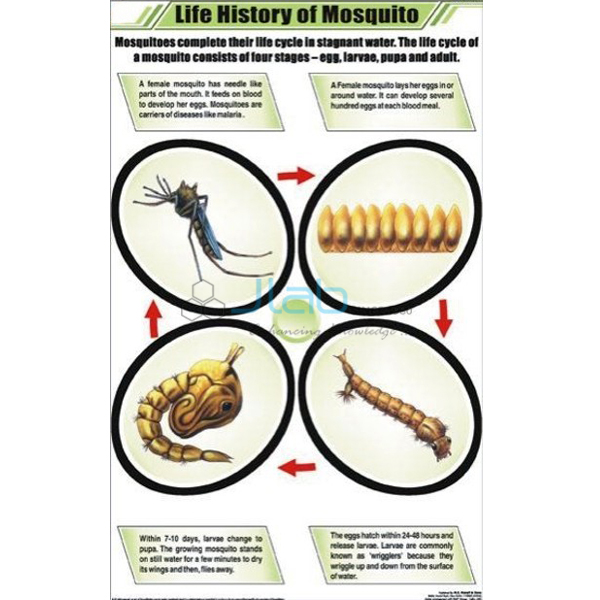
- Life History of Mosquito Chart — the mosquito’s stages from egg to adult, also from this series.
- Housefly Life Cycle Model — the housefly’s life cycle as a model.
- Sand Fly Life Cycle Model — the sandfly’s life cycle as a model.
- Insect Collecting Net — a collecting net with a telescopic, lockable handle.
- Insect Storage Box — a teakwood-framed box for pinned insects, lined with EVA sheet and made air-tight and pest proof.
Browse the Zoology Chart series or all Charts for more titles.
Request a Quote
Get a quotation by clicking the Add To Cart enquiry button on this page, or send the number of charts (minimum 10 units), any companion charts or collecting equipment, and your delivery city and country through the contact page.
Last updated: 3 October 2026