Sand Fly Life Cycle Model Manufacturer,Supplier and Exporter in India
Product Code : EL-BE-5201
Jlab Export is a leading Sand Fly Life Cycle Model Manufacturer,and suppliers in India
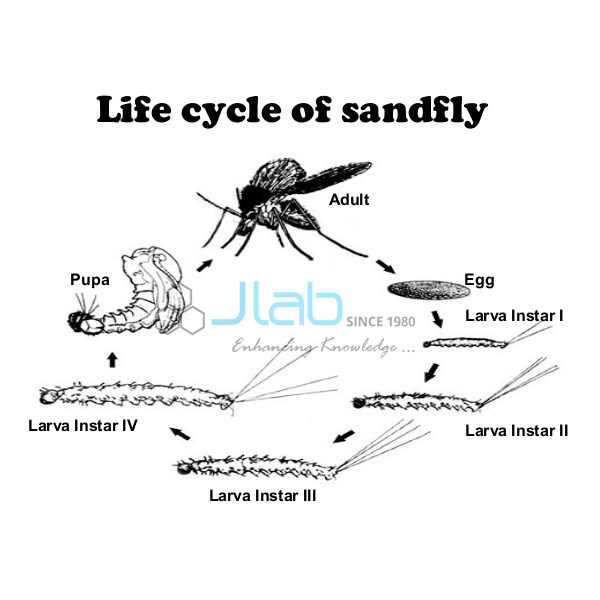
Sand Fly Life Cycle Model (code EL-BE-5201) is a zoology teaching model of the life cycle of the phlebotomine sand fly, the small biting fly that spreads kala-azar and other forms of leishmaniasis. It is used in school biology, college zoology, parasitology and public-health lessons on insect vectors. It is made by Jain Laboratory Instruments Pvt Ltd (JLab) at its works in Ambala, India.
Specifications
| Parameter | Detail |
|---|---|
| Subject shown | Life cycle of the sand fly, as named |
| Intended use | Zoology, parasitology and health-education teaching |
| Quality check | Each model is visually inspected before dispatch |
| Pack quantity | Each (sold individually) |
| Minimum order quantity | 10 units |
| Dispatch time | Usually 7–10 working days |
| Product code | EL-BE-5201 |
| Manufacturer | Jain Laboratory Instruments Pvt Ltd (JLab) — OEM |
| Country of origin | India (made in Ambala, Haryana) |
What Is the Sand Fly Life Cycle Model Used For?
Sand flies (Phlebotomus in the Old World, Lutzomyia in the Americas) are small, hairy, pale flies that hop rather than fly far and rest with their wings held in a V above the body. Only females bite, mostly from dusk to dawn, because they need blood for their eggs. Like mosquitoes they pass through egg, larva, pupa and adult, but their young stages live on land, not in water: eggs are laid in moist, dark places rich in organic matter, such as cracks in mud walls, animal shelters and soil, and the larvae feed on decaying material through four instars.
In India, Phlebotomus argentipes carries Leishmania donovani, the parasite of kala-azar (visceral leishmaniasis), so the model links insect biology with disease control in parasitology and community-health teaching.
What to Specify When Ordering
- Size, material and mounting — ask for them with the quotation.
- Quantity — minimum 10 units.
- Companion items — the Leishmania and other vector life-cycle models listed below.
Frequently Asked Questions
How does the sand fly life cycle differ from a mosquito’s?
Both have complete metamorphosis, but sand fly eggs, larvae and pupae develop in damp soil and crevices rich in organic matter, while mosquito young stages develop in water.
Which diseases do sand flies spread?
Leishmaniasis, including kala-azar (visceral leishmaniasis) and cutaneous leishmaniasis, as well as sandfly fever.
How are sand flies controlled?
Mainly by indoor residual spraying, plastering cracks in walls and floors, keeping animal shelters clean, and using fine-mesh bed nets.
Who manufactures the model?
JLab makes it in Ambala, India, and quotes directly; its size and material are confirmed with the quotation.
OEM Manufacturer
Jain Laboratory Instruments Pvt Ltd (JLab) is a laboratory equipment and zoology model manufacturer in India, incorporated in 2017 and based on Hargolal Road, Ambala, Haryana. The model is made in JLab’s own works, not purchased from a trader, so schools, colleges, dealers and importers buy direct from the maker, with every piece visually inspected before dispatch. JLab exports worldwide and ships to buyers in every region — Portugal in Southern Europe, Turkmenistan in Central Asia, Gabon in Central Africa, Sri Lanka in South Asia and the Czech Republic in Eastern Europe, for example. For tenders, see the JLab lab tenders page.
Related Vector and Parasite Models
- Life Cycle of Leishmania Donovani Model — the kala-azar parasite that the sand fly transmits.
- Housefly Life Cycle Model — another fly life cycle, for comparison.
- Anopheles Life Cycle Model — the malaria mosquito, whose young stages develop in water.
- Life Cycle of Hard and Soft Tick Model — the life cycles of blood-feeding arachnid vectors.
Browse the Biology Equipment range or all Biology Lab Equipment.
Request a Quote
JLab quotes as the manufacturer. Use Add To Cart, or send the quantity (at least 10 units) and the delivery country and city through the contact page.
Last updated: 4 October 2026