Life Cycle of Hard and Soft Tick Model Manufacturer,Supplier and Exporter in India
Product Code : EL-BE-5200
Jlab Export is a leading Life Cycle of Hard and Soft Tick Model Manufacturer,and suppliers in India
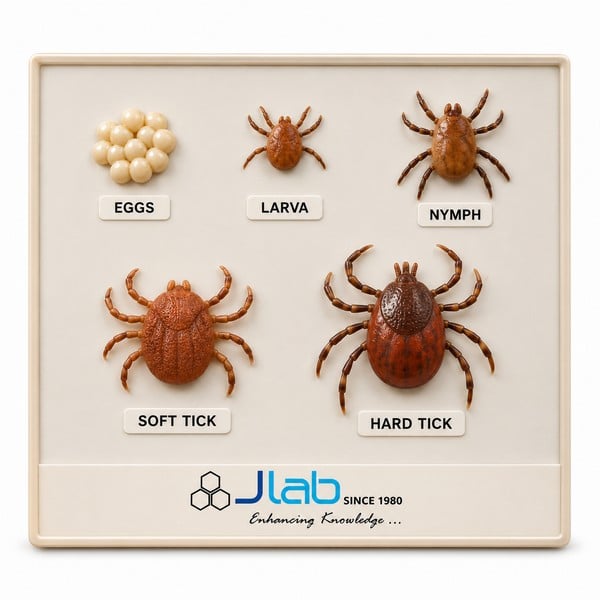
Ticks are blood-feeding arachnids, close relatives of mites, that live on dogs, cattle, birds and people. Hard ticks carry a shield on the back and stay attached for days. Soft ticks have a leathery, wrinkled body and feed quickly, mostly at night. This comparison board sets the two life cycles side by side in nine stage modules, for zoology, veterinary and public health lessons.
Specifications
| Type | Zoology teaching model |
| Subject | Life cycle of hard ticks (Ixodidae) and soft ticks (Argasidae) |
| Teaching use | Zoology, veterinary and public health lessons |
| Hard tick cycle | Egg, six-legged larva, eight-legged nymph and adult |
| Soft tick cycle | Egg, larva, two nymph stages and adult (the number of nymph stages varies by species) |
| Modules | Nine stage modules in two labelled life cycles |
| Board | 500 x 350 mm |
| Material | Rigid painted PVC or resin |
| Minimum order quantity | 10 units |
| Dispatch time | Usually 4–6 working days |
| Manufacturer | JLab (Jain Laboratory Instruments Pvt Ltd), Ambala, India |
Tick Practicals for Zoology Students
Preserved ticks from a veterinary department or a cattle shed make a good comparison set. Using forceps and a Magnifying Glass, students check each specimen for a hard shield and for mouthparts that show from above. They then sort it as a hard or a soft tick against the model.
Mites are the nearest relatives of ticks, so the Life Cycle of Scabies Model makes a natural partner in the same session. Adding the Bed Bug Model gives an insect for contrast. Students count the legs and body regions of each and explain why a tick is not an insect.
Frequently Asked Questions
Which courses is this model suited to?
College zoology and parasitology practicals, veterinary and animal husbandry courses, and public health and nursing classes on vector-borne disease. School biology can use it when teaching arachnids and animal parasites.
How is this model different from the scabies and bed bug models?
This one covers ticks, the larger arachnids that feed on blood and may need several hosts. The Life Cycle of Scabies Model covers a mite that spends its whole life in human skin, and the Bed Bug Model shows an insect. The three suit one combined lesson on ectoparasites.
How do you tell a hard tick from a soft tick?
A hard tick has a tough shield, the scutum, on its back, and its mouthparts point forward where they can be seen from above. A soft tick has no shield and a leathery, wrinkled body, and in the nymph and adult the mouthparts sit hidden underneath.
How many hosts does a tick feed on in its life?
Hard ticks take one large blood meal in each active stage. Some stay on one host throughout, while others drop off and find two or three different hosts. Soft ticks feed briefly many times, often on several hosts, and moult off the host between meals.
Which diseases do ticks carry in India?
Haemaphysalis ticks carry Kyasanur Forest disease in Karnataka and nearby states, and Hyalomma ticks carry Crimean-Congo haemorrhagic fever. Soft ticks of the genus Ornithodoros spread tick-borne relapsing fever. Some hard ticks can also cause tick paralysis.
Other Ectoparasite and Vector Models
For a quote, use Add To Cart or send us a message through the contact page.
Last updated: 20 November 2026