Beneficial Insects Chart Manufacturer,Supplier and Exporter in India
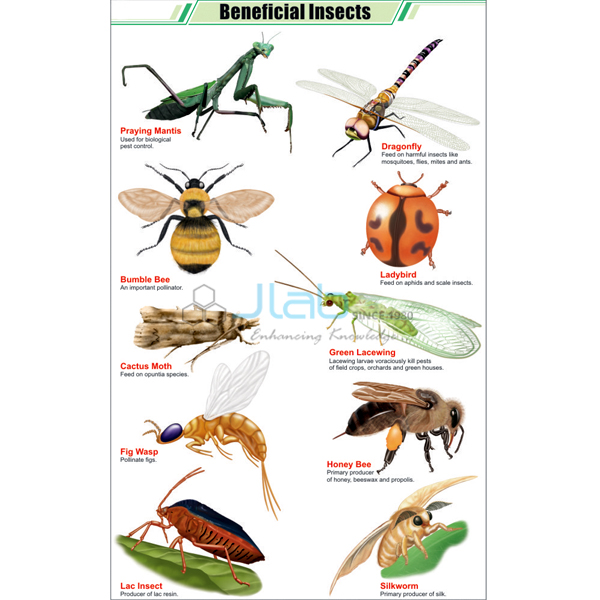
Product Code : EL-ZC-9333
Jlab Export is a leading Beneficial Insects Chart Manufacturer,and suppliers in India
Beneficial Insects Chart (code EL-ZC-9333) is a 58 x 90 cm wall chart on insects that are useful to people — pollinators, producers of honey, silk and lac, and predators of crop pests — for school science, agriculture and zoology lessons. It is printed in full colour on art paper, laminated on both sides and fitted with plastic rollers, in English only. JLab (Jain Laboratory Instruments Pvt Ltd, Ambala, India) supplies it to schools, colleges and dealers.
Specifications
| Parameter | Detail |
|---|---|
| Chart topic | Beneficial insects |
| Size | 58 x 90 cm (about 22.8 x 35.4 in) |
| Printing | Full colour on art paper |
| Lamination | Both sides, thick plastic film |
| Fittings | Plastic rollers |
| Language | English only |
| Quality check | Each chart is visually inspected before dispatch |
| Pack quantity | Each (sold individually) |
| Minimum order quantity | 10 units |
| Dispatch time | Usually 7–10 working days |
| Product code | EL-ZC-9333 |
| Supplied by | Jain Laboratory Instruments Pvt Ltd (JLab), Ambala, India |
What Is the Beneficial Insects Chart Used For?
Many insects work for people rather than against them. Bees, wasps, butterflies and moths pollinate crops and fruit trees — the fig, for example, relies on its own tiny fig wasps. The honey bee gives honey and beeswax, the silkworm (Bombyx mori) spins the cocoon from which silk is reeled, and the lac insect secretes the resin that becomes lac and shellac. Predatory insects are natural pest controllers: ladybird beetles eat aphids, dragonflies catch mosquitoes, and lacewing larvae and praying mantises feed on other small insects. In a well-known case of biological control, cactus moth caterpillars were used to clear invasive prickly-pear cactus (Opuntia).
The topic runs through the syllabus: bee-keeping appears in the class 9 chapter on improving food resources and again in class 12 on food production, biological pest control in the class 12 chapter on microbes in human welfare, and the fig and its wasp as the class 12 example of mutualism. Silk production (sericulture) suits agriculture and vocational courses. Pair the chart with the Harmful Insects Chart so students can weigh useful against damaging species, or use it to launch a school insect-collection project. The laminated surface wipes clean. The listing does not describe the artwork, so ask JLab for a larger image to check which insects are drawn.
What to Specify When Ordering
- Quantity — minimum 10 units, each chart supplied separately.
- Companion chart — the Harmful Insects Chart from the same series completes the pair.
- Silkworm teaching — the Sericulture (L. H. Silkworm) chart and the Silk Worm (Life Cycle) polyart chart can be quoted alongside.
- Practical work — the Insect Parts Prepared Slide set, an insect collecting net and a storage box for pinned specimens are separate items.
Frequently Asked Questions
What does the Beneficial Insects Chart cover?
Insects that are useful to people. The listing does not name the species drawn; the product photograph shows the chart, and JLab can send a larger image before you order.
What are the chart’s size and finish?
It measures 58 x 90 cm (about 22.8 x 35.4 inches), is printed in full colour on art paper, carries thick plastic-film lamination on both sides and has plastic rollers. The text is English only.
Why are some insects called beneficial?
Because they pollinate crops, give useful products such as honey, beeswax, silk and lac, or eat insects that damage crops.
What is biological pest control?
Using a pest’s natural enemies — predators, parasites or diseases — to keep its numbers down instead of relying only on chemical pesticides. Ladybirds released against aphids are the classic classroom example.
Are specimens or slides included?
No. This listing is the chart only; the insect slide set, collecting net and storage box linked below are sold separately.
Who supplies this chart?
JLab, the trading name of Jain Laboratory Instruments Pvt Ltd of Ambala, Haryana, India, supplies the Beneficial Insects Chart and quotes for it directly.
Supplier
JLab is the trading name of Jain Laboratory Instruments Pvt Ltd, a company on Hargolal Road, Ambala, Haryana, incorporated in 2017, that equips school and college science laboratories. With the equipment it produces itself it also supplies printed teaching charts like this one to schools, colleges, dealers and importers, inspects each chart visually before dispatch and handles follow-up orders directly. JLab exports worldwide and serves buyers in every region — the UAE in the Middle East, Brazil in South America, Germany in Western Europe, the Czech Republic in Eastern Europe and Uzbekistan in Central Asia, to name a few. Tender information is on the JLab lab tenders page.
Silkworm, Bee and Insect Study
- Harmful Insects Chart — insect pests and disease carriers, the companion title in this series.
- Sericulture (L. H. Silkworm) — a 58 x 90 cm silkworm chart on art paper, laminated both sides and fitted with plastic rollers.
- Silk Worm (Life Cycle) — a laminated polyart chart on the silkworm’s life cycle.
- Insect Parts Prepared Slide — labelled glass slides of insect parts such as bee and butterfly wings, in a slotted plastic case.
- Insect Collecting Net — a net with a telescopic, lockable handle for field collecting.
- Insect Storage Box — an air-tight, pest-proof box for pinned insect collections.
See more in the Zoology Chart series or the complete Charts range.
Request a Quote
Ask for a quotation with the Add To Cart enquiry button on this page, or send the number of charts (minimum 10 units), any companion charts, slides or collecting equipment, and your delivery city and country through the contact page.
Last updated: 3 October 2026