Plant Kingdom Chart Manufacturer,Supplier and Exporter in India
Product Code : EL-BC-9228
Jlab Export is a leading Plant Kingdom Chart Manufacturer,and suppliers in India
Plant Kingdom Chart (code EL-BC-9228) is a 58 x 90 cm botany wall chart for teaching plant classification in school and college biology classrooms. It is printed in full colour on art paper, laminated on both sides with thick plastic film to make it water and tear proof, and fitted with plastic rollers for hanging. JLab (Jain Laboratory Instruments Pvt Ltd, Ambala, India) supplies it to schools, colleges and dealers.
Get a quote: use the Add To Cart enquiry button below, or send your quantity and destination through the contact page.
Specifications
| Parameter | Detail |
|---|---|
| Chart topic | Classification of the plant kingdom |
| Size | 58 x 90 cm (about 22.8 x 35.4 in) |
| Printing | Full colour on art paper |
| Lamination | Both sides, thick plastic film, to make the chart water and tear proof |
| Fittings | Plastic rollers for hanging on a wall |
| Language | English only |
| Quality check | Each chart is visually inspected before dispatch |
| Pack quantity | Each (sold individually) |
| Minimum order quantity | 10 units |
| Dispatch time | Usually 7–10 working days |
| Product code | EL-BC-9228 |
| Supplied by | Jain Laboratory Instruments Pvt Ltd (JLab), Ambala, India |
What Is the Plant Kingdom Chart Used For?
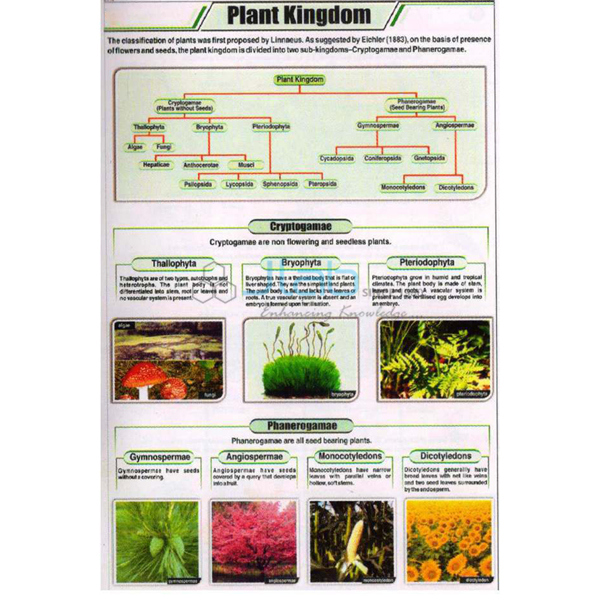
A plant kingdom chart gives students one overview of how botanists group plants. In the classical two-way scheme the non-seed plants (Cryptogamae) — algae, bryophytes such as mosses and liverworts, and pteridophytes such as ferns — are set apart from the seed plants (Phanerogamae). The seed plants are then divided into gymnosperms, whose seeds are not enclosed in a fruit, and angiosperms, the flowering plants, which are split into monocots and dicots. As a classification chart for biology it supports the class 11 chapter on the plant kingdom and first-year college botany, and it helps students place the specimens they meet in practical spotting work, such as Spirogyra, a moss, a fern, pine and a flowering plant.
Hang it by its rollers near the board, with specimens or herbarium sheets beside it, so that each plant group can be matched to a real example. The laminated face wipes clean with a slightly damp cloth, and the chart rolls up for storage between terms.
What to Specify When Ordering
- Quantity — the minimum order is 10 units.
- Language — the chart is listed in English only; ask JLab before ordering if your syllabus needs another language.
- Companion charts — the algae, fungi, moss and fern charts linked below can go on the same enquiry if each group needs more depth.
- Delivery details — the destination city and country, or the port, so that packing and transport can be quoted.
Frequently Asked Questions
What does the Plant Kingdom Chart teach?
How plants are grouped, from algae, mosses and ferns to gymnosperms and flowering plants, and how those groups relate to each other. It fits the class 11 plant kingdom chapter and first-year college botany. The listing does not itemise the artwork, so check the product photograph on this page or ask JLab for a preview.
What size is the chart and how is it finished?
It measures 58 x 90 cm, is printed in full colour on art paper and is laminated on both sides with thick plastic film, which the listing says makes it water and tear proof. Plastic rollers are fitted for hanging.
Is the chart available in Hindi or other languages?
It is listed in English only. If you need another language, ask JLab before ordering rather than assuming another version exists.
Why are fungi not counted as plants in the class 11 syllabus?
Older two-way schemes, such as Eichler’s, placed fungi with the algae among the thallophytes. The five-kingdom system taught in class 11 gives fungi a kingdom of their own because they have no chlorophyll and their cell walls contain chitin, which is worth pointing out when a classroom chart follows the older scheme.
What is the minimum order, and how soon is it dispatched?
The minimum order is 10 units, and every chart is visually inspected before it is packed. Dispatch is usually within 7–10 working days; for export orders, transit time depends on the destination and the shipping method.
What should an export enquiry include?
The quantity, the destination country and port or city, your preferred delivery terms (for example FOB or CIF), any packing or labelling needs, and the tender reference if the order is for a tender.
Who supplies the Plant Kingdom Chart?
JLab, the trading name of Jain Laboratory Instruments Pvt Ltd in Ambala, Haryana, India, supplies it and quotes for it directly.
Supplier
JLab is the trading name of Jain Laboratory Instruments Pvt Ltd, a laboratory equipment and science teaching aids company incorporated in 2017 and based on Hargolal Road, Ambala, Haryana. Next to the laboratory equipment it makes itself, JLab supplies printed teaching charts such as this botany series, so schools, colleges, dealers and importers can put charts and lab apparatus on one quotation; each chart is visually inspected before dispatch, and repeat orders go through the same team. The company is registered under CIN U29309HR2017PTC069123 and for GST under GSTIN 06AADCJ9848D1ZE. JLab exports worldwide and can ship to buyers in every region — for example Myanmar in Southeast Asia, Lesotho in Southern Africa, Canada in North America, the UK in Western Europe and Colombia in South America. Institutions buying through a tender can find details on the JLab lab tenders page.
Related Botany Charts
- Algae Chart — a separate chart on the algae, one of the non-seed groups.
- Fungi Chart — for teaching fungi, which the five-kingdom system places in their own kingdom.
- Life Cycle of Moss Chart — follows a bryophyte through its life cycle.
- Life Cycle of Fern Chart — the matching life-cycle chart for a pteridophyte.
- Typical Plant Chart — the parts of a flowering plant, at the angiosperm end of the classification.
See every title in the Botany Charts range or browse all Charts.
Request a Quote
Quotes come directly from JLab. Use the Add To Cart enquiry button on this page, or send the number of charts you need (minimum 10 units), any companion charts, and the delivery city and country through the contact page.
Last updated: 4 October 2026