Nitrogen Cycle Manufacturer,Supplier and Exporter in India
Product Code : EL-GSC-2955
Jlab Export is a leading Nitrogen Cycle Manufacturer,and suppliers in India
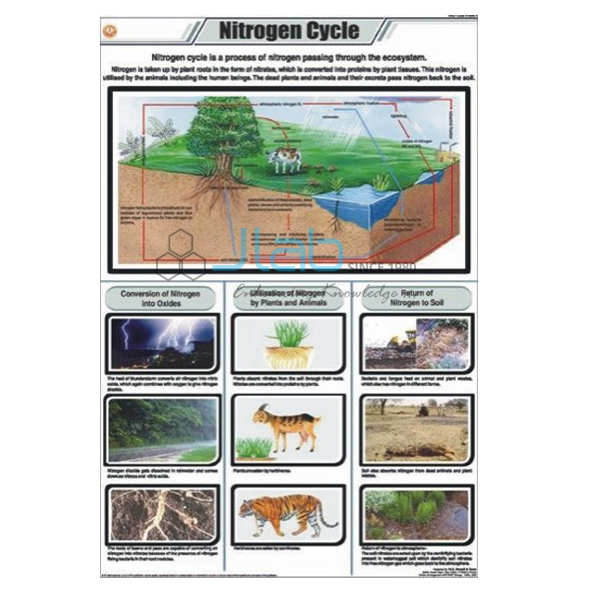
Nitrogen Cycle (code EL-GSC-2955) is a 58 x 90 cm wall chart on the nitrogen cycle — the way nitrogen passes between the air, the soil and living things — for biology, environmental science and agriculture lessons. It is printed in full colour on coated art paper, laminated on both sides and fitted with plastic rollers. JLab (Jain Laboratory Instruments Pvt Ltd, Ambala, India) supplies it to schools, colleges and dealers.
Get a quote: use the Add To Cart enquiry button below, or send your quantity and destination through the contact page.
Specifications
| Parameter | Detail |
|---|---|
| Chart topic | Nitrogen cycle |
| Size (overall) | 58 x 90 cm (about 22.8 x 35.4 in) |
| Size when rolled | 58 x 4 x 2 cm |
| Paper | Coated art paper, 130 gsm |
| Printing | Full colour, offset printing using CTP (computer-to-plate) technology |
| Lamination | Both sides, thick plastic film (30 micron heat-sealable polyester) |
| Fittings | Plastic rollers, for wall hanging |
| Surface | Markable and washable |
| Weight | 228 g |
| Language | English only |
| Quality check | Each chart is visually inspected before dispatch |
| Pack quantity | Each (sold individually) |
| Minimum order quantity | 10 units |
| Dispatch time | Usually 7–10 working days |
| Product code | EL-GSC-2955 |
| Supplied by | Jain Laboratory Instruments Pvt Ltd (JLab), Ambala, India |
What Is the Nitrogen Cycle Chart Used For?
Nitrogen makes up most of the air, yet plants and animals cannot use nitrogen gas directly; they need it in combined form to build proteins and nucleic acids. In nitrogen fixation, lightning and bacteria — Rhizobium in the root nodules of legumes such as peas and beans, and free-living soil bacteria — convert atmospheric nitrogen into compounds that plants can use, and fertiliser plants do the same industrially. Nitrifying bacteria then turn ammonia into nitrites and nitrates, which roots absorb, and animals obtain their nitrogen by eating plants. When organisms die or excrete waste, decomposers release ammonia again (ammonification), and denitrifying bacteria return nitrogen gas to the air, closing the cycle.
The topic comes up in middle-school science on useful microorganisms, in secondary and senior biology on nutrient cycles and plant nutrition, and in agriculture lessons that explain why farmers grow legumes in crop rotation. The chart pairs naturally with the Carbon Cycle and Oxygen Cycle charts from the same series. Its surface is listed as markable and washable, so students can draw in arrows or add the names of the bacteria during a lesson and the chart can be wiped clean afterwards.
What to Specify When Ordering
- Quantity — the minimum order is 10 charts, each sold individually.
- Cycle set — order the Carbon Cycle and Oxygen Cycle charts with it for a complete display of the three cycles.
- Practical work — a soil test kit with nitrate and ammonia-nitrogen tests links the chart to real soil.
- Language — listed in English only; ask JLab for a larger image of the current print if you need to check the labels.
Frequently Asked Questions
Which stages of the cycle does the chart show?
The listing does not itemise the panels. Nitrogen fixation, nitrification, uptake by plants, ammonification and denitrification are the stages normally taught; ask JLab for a larger image of the current print to check how they are drawn.
Which classes is it suitable for?
Middle-school science, secondary and senior-school biology, environmental science and introductory agriculture or soil-science courses.
What paper and lamination does it use?
It is offset printed in full colour, using CTP technology, on 130 gsm coated art paper and laminated on both sides with 30 micron heat-sealable polyester.
How is the chart hung and stored?
Plastic rollers are fitted for wall hanging. Rolled, the chart is 58 x 4 x 2 cm and it weighs 228 g.
What are the minimum order and dispatch time?
The minimum order is 10 units. Charts are visually inspected and usually dispatched within 7–10 working days; export transit depends on the destination.
What information does an export quotation need?
The quantity, destination country and port or city, delivery terms (for example FOB or CIF), packing or labelling instructions and any tender reference.
Who supplies the Nitrogen Cycle chart?
JLab (Jain Laboratory Instruments Pvt Ltd) in Ambala, Haryana, supplies it and sends quotations directly.
Supplier
JLab is the trading name of Jain Laboratory Instruments Pvt Ltd, incorporated in 2017 and based on Hargolal Road, Ambala, Haryana. JLab supplies printed biology and general science charts alongside the school laboratory equipment it produces, so a biology or agriculture department can order cycle charts and soil-testing kits together; each chart is visually inspected before packing. JLab exports worldwide and ships to buyers in every region — for example South Africa in Southern Africa, Afghanistan in South Asia, Indonesia in Southeast Asia, Brazil in South America and Rwanda in East Africa. Tender buyers can refer to the JLab lab tenders page.
Nutrient Cycles and Soil
- Carbon Cycle — the series chart on how carbon moves between air, living things, oceans and fuels.
- Oxygen Cycle — the series chart on how oxygen is released and used.
- Soil Test Kit — colour-card tests including nitrate, nitrogen and ammonia nitrogen.
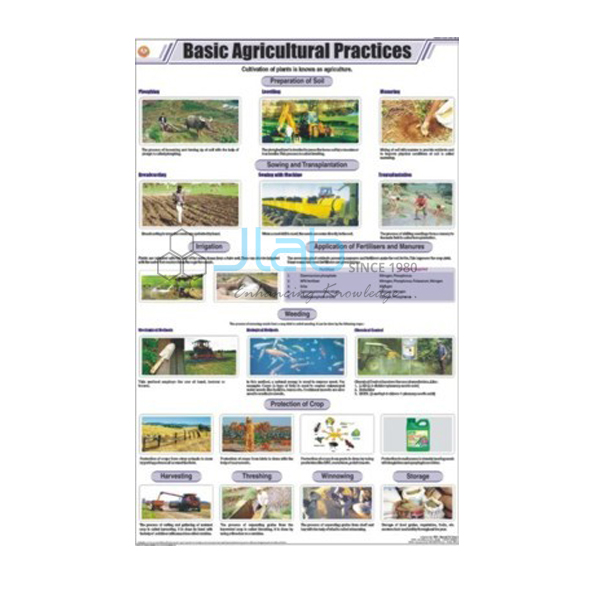
- Basic Agricultural Practices — the series chart on growing crops, where manures and fertilisers come in.
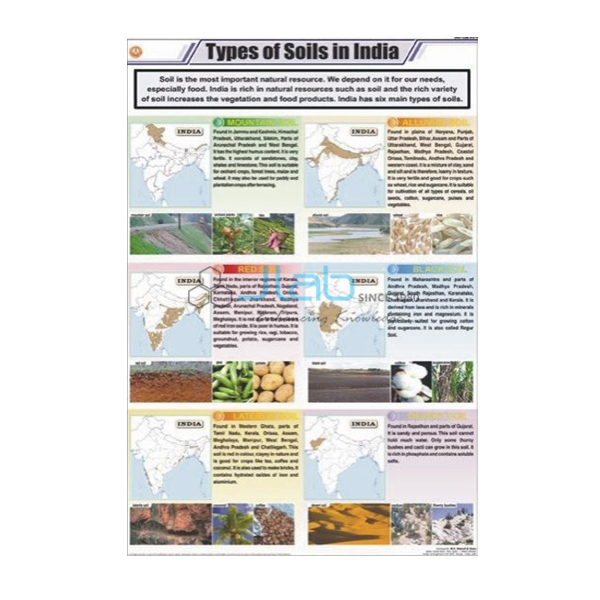
- Types of Soils in India — the series chart on India’s major soil types.
Browse the General Science Charts range or all Charts.
Request a Quote
Quotations come directly from JLab. Use the Add To Cart enquiry button on this page, or send the quantity (minimum 10 units), the other cycle charts or kits you want and the delivery location through the contact page.
Last updated: 4 October 2026