Solar Cooker Manufacturer,Supplier and Exporter in India

Product Code : EL-GSC-2962
Jlab Export is a leading Solar Cooker Manufacturer,and suppliers in India
Solar Cooker (code EL-GSC-2962) is a 58 x 90 cm science wall chart on solar cookers — devices that cook food with the energy of sunlight instead of fuel — for lessons on solar energy, heat and renewable sources of energy. It is offset printed in full colour on coated art paper, laminated on both sides and hung from plastic rollers. JLab (Jain Laboratory Instruments Pvt Ltd, Ambala, India) supplies it to schools, colleges and dealers.
Specifications
| Parameter | Detail |
|---|---|
| Chart topic | Solar cookers — cooking with energy from sunlight |
| Size (overall) | 58 x 90 cm (about 22.8 x 35.4 in) |
| Size when rolled | 58 x 4 x 2 cm |
| Paper | Coated art paper, 130 gsm |
| Printing | Full colour, offset printing using CTP (computer-to-plate) technology |
| Lamination | Both sides, thick plastic film (30 micron heat-sealable polyester) |
| Fittings | Plastic rollers, for wall hanging |
| Surface | Markable and washable |
| Weight | 228 g |
| Language | English only |
| Quality check | Each chart is visually inspected before dispatch |
| Pack quantity | Each (sold individually) |
| Minimum order quantity | 10 units |
| Dispatch time | Usually 7–10 working days |
| Product code | EL-GSC-2962 |
| Supplied by | Jain Laboratory Instruments Pvt Ltd (JLab), Ambala, India |
What Is the Solar Cooker Chart Used For?
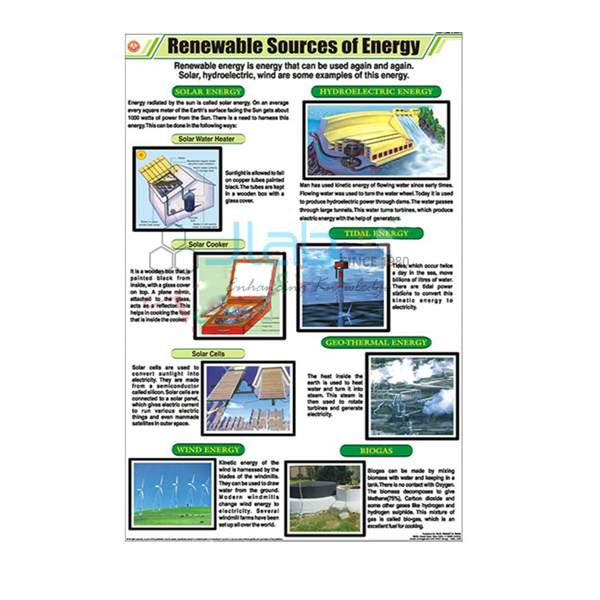
A solar cooker is one of the clearest everyday examples of how heat from the Sun can be collected and put to work, which is why it appears in school lessons on sources of energy. In the common box-type cooker, an insulated box painted black inside absorbs the sunlight, a glass lid lets light in but holds the heat back (the same idea as a greenhouse), and a plane mirror on the lid reflects extra sunlight into the box. Concentrating cookers use a curved, parabolic reflector to focus sunlight onto a pot placed at the focus and reach higher temperatures, while panel cookers use flat reflective panels to direct light onto a dark pot.
Teachers use the chart to discuss why black surfaces absorb more heat, how reflection and the greenhouse effect raise the temperature inside the cooker, and the trade-offs of the technology: no fuel, smoke or running cost, but slow cooking and no use at night or under heavy cloud. It fits science lessons on energy, environmental studies on renewable resources and project work where students build a simple cardboard cooker. The markable, washable lamination lets students trace the path of the sunlight on the chart and wipe it clean afterwards.
What to Specify When Ordering
- Quantity — 10 charts minimum, each supplied singly.
- Energy chart set — Renewable Sources of Energy, Bio-Gas and Fossil Fuels from the same series give a full energy display.
- Practical kits — a solar energy kit or solar cell demonstration lets students see sunlight doing work.
- Print check — listed in English only; request a larger image of the current print before ordering for a syllabus.
Frequently Asked Questions
Which types of solar cooker does the chart cover?
The listing does not itemise the panels. Box-type, concentrating (parabolic) and panel cookers are the designs normally taught; JLab can send a larger image of the current print so you can check what is shown.
What science ideas can be taught with it?
Absorption of heat by black surfaces, reflection by mirrors, the greenhouse effect of a glass cover and the advantages and limits of solar energy as a renewable source.
What is the chart made of?
Coated art paper of 130 gsm, offset printed in full colour with CTP technology, laminated on both sides with 30 micron heat-sealable polyester; it weighs 228 g.
What size is it?
58 x 90 cm overall, about 22.8 x 35.4 in, and 58 x 4 x 2 cm when rolled for storage or shipping.
What should an export enquiry include?
The quantity, destination country and port or city, preferred delivery terms such as FOB or CIF, any packing or labelling requirements and the tender reference if the purchase is for a tender.
Who supplies the Solar Cooker chart?
JLab (Jain Laboratory Instruments Pvt Ltd), based in Ambala, Haryana, supplies it and sends quotations directly.
Supplier
JLab is the trading name of Jain Laboratory Instruments Pvt Ltd, incorporated in 2017 and based on Hargolal Road, Ambala, Haryana. As well as the science equipment it produces, JLab supplies the charts of this general science series, so a school can combine energy charts with physics demonstration kits in one order; every chart is looked over before packing. JLab exports worldwide and ships to buyers in every region — Switzerland in Western Europe, Sudan in North Africa, Uruguay in South America, South Korea in East Asia and the Czech Republic in Eastern Europe are some examples. Details for tender buyers are on the JLab lab tenders page.
Energy Charts and Solar Energy Kits
- Renewable Sources of Energy — the series chart on energy sources that nature keeps replenishing.
- Non Conventional Sources of Energy — a wall chart on wind, bio, solar, geothermal and tidal energy.
- Bio-Gas — the series chart on fuel gas made from cattle dung and organic waste.
- Fossil Fuels — the series chart on coal, petroleum and natural gas, for comparison with solar energy.
- Solar Energy Kit — students build little boats or model cars driven by a panel-powered fan.
- Solar Cell Demonstration — solar cells drive a small motor to show light energy turning into motion.
See the complete General Science Charts range or all Charts.
Request a Quote
Quotations come straight from JLab. Press the Add To Cart enquiry button on this page, or send the quantity (minimum 10 units), the other charts or kits you need and your delivery location via the contact page.
Last updated: 4 October 2026