
Water Harvesting Manufacturer,Supplier and Exporter in India
Product Code : EL-GSC-2963
Jlab Export is a leading Water Harvesting Manufacturer,and suppliers in India
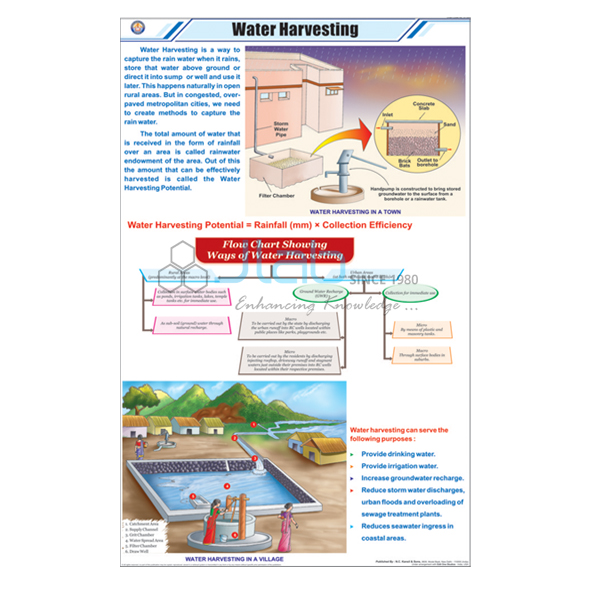
Water Harvesting (code EL-GSC-2963) is a classroom wall chart on water harvesting — catching rain water where it falls and storing it or returning it to the ground — for science, geography and environmental studies lessons on saving water. The chart is printed in full colour on art paper, laminated on both sides with thick plastic film and fitted with plastic rollers. JLab (Jain Laboratory Instruments Pvt Ltd, Ambala, India) supplies it to schools, colleges and dealers.
Specifications
| Parameter | Detail |
|---|---|
| Chart topic | Water harvesting — collecting and storing rain water |
| Printing | Full colour on art paper |
| Lamination | Both sides, thick plastic film |
| Fittings | Plastic rollers |
| Quality check | Each chart is visually inspected before dispatch |
| Pack quantity | Each (sold individually) |
| Minimum order quantity | 10 units |
| Dispatch time | Usually 7–10 working days |
| Product code | EL-GSC-2963 |
| Supplied by | Jain Laboratory Instruments Pvt Ltd (JLab), Ambala, India |
What Is the Water Harvesting Chart Used For?
Rainwater harvesting means collecting rain where it falls instead of letting it run off into drains. On a building, water from the roof is led through gutters and pipes into a storage tank, or into a pit or old well that lets it soak down and recharge the groundwater; the first, dirtiest rain is usually diverted or filtered. In open land, pits, trenches and small check dams slow the runoff so that more water sinks into the soil. India also has long-standing traditions of harvesting rain, such as johads (small earthen check dams) and the underground tankas of Rajasthan.
The chart helps teachers explain why water harvesting matters where water tables are falling and city surfaces shed most of the rain, and it supports project work in which students survey their own school roof and plan a collection system. It suits environmental studies, science lessons on water as a resource and geography lessons on water conservation.
What to Specify When Ordering
- Quantity — minimum order 10 charts, each sold individually.
- Size and language — ask JLab to confirm these for the current print, as the present listing text belongs to a different chart.
- Water topic set — Purification of Water and a water cycle chart make a matching display on water resources.
Frequently Asked Questions
What size is the Water Harvesting chart?
The size is not given correctly in the current listing, so please ask JLab to confirm it, together with the language of the print, when you request a quote.
What topics does it help to teach?
Rooftop rainwater collection, groundwater recharge and traditional water-harvesting structures, together with the reasons for conserving rain water. The listing does not itemise the panels; JLab can send a larger image of the current print.
How is the chart finished?
It is printed in full colour on art paper, laminated on both sides with thick plastic film and fitted with plastic rollers for hanging.
Who supplies this chart?
JLab (Jain Laboratory Instruments Pvt Ltd) of Ambala, Haryana, supplies it and quotes directly; for export, include the destination country and port, delivery terms such as FOB or CIF and any tender reference.
Supplier
JLab is the trading name of Jain Laboratory Instruments Pvt Ltd, incorporated in 2017 and based on Hargolal Road, Ambala, Haryana. Next to the laboratory equipment it produces, JLab supplies this general science chart series, so schools can add water-resource charts to an equipment order; every chart is checked by eye before packing. JLab exports worldwide and ships to buyers in every region — Belgium in Western Europe, Slovakia in Eastern Europe, Singapore in Southeast Asia, Belize in Central America and the Caribbean and the Maldives in South Asia, for example. Tender information is on the JLab lab tenders page.
Water and Conservation Teaching Aids
- Water Cycle In Nature Chart — a wall chart on how water moves between the sea, the air and the land.
- Purification of Water — the series chart on making water safe to use.
- Water Pollutants and Purification — a hands-on classroom activity set on water pollution and treatment.
- Soil Conservation Chart — a wall chart on conserving soil, which goes hand in hand with conserving water.
Browse the General Science Charts range or all Charts.
Request a Quote
JLab replies to quotation requests directly. Use the Add To Cart enquiry button on this page, or send the quantity (minimum 10 units) and your delivery location through the contact page, and ask for the size and language of the current print.
Last updated: 4 October 2026