

Heat Transfer From Pin-Fin Apparatus Manufacturer,Supplier and Exporter in India
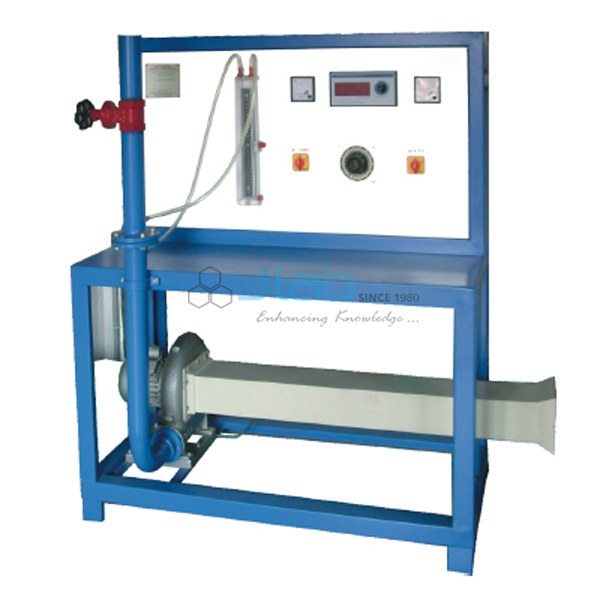
Product Code : EL-HTFAPF-7374
Jlab Export is a leading Heat Transfer From Pin-Fin Apparatus Manufacturer,and suppliers in India
Heat Transfer From Pin-Fin Apparatus (code EL-HTFAPF-7374) is a heat transfer set-up in which a pin-type fin, heated by a band heater assembly, is fitted in a duct so that its heat loss can be studied in both natural and forced convection. A blower unit with an orifice and manometer supplies and measures the air for the forced tests. JLab manufactures this fin-and-duct apparatus, with its 12-channel control panel, in Ambala, India.
Specifications
| Parameter | Detail |
|---|---|
| Fin | Pin type, fitted in a duct |
| Heater | Band heater assembly |
| Air supply | Blower unit |
| Air-flow measurement | Orifice with manometer |
| Temperature sensors | Set of thermocouples |
| Temperature indicator | 12-channel, digital |
| Voltmeter | 0–250 V |
| Ammeter | 0–3 A |
| Dimmerstat | 0–2 A |
| Switches | Mains on/off, blower on/off |
| Quality check | Each apparatus is visually inspected before dispatch |
| Pack quantity | Each (sold individually) |
| Minimum order quantity | 1 unit |
| Dispatch time | Usually 14–18 working days |
| Product code | EL-HTFAPF-7374 |
| Manufacturer | Jain Laboratory Instruments Pvt Ltd (JLab) — OEM |
| Country of origin | India (made in Ambala, Haryana) |
Natural and Forced Convection Runs
For a natural convection run the blower stays off and the fin loses heat to still air in the duct; the readings give the Grashof and Prandtl numbers, and from them the Nusselt number and h. Switching the blower on gives the forced run: the manometer reading across the orifice gives the air velocity and so the Reynolds number, and Nu then follows from Re and Pr. The thermocouples show how far the temperature falls from the base to the tip in each case, and the dimmerstat lets both runs be repeated at several heat inputs.
Fin Equations Used With the Readings
With h known, the fin parameter is m = √(hP/kA), where P is the fin perimeter, A its cross-section and k the conductivity of the fin material. Taking the tip as insulated, the predicted temperature at a distance x from the base is T = T∞ + (Tb − T∞) cosh[m(L − x)] / cosh(mL), which students compare with the measured profile. The heat leaving the fin is Q = √(hPkA) (Tb − T∞) tanh(mL), and the fin effectiveness is Q divided by the heat the bare base area would lose without the fin, hA(Tb − T∞).
Other Convection and Conduction Rigs
- Heat Transfer In Forced Convection — measures h for blower air flowing through a heated pipe.
- Heat Transfer In Natural Convection — finds h for a heated vertical brass tube in still air.
- Thermal Conductivity of Metal Rod — plots the temperature fall along an insulated, water-cooled copper bar.
JLab lists this apparatus under Heat Transfer From A Pin Fin within its Heat Transfer Lab Equipment.
Request a Quote
Place the order with Add To Cart, or send the number of units and the delivery address through the contact page for a quotation.
Last updated: 30 October 2026