Investigating Spontaneous Generation Manufacturer,Supplier and Exporter in India

Product Code : EL-ME-7148
Jlab Export is a leading Investigating Spontaneous Generation Manufacturer,and suppliers in India
Investigating Spontaneous Generation (code EL-ME-7148) is a class investigation in which students recreate Louis Pasteur’s classic experiment on whether life can arise from non-life. They grow organisms in flasks exposed to particles in the air and compare them with flasks that have special S-shaped necks, open to air but not to particulate matter; the investigation is planned for a class of 40 students. JLab (Jain Laboratory Instruments Pvt Ltd, Ambala, India) supplies it to schools, colleges and dealers.
Specifications
| Parameter | Detail |
|---|---|
| Experiment | Recreation of Louis Pasteur’s spontaneous generation experiment |
| Question investigated | Can life arise from non-life? |
| Test flasks | Flasks exposed to particles in the atmosphere |
| Comparison flasks | Flasks with special S-shaped necks, exposed to air but not to particulate matter |
| Class size | 40 students |
| Shelf life of any broth or media | Shelf life depends on the chemical, its grade and storage conditions; ask us for the expiry date of the batch you are quoted |
| Quality check | Each kit is visually inspected before dispatch |
| Pack quantity | Each (one kit) |
| Minimum order quantity | 10 units |
| Dispatch time | Usually 7–10 working days |
| Product code | EL-ME-7148 |
| Supplied by | Jain Laboratory Instruments Pvt Ltd (JLab), Ambala, India |
What Is the Spontaneous Generation Investigation Used For?
For centuries people believed that living things could appear from non-living matter — maggots from rotting meat, or microbes from a broth left standing. This idea was called spontaneous generation, and by 1864 the French scientist Louis Pasteur had dispelled it with one of science’s most famous experiments. He showed that microorganisms did not develop on their own in a sterilised nutrient broth. The key was the shape of the flask: in a flask with a long S-shaped neck, air can reach the broth, but dust and the microbes carried on it settle in the bend of the neck, so the broth stays clear. In a flask open to airborne particles, microbes soon grow.
Repeating the comparison themselves, students see that life comes from pre-existing life, a principle known as biogenesis. It underpins sterilisation, pasteurisation and aseptic technique in every microbiology lab, and it opens the origin-of-life discussion at the start of the Evolution chapter in CBSE class 12 biology. The investigation also suits school science clubs and first-year college microbiology, where it introduces the idea of a controlled experiment — two set-ups that differ in only one factor.
What to Specify When Ordering
- Number of kits — each kit is planned for a class of 40 students; the minimum order is 10 kits.
- Contents list — ask for the itemised list so you can check what glassware and media are included.
- Support apparatus — add a heat source, an incubator or extra glassware if your lab needs them.
Frequently Asked Questions
What do students do in this investigation?
They recreate Pasteur’s experiment: organisms are grown in flasks exposed to particles in the atmosphere and compared with flasks that have S-shaped necks, which let air in but keep particulate matter out.
Why do the S-shaped necks matter?
Dust and the microbes on it settle in the bend of the neck instead of reaching the broth. If the broth stays clear even though air can enter, life has not arisen spontaneously — it needs microbes from outside.
How many students does one kit serve?
The listing gives a class size of 40 students for one kit.
Which syllabus topics does it support?
The origin-of-life section of the Evolution chapter in CBSE class 12 biology, introductory microbiology on sterilisation and aseptic technique, and lessons on how to design a controlled experiment.
What information is needed for an export quotation?
Send the number of kits, the destination country and port or city, your preferred delivery terms (for example FOB or CIF), any packing or labelling needs and a tender reference if relevant.
Who supplies this investigation?
Jain Laboratory Instruments Pvt Ltd, trading as JLab, supplies it from Ambala, Haryana, India, and quotes for it directly.
Supplier
JLab is the trading name of Jain Laboratory Instruments Pvt Ltd, a science education equipment company incorporated in 2017 and based on Hargolal Road, Ambala, Haryana. It resells this investigation alongside the microbiology apparatus and biology equipment of its own range, so a college or dealer can source a complete practical in one order, and each kit is checked by eye before dispatch. The company holds GSTIN 06AADCJ9848D1ZE and is identified internationally by Legal Entity Identifier 549300DTGS77DGYD6N03. JLab exports worldwide and ships to buyers in every region — for example Slovakia in Eastern Europe, Rwanda in East Africa, Ireland in Western Europe, Turkey in the Middle East and Estonia in Northern Europe.
Related Microbiology Investigations
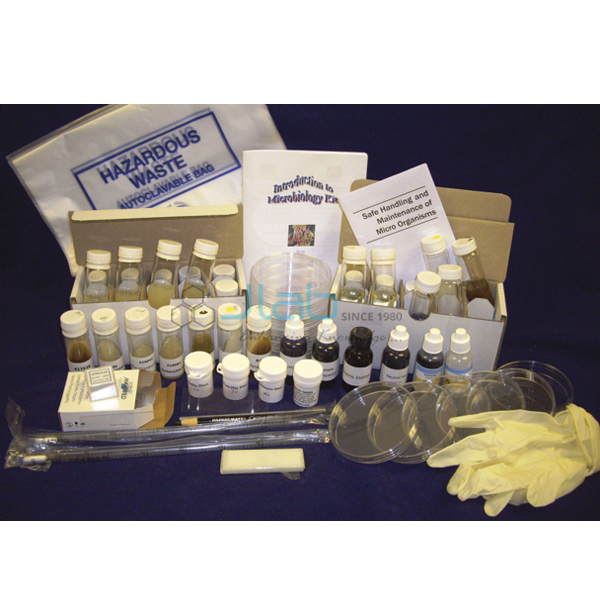
- Introduction to Microbiology Kit — plate and broth cultures, pasteurisation and other starter activities.
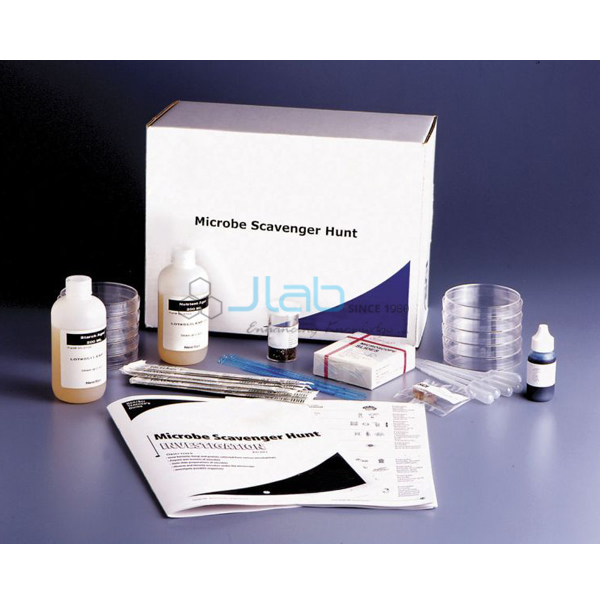
- Microbe Scavenger Hunt — students collect microbes from water, air, soil and food.
- Gram Staining of Bacteria — ampoule stain sets for sorting bacteria by Gram reaction.
- Bacteria Slide Set — prepared slides of common bacteria.
See the full Microbiology Equipment range or all Biology Lab Equipment.
Request a Quote
JLab replies to every enquiry directly. Use the Add To Cart button on this page, or send the number of kits (minimum 10 units) and your delivery location through the contact page.
Last updated: 5 October 2026