Viruses and Bacteria Poster Manufacturer,Supplier and Exporter in India
Product Code : EL-ME-7151
Jlab Export is a leading Viruses and Bacteria Poster Manufacturer,and suppliers in India
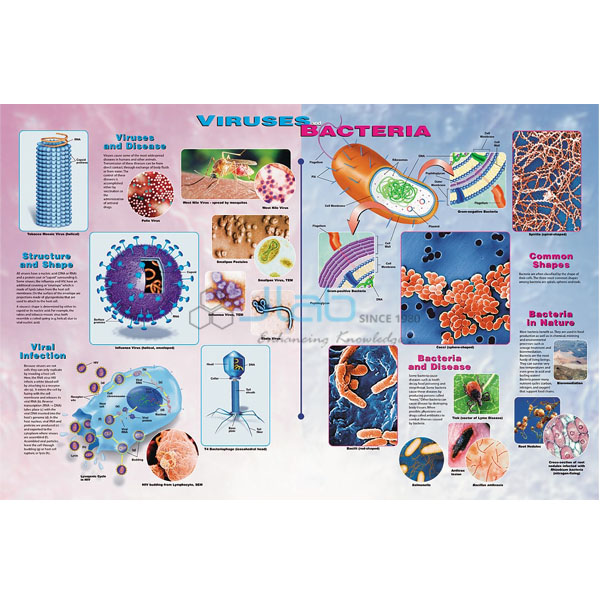
The Viruses and Bacteria Poster is a microbiology wall poster that takes a close look at the viruses and bacteria that most often affect people. It measures 890 mm wide by 585 mm high. Detailed illustrations and photographs show how to identify these agents and how they cause harm to humans. For a laminated 58 x 90 cm chart on viruses alone, choose the Viruses Chart.
Specifications
| Type | Wall poster |
| Size | 890 mm wide x 585 mm high (about 35 x 23 in) |
| Subject | Common viruses and bacteria that affect humans |
| Artwork | Detailed illustrations and photographs |
| Teaches | How to identify viruses and bacteria, and how they cause harm to humans |
| Pack quantity | Each (sold individually) |
| Minimum order quantity | 10 units |
| Dispatch time | Usually 4–6 working days |
| Manufacturer | JLab (Jain Laboratory Instruments Pvt Ltd), Ambala, India |
How Viruses and Bacteria Differ
| Feature | Bacteria | Viruses |
|---|---|---|
| Are they cells? | Yes, single prokaryotic cells with no nucleus | No, they are not cells at all |
| Size | Usually 0.5 to 5 micrometres; seen with a light microscope | Mostly 20 to 300 nanometres; seen only with an electron microscope |
| Structure | Cell wall, membrane, cytoplasm, ribosomes and DNA | DNA or RNA inside a protein coat, sometimes with an outer envelope |
| Reproduction | Divide on their own by binary fission | Copy themselves only inside a living host cell |
| Treatment | Many infections respond to antibiotics | Antibiotics have no effect; antivirals and vaccines are used |
| Example diseases | Tuberculosis, cholera, typhoid | Common cold, influenza, measles |
Use the table as a checklist while students study the poster. Most bacteria are harmless, so ask students to say which groups on the poster cause disease.
Displaying and Storing the Poster
Hang the poster at eye level near the microscope bench, out of direct sunlight, which fades print. Fix it with removable tabs rather than pins through the artwork.
Between terms, roll it loosely around a wide tube and keep it in a dry cupboard. Never fold it, as creases stay visible.
Frequently Asked Questions
How many posters should a school order?
One poster per biology room or microbiology lab is usual. Schools that teach in several rooms often order one for each. The minimum order is 10 units, so a group of schools can combine its needs in one order.
Is it the same size as the other JLab biology posters?
Yes. It shares the 890 x 585 mm format of the Systems of the Human Body Poster and the Human Genetic Disorders Poster. A set of these posters therefore hangs evenly in one row.
What is the difference between viruses and bacteria?
Bacteria are single living cells that feed, grow and divide on their own. Viruses are much smaller particles of DNA or RNA in a protein coat. They can only multiply by taking over a living host cell.
Why don’t antibiotics work against viruses?
Antibiotics attack parts that only bacterial cells have, such as the cell wall or bacterial ribosomes. Viruses have none of these parts, because they are not cells. Taking antibiotics for a cold or flu does not help and adds to antibiotic resistance.
Are all bacteria harmful?
No. Most bacteria are harmless, and many are useful, such as gut bacteria that help digestion and soil bacteria that recycle nutrients. Only a small share cause disease, and the poster shows how those harm humans.
Other Virus and Bacteria Teaching Aids
- Viruses Chart (58 x 90 cm laminated wall chart)
- Bacteria Chart (58 x 90 cm laminated wall chart)
- Bacteria Slide Set (12 prepared slides)
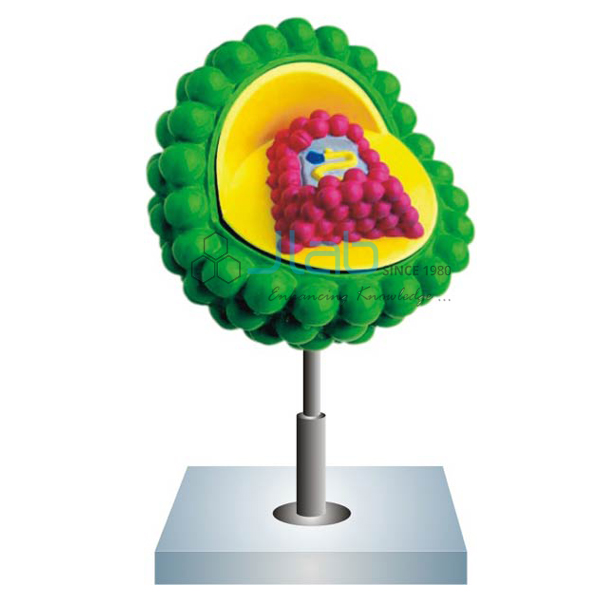
- Bacteriophage Virus Model
- Bacteria Structure Model
For a quote, use Add To Cart or send us a message through the contact page.
Last updated: 26 November 2026