Rack and Pinion Type Manufacturer,Supplier and Exporter in India
Product Code : EL-AELE-9427
Jlab Export is a leading Rack and Pinion Type Manufacturer,and suppliers in India
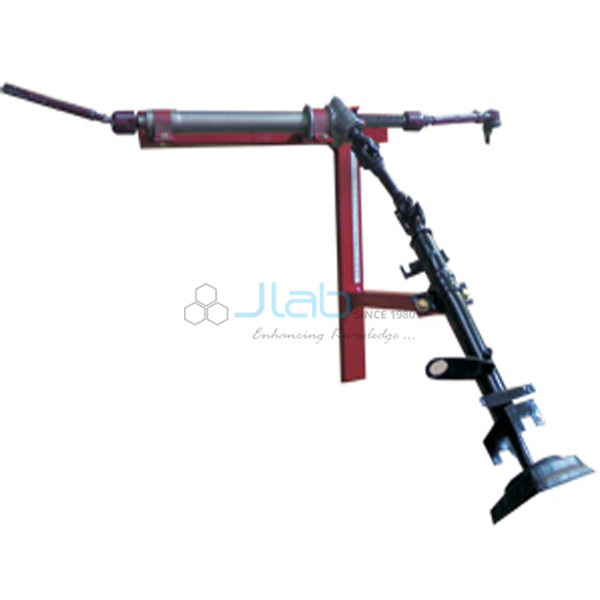
This bench lab system teaches students how a combined gear drive of the rack and pinion type is put together and set up correctly. The work runs through six stages: reading the brief and the drawing, assembly, setting, adjusting, testing and making calculations. The drive is built on a tubular steel frame of square profile with bearing elements, and the parts are stored in a housing system.
Specifications
| Drive type | Combined drive, rack and pinion |
| Frame | Tubular steel, square profile, with bearing elements |
| Exercise stages | Brief and drawing, assembly, setting, adjusting, testing, calculations |
| Components | Modular, kept in a protective housing system |
| Minimum order quantity | 1 unit |
| Dispatch time | Usually 14–18 working days |
| Manufacturer | JLab (Jain Laboratory Instruments Pvt Ltd), Ambala, India |
Drive Assembly Practicals for Students
A first practical starts at the drawing. Students pick out the rack, the pinion and the bearing elements, then assemble the drive on the frame in the order the brief sets out. Once the pinion is in mesh, they set the play between the teeth. The backlash is read with a Feeler Gauge between the tooth flanks, or with a Dial Gauge resting on the rack while the pinion is held still.
In the testing stage the pinion is turned through a counted number of revolutions and the rack travel is measured with a Steel Rule. Students compare the reading with the calculated travel, which is the number of pinion teeth times the circular pitch for each revolution. Because the components are modular, a group can then rearrange the set to try an idea of its own.
Frequently Asked Questions
What does a rack and pinion drive do?
It turns rotary motion into straight-line motion. The pinion is a small gear that meshes with a toothed bar, the rack. One turn of the pinion moves the rack by its number of teeth times the circular pitch. Driving the rack instead turns the pinion.
What causes knocking or lost motion in a rack and pinion drive?
Usually too much backlash, worn teeth or a loose mounting. Each time the drive reverses, the free play is taken up with a knock and the rack lags behind the pinion. Check the mesh setting, the bearing elements and the fixing screws before blaming the gears.
Why does backlash have to be set?
Backlash is the small free play between meshing teeth. With too little, the teeth bind, run hot and wear fast. With too much, the rack lags each time the pinion reverses, which shows up as lost motion. The frame and bearing elements let the mesh be set and then held.
Can students build their own arrangements?
Yes. The components are modular and the set-up is flexible. Once the set exercises are done, students can plan and assemble a drive of their own design and test it against their calculations.
What happens if the rack and pinion are out of line?
The teeth touch only at one end or one edge, so the drive turns stiffly in places and wears unevenly. Students feel tight spots as the pinion is turned along the full rack. Set the rack parallel to the pinion axis and check the backlash again at several points.
Other Gear and Drive Teaching Sets
- Spur Gear Set (one and two stage gear trains)
- Gear Trains Apparatus (simple and epicyclic gearing)
- Three Stage Spur Gear
For a quote, use Add To Cart or send us a message through the contact page.
Last updated: 5 November 2026