Refraction of Light Through Lenses Manufacturer,Supplier and Exporter in India
Product Code : EL-PC-2899
Jlab Export is a leading Refraction of Light Through Lenses Manufacturer,and suppliers in India
Refraction of Light Through Lenses (code EL-PC-2899) is a physics wall chart on how convex and concave lenses bend light and form images, used in optics lessons in schools, colleges and physics labs. It measures 58 x 90 cm, is printed in full colour on 130 gsm coated art paper and is sealed in 30 micron polyester on both sides, so ray diagrams can be drawn over it and wiped off. It is made by Jain Laboratory Instruments Pvt Ltd (JLab) at its works in Ambala, India.
Specifications
| Parameter | Detail |
|---|---|
| Topic | Refraction of light through lenses (Physics Charts series) |
| Size (overall) | 58 x 90 cm |
| Paper | Coated art paper, 130 gsm |
| Printing | Full colour, offset printed using CTP technology |
| Lamination | Both sides, 30 micron heat-sealable polyester |
| Hanging | Wall hanging on plastic rollers |
| Surface | Markable and washable |
| Weight | 228 g |
| Size when rolled | 58 x 4 x 2 cm |
| Language | English only |
| Quality check | Each chart is visually inspected before dispatch |
| Pack quantity | Each (sold individually) |
| Minimum order quantity | 10 units |
| Dispatch time | Usually 7–10 working days |
| Product code | EL-PC-2899 |
| Manufacturer | Jain Laboratory Instruments Pvt Ltd (JLab) — OEM |
| Country of origin | India (made in Ambala, Haryana) |
What Is the Lens Refraction Chart Used For?
A convex lens is thicker at the centre and converges light; a concave lens is thinner at the centre and spreads it out. Image formation is explained with three standard rays: a ray parallel to the principal axis passes through the principal focus of a convex lens (or appears to come from that of a concave lens), a ray through the optical centre goes straight on, and a ray through the focus leaves parallel to the axis. A convex lens gives a real, inverted image when the object is beyond its focus and a virtual, upright, magnified image when the object is inside the focus — the principle of the magnifying glass — while a concave lens always gives a virtual, upright, diminished image. The lens formula links object distance, image distance and focal length, and the power of a lens in dioptres is the reciprocal of its focal length in metres, positive for convex and negative for concave.
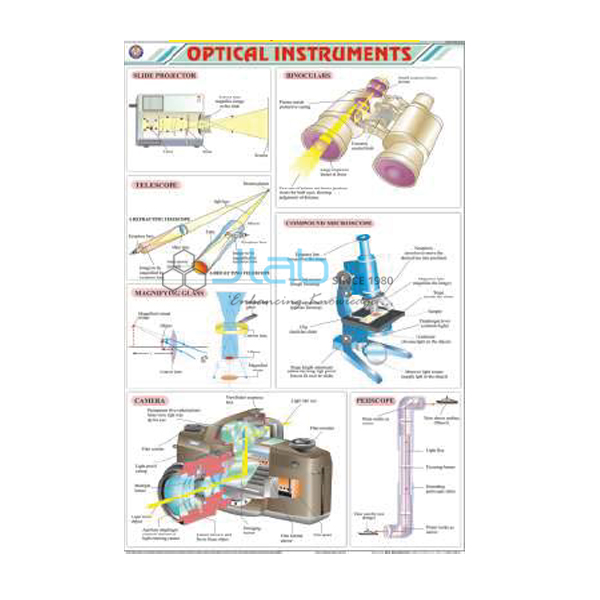
These ideas run through the light chapter of class 10 science, the class 10 practical of finding the focal length of a convex lens from the image of a distant object, and the class 12 optical-bench experiment that finds it from object and image distances; they also explain spectacles, cameras, projectors and microscopes. Students can trace rays on the markable surface during a lesson. The listing names the topic but does not itemise the diagrams, so ask for a preview image if you need to check them before ordering.
What to Specify When Ordering
- Number of charts — 10 units is the minimum order.
- Lenses and an optical bench for the practicals — separate listings that can go on the same enquiry.
- Companion charts — for example the prism and eye-defects charts from the same Physics Charts series.
- Destination and delivery terms for the quotation.
Frequently Asked Questions
Which lenses and ray diagrams does the chart show?
The listing gives the topic — refraction of light through lenses — without itemising the diagrams. A preview image from JLab will show which lenses and object positions are drawn.
Are lenses supplied with the chart?
No, this listing covers the chart only. Glass convex and concave lenses, a lens demonstration set and a student optical bench are listed separately.
How large and heavy is the chart?
It is 58 x 90 cm and weighs 228 g, and it rolls up to about 58 x 4 x 2 cm for storage or shipping.
Can teachers draw on it?
Yes. Both sides carry 30 micron heat-sealable polyester lamination and the surface is listed as markable and washable, so ray diagrams can be drawn over the print and cleaned off.
What paper, printing and language are used?
130 gsm coated art paper, offset printed in full colour using CTP technology, with English text only.
What should an export enquiry include?
The quantity, the destination country and port or city, the delivery terms (for example FOB or CIF), any special packing or labelling, and the tender reference where applicable.
Who manufactures this chart?
Jain Laboratory Instruments Pvt Ltd, trading as JLab, at its works in Ambala, Haryana, India.
OEM Manufacturer
JLab is the trading name of Jain Laboratory Instruments Pvt Ltd, a physics teaching aids and laboratory equipment manufacturer in India, incorporated in 2017 and based on Hargolal Road, Ambala, Haryana. This chart is made at JLab’s own works rather than bought from a trader, so schools, colleges, dealers and importers buy factory-direct, each chart is visually inspected before dispatch, and the same manufacturer handles repeat orders. JLab exports worldwide and ships to buyers in every region, for example Fiji in Oceania, Mexico in North America, Panama in Central America and the Caribbean, Hong Kong in East Asia and Colombia in South America. Tender details are on the JLab lab tenders page.
Lenses, Optical Bench and Related Charts
- Lens Glass Double Convex — converging glass lenses in a range of sizes for focal-length practicals.
- Lens Glass Double Concave — diverging lenses to compare with the convex type.
- Lens Demonstration Set — several lens shapes in labelled pouches for showing the difference in class.
- Optical Bench Student Complete Set — for experiments on lenses, mirrors, focal lengths and image formation.
- Refraction Through Prisms — the companion chart on deviation and dispersion of light by a prism.
- Eye and its Defects — applies lenses to the correction of short and long sight.
See all titles in the Physics Charts series and the wider Charts range.
Request a Quote
Quotes come direct from the manufacturer. Use the Add To Cart enquiry button on this page, or send the number of charts (minimum 10 units), any lenses or companion charts you need and your delivery location through the contact page.
Last updated: 4 October 2026