

Thermal Conductivity of Insulating Powder Manufacturer,Supplier and Exporter in India
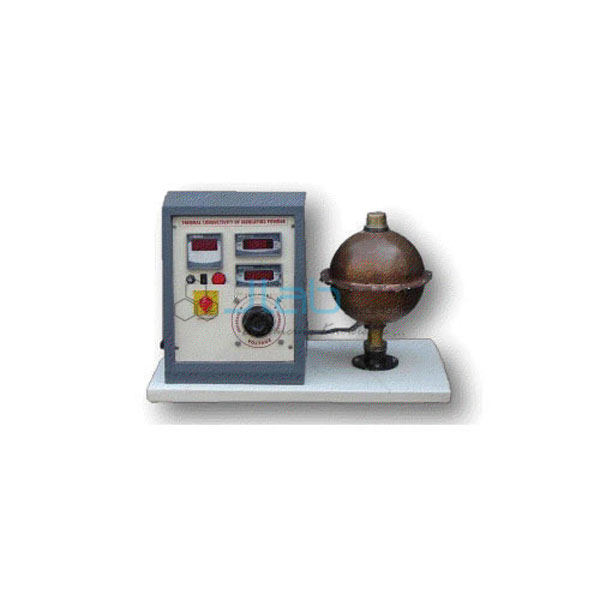
Product Code : EL-TCOIP-7372
Jlab Export is a leading Thermal Conductivity of Insulating Powder Manufacturer,and suppliers in India
Thermal Conductivity of Insulating Powder (code EL-TCOIP-7372) is a heat transfer lab set-up for finding the thermal conductivity of a powder packed between two thin-walled concentric copper spheres, 100 mm and 200 mm in diameter. A nichrome wire coil inside the inner sphere is the heat source, so heat flows radially outwards through the powder layer. JLab builds this two-sphere rig and its digital control panel in Ambala, India.
Specifications
| Parameter | Detail |
|---|---|
| Spheres | Two thin-walled concentric copper spheres |
| Inner sphere diameter | 100 mm |
| Outer sphere diameter | 200 mm |
| Heater | Nichrome wire coil inside the inner sphere |
| Heat input control | Variac, 0–230 V / 2 A |
| Temperature sensors | RTD PT-100 type, 10 nos. |
| Digital voltmeter | 0–300 V |
| Digital ammeter | 0–2 A |
| Digital temperature indicator | 0–300 °C |
| Panel controls | Multi-channel switch, ON/OFF switch, mains indicator |
| Quality check | Each rig is visually inspected before dispatch |
| Pack quantity | Each (sold individually) |
| Minimum order quantity | 1 unit |
| Dispatch time | Usually 14–18 working days |
| Product code | EL-TCOIP-7372 |
| Manufacturer | Jain Laboratory Instruments Pvt Ltd (JLab) — OEM |
| Country of origin | India (made in Ambala, Haryana) |
How k Is Worked Out From the Sphere Temperatures
The variac is set and the rig is left until the RTD readings stop changing. At that steady state the heater power Q, the voltmeter reading multiplied by the ammeter reading, all passes outwards through the powder. Because the powder surrounds the heated sphere completely, no heat can bypass the layer at the edges, as it can with a flat slab. Averaging the sensors on each surface gives the inner-sphere temperature T1 and the outer-sphere temperature T2. Conduction through a spherical shell gives Q = 4πk r1 r2 (T1 − T2) / (r2 − r1), so k = Q (r2 − r1) / [4π r1 r2 (T1 − T2)], where r1 and r2 are the radii of the inner and outer spheres.
Comparing the Powder at Different Temperatures
The variac lets the heat input be raised in steps. Each new steady state gives a fresh pair of sphere temperatures and a value of k at a higher mean temperature, (T1 + T2)/2. Plotting k against that mean temperature is the comparison experiment the set-up is meant for. The multi-channel switch lets the single digital indicator read all ten RTD sensors in turn.
Other Thermal Conductivity Set-ups
- Thermal Conductivity of Metal Rod — finds k for a copper bar, a good conductor, from its temperature gradient.
- Thermal Conductivity of Liquid — uses the guarded hot plate method on a liquid layer.
- Heat Transfer Through Composite Wall — determines the thermal resistance and conductivity of a layered wall.
This set-up sits in the Thermal Conductivity of Insulating Powder category of JLab’s Heat Transfer Lab Equipment.
Request a Quote
Add the set-up to your enquiry with Add To Cart, or write through the contact page giving the number of rigs and the delivery address.
Last updated: 30 October 2026