Transport Incubator Manufacturer,Supplier and Exporter in India
Product Code : EL-NE-2041
Jlab Export is a leading Transport Incubator Manufacturer,and suppliers in India
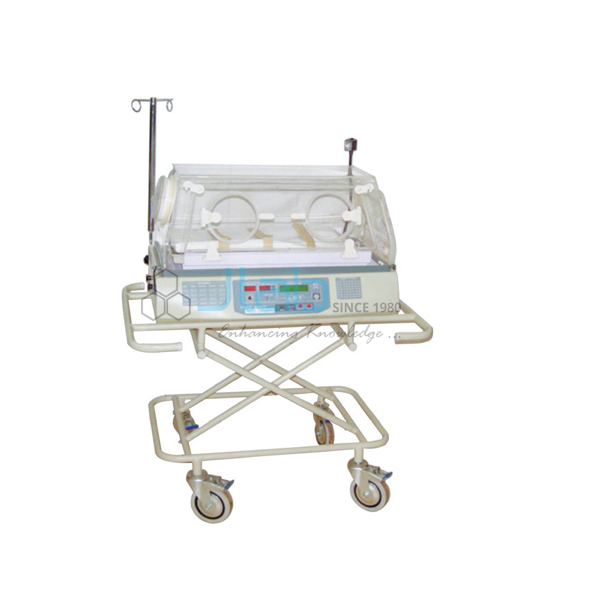
A transport incubator carries a newborn between wards or hospitals inside its own warmed hood. This one has a microprocessor controller with an LED display, a double-wall acrylic hood, four oval hand ports and access panels at the front and back. It works in skin or air control mode and rolls on braked castors with an IV pole.
Specifications
| Control | Microprocessor, LED display |
| Hood | Double-wall acrylic, heat spread over the whole hood |
| Access | Four oval ports; access panels front and back |
| Tube passages | Diffusers, 2 front and 2 back |
| Control modes | Skin mode and air mode, with skin temperature probe |
| Monitoring | Air temperature, patient temperature, oxygen concentration |
| Humidity | Passive system |
| Alarms | Heating, skin probe, air probe, air circulation, power supply and system failure; low battery |
| Internal noise level | Below 60 dB |
| Other fittings | Memory foam mattress, air micro-filter, castors with brakes, IV pole |
| Minimum order quantity | 1 unit |
| Dispatch time | Usually 14–18 working days |
| Manufacturer | JLab (Jain Laboratory Instruments Pvt Ltd), Ambala, India |
Lab Exercises with the Transport Incubator
Biomedical-engineering students run the alarm tests on the bench. They unplug the skin probe to raise the probe-failure alarm, then pull the mains plug to see the power alarm and the change to battery. A Digital Stop Watch times the warm-up from cold, and one probe of a Digital Tele Thermometer, set beside the air sensor, checks the air temperature shown on the display.
Nursing students then rehearse a transfer with a Nursing Baby. They load the model through the front panel, pass dummy lines through the diffusers, close every port and release the brakes only when the team is ready to move.
Frequently Asked Questions
How long will it run on its battery?
Run time depends on the charge in the battery, how cold the surroundings are and how hard the heater has to work. The low-battery alarm warns before the charge runs out. Keep the unit on mains power until departure and plug it in again on arrival.
Why warm the incubator on mains power before a transfer?
Heating a cold incubator takes the most power. Doing it on battery drains the charge before the journey starts, so pre-warm on mains for the time your transport protocol gives, and only then move the baby in.
What is the difference between skin mode and air mode?
In skin mode the heater follows the reading from the patient skin probe. In air mode it holds the air temperature inside the hood. Trained staff choose the mode and the set values under the hospital protocol.
Why keep the ports closed during a transfer?
Each open port lets warm air out, and the hood cools quickly in a cold corridor or vehicle. Pass tubes and lines through the diffusers instead, two at the front and two at the back, and open a port only for care.
Which parts come out for cleaning?
The removable parts lift out so the hood and fittings can be cleaned between uses. Wipe the acrylic with a cleaner that is safe for acrylic, since some solvents craze it, and check the air micro-filter on the schedule your biomedical team sets.
Neonatal Units for Ward Use
For a quote, use Add To Cart or send us a message through the contact page.
Last updated: 12 November 2026