Triple Beam Balance (Low Form) Manufacturer,Supplier and Exporter in India
Product Code : EL-MI-2137
Jlab Export is a leading Triple Beam Balance (Low Form) Manufacturer,and suppliers in India
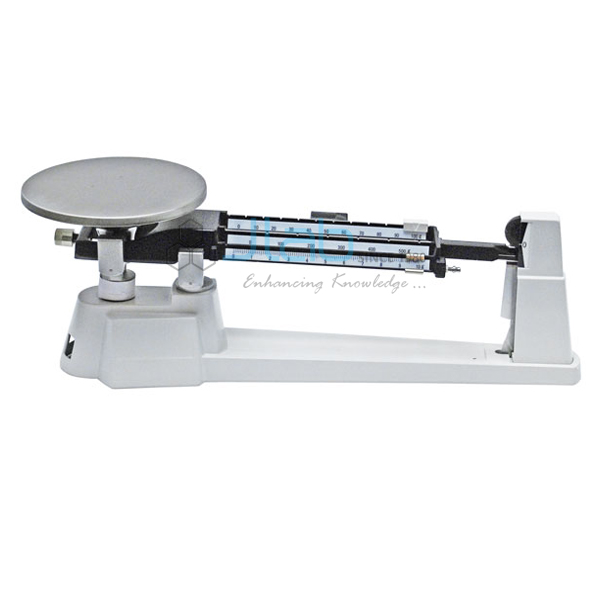
Three notched beams with sliding masses let students build up a reading in hundreds, tens and tenths of a gram on this single pan, low form balance. It weighs 610 g on the beams and up to 2610 g with a supplementary mass set, ordered separately. The stainless steel pan is 150 mm across, and magnetic damping steadies the pointer.
Specifications
| Type | Single pan, low form |
| Capacity | 610 g on the beams, 2610 g with the separate supplementary mass set |
| Beams | Three notched beams: 0–500 g × 100 g, 0–100 g × 10 g and 0–10 g × 0.1 g, centre indicating sliding masses |
| Zero adjustment | Spring loaded zero adjust compensator |
| Damping | Magnetic |
| Pan | Stainless steel, 150 mm diameter |
| Base balance includes | Stainless steel pan and the sliding beam riders on the three beams |
| Optional tare beam | Built into the beam assembly, uncalibrated, 200 g capacity |
| Ordered separately | Supplementary mass set for the 2610 g range; support rod for under weighing |
| Minimum order quantity | 5 units |
| Dispatch time | Usually 7–10 working days |
| Manufacturer | JLab (Jain Laboratory Instruments Pvt Ltd), Ambala, India |
Practicals on the Triple Beam Balance
Students find the density of water by weighing an empty Measuring Cylinder, adding a known volume of water and weighing it again. The gain in mass divided by the volume should come out close to 1 g per cubic centimetre.
In heat practicals the balance gives the mass of the copper vessel from the Calorimeter, first empty with its stirrer and then with water. Those masses go into the method of mixtures for the specific heat of a solid. On a balance fitted with the optional tare beam, a container can be weighed out before a sample goes in.
Frequently Asked Questions
What should we check if the beam sticks or will not swing freely?
First make sure nothing touches the beam or the pan and that the balance stands level. Dust, lint or iron filings in the damping magnet gap can drag on the beam, so clean the gap with a soft brush. Bent parts near the damper also cause sticking, usually after the balance was lifted by its beam.
How is the support rod used for weighing below the balance?
With the support rod fitted (it is ordered separately), an object can hang on a thread below the balance and dip into water in a beaker. Weighing it in air and then in water gives the upthrust, which is the basis of density work by Archimedes’ principle.
Why must each sliding mass sit in a notch before I read it?
The notches mark the exact 100 g and 10 g steps on the two coarse beams. A mass resting between notches gives a value that is neither step. Move each large mass to the last notch that does not tip the beam, then slide the 0.1 g mass until the pointer balances.
Why does my reading change when the balance is moved to another bench?
The beams read correctly only when the balance is level and its zero is set where it stands. After any move, clear the pan, put all sliding masses at zero and turn the compensator until the pointer rests on the zero mark again.
Should a school order the triple beam or a two pan balance?
For routine class weighing, the triple beam needs no loose weights. The object goes on the single pan, and the three notched beams read up to 610 g, or 2610 g with the separate mass set. A two pan balance suits lessons that compare an object with reference masses in the second pan.
Other Balances and Masses
- Double Beam Balance (Two Pan) (two pans and two graduated beams)
- Triple Beam Balance Mass Set (supplementary masses, ordered separately)
- Analytical Balance
For a quote, use Add To Cart or send us a message through the contact page.
Last updated: 19 November 2026