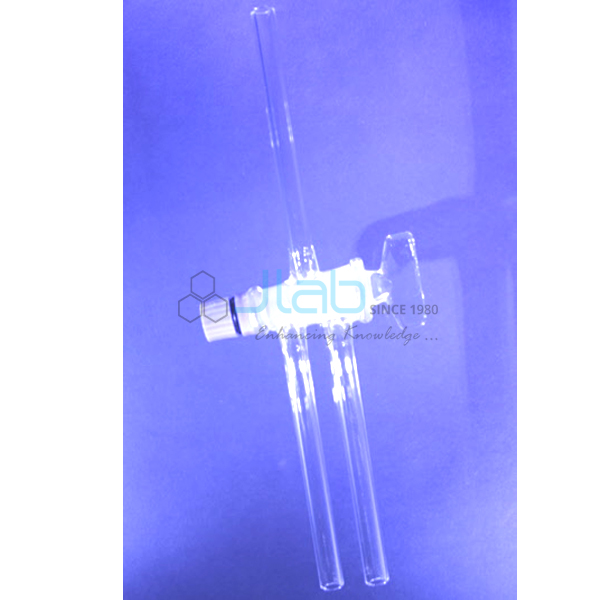
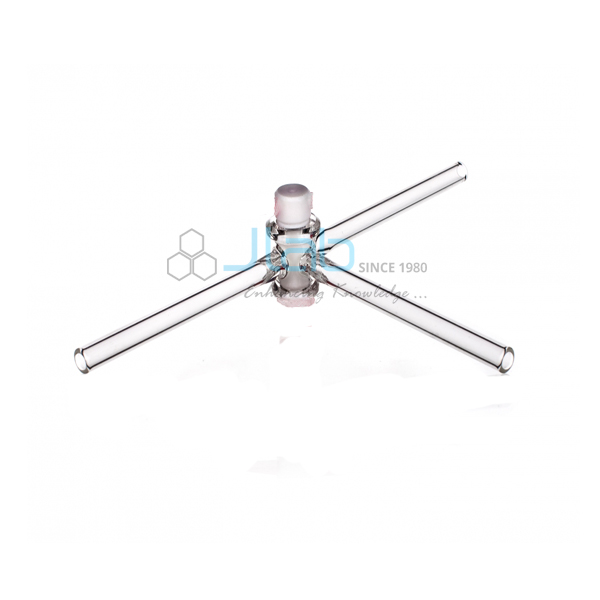
Valve Type Stopcocks, PTFE Key, Right Angle Manufacturer,Supplier and Exporter in India

Product Code : EL-SCSAS-1661
Jlab Export is a leading Valve Type Stopcocks, PTFE Key, Right Angle Manufacturer,and suppliers in India
On this stopcock the two arms leave the body at a right angle, so the valve can turn a line through a corner while it sets the flow. Its PTFE key screws in or out against a seat to give fine control. Sizes are 2 mm and 4 mm.
Specifications
| Type | Valve type, right angle |
| Key | PTFE |
| Sizes | 2 mm and 4 mm |
| Minimum order quantity | 50 units |
| Dispatch time | Usually 3–5 working days |
| Manufacturer | JLab (Jain Laboratory Instruments Pvt Ltd), Ambala, India |
Practicals with an Angled Valve
Some reactions in a Flasks, Round Bottom, Three Necks, Parallel Side Necks JLab run under a gentle flow of gas. The valve on the gas line sets a slow stream that students can count as bubbles at the outlet. Tubing from the valve runs to an Adapters - Cone and Rubber Tubing Straight Connection fitted in one side neck.
Teachers can open the valve fully and then close it in small steps while students watch the bubble rate fall. It shows how the rate changes with each part turn of the key.
Frequently Asked Questions
Why should the key not be forced down when closing?
The seal is made by the soft PTFE tip pressing on its seat. Turning hard past the point where the flow stops squashes the tip out of shape, and it may then never shut cleanly. Stop turning as soon as the drip stops.
What does the right angle change?
Only the layout. The inlet and outlet leave the body at a right angle, so the valve can take a supply from a vertical line and send it out sideways, or the reverse, without an extra bend. The flow control works just as on the straight valve.
Why does the flow slowly fall even though the key has not moved?
At low settings the gap at the tip is very small, so fine solids, crystals or a fibre can partly block it. Filter or settle the liquid before it reaches the valve, and open the key fully for a moment to flush the gap.
Why does a drip continue after the valve is closed?
Usually there is grit or a scratch on the seat, or the tip has been squashed by overtightening. Take the key out, rinse both parts and look at the tip. A clean, undamaged tip closes against the seat with light hand pressure.
Straight Valves and Other Stopcocks
- Valve Type Stopcocks, PTFE Key (straight form)
- T Bore Stopcocks, Borosilicate Glass, PTFE Key
- Stopcocks, Glass Key, Straight Through
For a quote, use Add To Cart or send us a message through the contact page.
Last updated: 14 November 2026