
World Types of Soil Manufacturer,Supplier and Exporter in India
Product Code : EL-GE-7468
Jlab Export is a leading World Types of Soil Manufacturer,and suppliers in India
World Types of Soil (code EL-GE-7468) is a reference collection of 19 soil groups from the world soil classification system, with 100 mL of each soil supplied air-dried and sieved. Geography, soil science and agriculture classes use it to compare soils formed under very different climates and parent materials, from tundra Cryosols to tropical Ferralsols and Nitisols. It is made by Jain Laboratory Instruments Pvt Ltd (JLab) at its works in Ambala, India.
Specifications
| Parameter | Detail |
|---|---|
| Contents | 19 soil groups from the world soil classification system |
| Amount of each soil | 100 mL |
| Preparation | Air-dried and sieved |
| Quality check | Each collection is visually inspected before dispatch |
| Pack quantity | Each (sold individually) |
| Minimum order quantity | 10 units |
| Dispatch time | Usually 7–10 working days |
| Product code | EL-GE-7468 |
| Manufacturer | Jain Laboratory Instruments Pvt Ltd (JLab) — OEM |
| Country of origin | India (made in Ambala, Haryana) |
Which Soil Groups Are in the Collection?
| Soil group | Description |
|---|---|
| Acrisols | Clay-rich, red |
| Arenosols | Sand soil with little organic material |
| Andosols | Pumice dust soil |
| Cambisols | Silt soil from a floodplain |
| Cryosols | Soil from the tundra region, glacial till |
| Calcisols | Soil with an accumulation of secondary calcium carbonate |
| Chernozems | Black earth |
| Durisols | Soil with a hardened layer cemented by secondary silica (a duripan) |
| Ferralsols | Bauxitic soil |
| Fluvisols | Silt deposited by a river or lake (gravel) |
| Gleysols | Grey, mottled clay |
| Gypsisols | Gypsum-rich soil |
| Histosols | Peaty, organic-rich soil |
| Leptosols | Very shallow soil over hard rock or in unconsolidated, very gravelly material |
| Lithosols | Mainly parent material |
| Podzols | Acid soil with a bleached grey layer over a subsoil where humus, iron and aluminium accumulate (general description of the group) |
| Nitisols | Homogeneous, clay-rich soil of the Kenyan highland type |
| Plinthosols | Wet soil with an irreversibly hardening mixture of iron, clay and quartz in the subsoil |
| Phaeozems | Black soil with a chalky parent material |
How Does It Compare with Other JLab Soil Sets?
| Set | Samples | Basis | Amount of each |
|---|---|---|---|
| World Types of Soil (EL-GE-7468) | 19 groups | World soil classification system | 100 mL, air-dried and sieved |
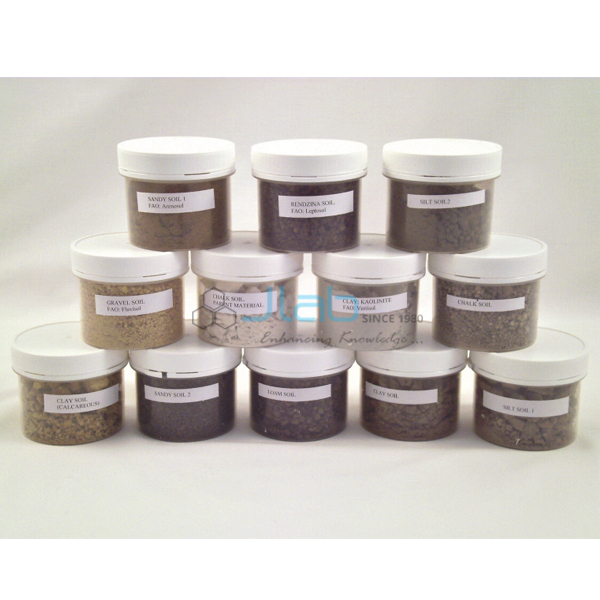
| Types of Soil | 12 | Common soil types, including chalk, rendzina, kaolinite clay and paired silt, clay and sandy soils | 15 mL, air-dried and sieved |
| Advanced Soil Kit | 6 | Clay, calcareous, loam, gravel, peat-loam and sandy soil, with teaching notes | 0.5 kg labelled bag |
| Soil Kit | 4 | Peat-loam, clay, sandy and calcareous soil | Not stated in its listing |
Choose World Types of Soil when a course follows the international soil groups and needs a reasonable amount of each soil. Types of Soil covers everyday texture types in smaller amounts, and the Advanced Soil Kit and Soil Kit suit introductory lessons on a handful of common soils.
What Is the World Types of Soil Collection Used For?
Soil groups in the world classification reflect the climate, vegetation, parent material and drainage under which each soil formed, and this collection puts those contrasts on one bench. Students can set Cryosols from the permafrost tundra against Ferralsols, the deeply weathered iron- and aluminium-rich soils of the humid tropics; compare the humus-rich black Chernozems of temperate grasslands with peaty Histosols and waterlogged, grey Gleysols; and see how shallow Leptosols differ from deep, clay-rich Nitisols. It supports soil and natural-region topics in school geography, and soil science, agriculture and environmental science courses at college level.
Three groups are defined by what has built up in them: Calcisols hold secondary calcium carbonate, Gypsisols hold gypsum, and Durisols have a layer cemented hard by secondary silica. A drop of dilute hydrochloric acid makes carbonate fizz, while gypsum and silica do not, which gives students a simple test to tell them apart. The 100 mL samples are large enough for colour, texture and hand-lens work; keep each soil separate and clearly labelled so that samples are not mixed.
What to Specify When Ordering
- Number of collections — the minimum order is 10.
- Labelling and packing — state any labelling or packing requirements, for example for a tender or for export.
- Companion items — sieves, soil pH test paper or the smaller soil sets can go on the same enquiry.
Frequently Asked Questions
Which soil groups are in the collection?
Acrisols, Arenosols, Andosols, Cambisols, Cryosols, Calcisols, Chernozems, Durisols, Ferralsols, Fluvisols, Gleysols, Gypsisols, Histosols, Leptosols, Lithosols, Podzols, Nitisols, Plinthosols and Phaeozems — 19 groups in all.
How much of each soil is supplied?
100 mL of each soil, air-dried and sieved, which is enough for examination and simple classroom tests.
What are Durisols?
Soils with a hardened layer cemented by secondary silica, known as a duripan, found mainly in dry regions. They are not gypsum soils — soils in which gypsum accumulates are Gypsisols, which the collection also includes.
How can students tell Calcisols from Gypsisols?
Calcisols contain secondary calcium carbonate, which fizzes with dilute hydrochloric acid; Gypsisols are rich in gypsum, which does not. The acid test is a quick way to separate the two.
Are Podzols and Nitisols separate samples?
Yes. They are two different soil groups: Podzols are acid soils with a bleached layer over a humus- and iron-enriched subsoil, and Nitisols are deep, clay-rich soils of the Kenyan highland type.
How does it differ from the Types of Soil set?
World Types of Soil follows the world soil classification with 19 groups at 100 mL each; Types of Soil has 12 smaller 15 mL samples of common soil types.
What should an export enquiry include?
The number of collections, destination country and port or city, delivery terms such as FOB or CIF, labelling or packing needs and any tender reference. Soil imports are regulated in many countries, so check your local rules first.
Who manufactures World Types of Soil?
Jain Laboratory Instruments Pvt Ltd, trading as JLab, at its works in Ambala, Haryana, India.
OEM Manufacturer
JLab is the trading name of Jain Laboratory Instruments Pvt Ltd, an Indian manufacturer of geography, earth science and laboratory teaching equipment, incorporated in 2017 and based on Hargolal Road, Ambala, Haryana. The collection is put together at JLab’s own works instead of being bought from a trader, so schools, universities, dealers and importers buy direct from the maker, each collection is visually checked before dispatch, and repeat orders are handled by the manufacturer. The company is an MSME-registered manufacturing enterprise (Udyam UDYAM-HR-01-0003849) and trades internationally under Importer-Exporter Code 3317504552. Buyers anywhere can order — JLab ships to every region, for example Ghana in West Africa, Malawi in East Africa, Bhutan in South Asia, South Korea in East Asia and Samoa in Oceania. For tender purchases see the JLab lab tenders page.
Related Soil Study Items
- Types of Soil — 12 smaller samples of common soil types for texture comparison.
- Advanced Soil Kit — bagged samples of the main soil types with teaching notes.
- Soil Kit — peat-loam, clay, sandy and calcareous soils for introductory lessons.
- Sieves — a sieve set with bottom pan and lid for separating soil by particle size.
- Soil pH Test Paper — for measuring soil pH.
Browse the Geology Equipment range or all Geography Lab Models.
Request a Quote
Quotes come directly from the manufacturer. Use the Add To Cart enquiry button on this page, or send the number of collections (minimum 10 units), any labelling needs and your delivery location through the contact page.
Last updated: 3 October 2026