Advanced Fibre Optics Trainer Manufacturer,Supplier and Exporter in India
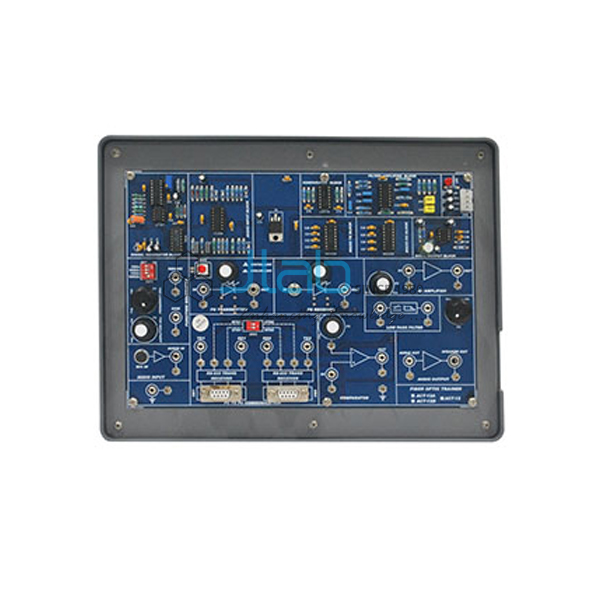
Product Code : EL-PET-10227
Jlab Export is a leading Advanced Fibre Optics Trainer Manufacturer,and suppliers in India
Advanced Fibre Optics Trainer (code EL-PET-10227) is a two-channel fibre optic communication trainer with LED transmitters at 660 nm and 950 nm and two photodetector receivers. Beyond basic analog and digital links it carries PCM through a codec IC, 16-channel TDM with Manchester coding, bit error rate measurement and a two-channel voice link. Jain Laboratory Instruments Pvt Ltd (JLab) manufactures the trainer at its Ambala works.
Specifications
| Parameter | Detail |
|---|---|
| Signal generators | Sine wave, 1 Hz to 10 kHz, amplitude adjustable; square wave (TTL) |
| Transmitters | Two fibre optic LEDs, peak emission wavelengths 660 nm and 950 nm |
| Receivers | Two fibre optic photodetectors |
| On-board circuits | Analog and digital drivers; AC amplifiers; comparator |
| Clock generator | 32K, 64K, 128K and 1M outputs |
| Test signal sources | 16-bit PRBS generator; white noise generator output |
| PCM | PCM modulation and demodulation using a codec IC |
| TDM | 16-channel TDM multiplexing and demultiplexing, with Manchester coding and decoding |
| Bit error rate measurement | 8-bit counter with LED indication, up to a count of 255 |
| Filter | 4th-order Butterworth, 3.4 kHz cut-off frequency |
| Voice link | Two-channel voice link using phone and speaker (A-law) |
| PC link | Serial PC-to-PC link through a 9-pin D-type connector |
| Quality check | Each trainer is visually inspected before dispatch |
| Pack quantity | Each (sold individually) |
| Minimum order quantity | 10 units |
| Dispatch time | Usually 7–10 working days |
| Product code | EL-PET-10227 |
| Manufacturer | Jain Laboratory Instruments Pvt Ltd (JLab) — OEM |
| Country of origin | India (made in Ambala, Haryana) |
How Does It Compare with Other JLab Fibre Optic Trainers?
| Trainer | Transmitters | Receivers | Filter |
|---|---|---|---|
| This trainer (EL-PET-10227) | Two LEDs, 660 nm and 950 nm | Two photodetectors | 4th-order Butterworth, 3.4 kHz |
| Advanced Fiber Optics Trainer (full duplex, AM/FM/PWM) | Two LEDs, 660 nm and 950 nm | Two photodetectors | Two, 4th-order Butterworth, 3.4 kHz |
| Fiber Optic Trainer | One LED, 660 nm | One photodetector | 4th-order Butterworth, 3.4 kHz |
| Laser Fiber Optic Trainer | One laser fibre optic LED, 660 nm | One photodetector | 4th-order Butterworth, 3.4 kHz |
Both advanced trainers use the same pair of wavelengths. This one has PCM, TDM with Manchester coding and bit error rate counting; the Advanced Fiber Optics Trainer covers AM, FM and PWM links instead. Both have a voice link and a serial PC-to-PC link. The Fiber Optic Trainer and the Laser Fiber Optic Trainer each have a single 660 nm transmitter and one receiver.
What Is the Advanced Fibre Optics Trainer Used For?
It is used for optical communication practicals that go past a single analog link into the digital techniques of real fibre systems: sampling and coding speech with PCM, sharing one link among many channels by time-division multiplexing, and judging link quality by counting bit errors. The second transmitter and receiver let two channels run side by side, and the 660 nm and 950 nm sources show how a link behaves with visible red and with near-infrared light.
Frequently Asked Questions
What does the codec IC do in the PCM section?
It samples the analog signal, quantises each sample and codes it as a binary word for transmission, then does the reverse at the receiving end. The voice link uses A-law, a companding law that gives quiet sounds finer quantising steps than loud ones.
Why is Manchester coding used with the TDM section?
Manchester coding puts a transition in the middle of every bit, so the receiver can recover the clock from the data itself and the signal carries no DC component. Staying in step matters when sixteen channels share one stream and each must be picked out again at the right moment.
How is the bit error rate found?
Errors in the received data are counted on the 8-bit counter and shown on LEDs; dividing the error count by the number of bits sent gives the bit error rate. A pseudo-random sequence, such as the one from the on-board PRBS generator, is the usual test pattern because it exercises many bit combinations.
What should an export quotation request include?
The number of trainers, the destination country and port or city, the delivery terms you want (for example FOB or CIF), any packing or labelling instructions and the tender reference if the purchase is for a tender.
OEM Manufacturer
JLab is the trading name of Jain Laboratory Instruments Pvt Ltd, a manufacturer of electronics and communication trainers in India, incorporated in 2017 and based on Hargolal Road, Ambala, Haryana. This trainer is built in JLab’s own works and not sourced from a trader, so colleges, dealers and importers buy it from the manufacturer and return to the same maker for repeat orders. JLab exports worldwide and ships to buyers in every region — for example Finland in Northern Europe, Angola in Central Africa, Kuwait in the Middle East, Croatia in Southern Europe and Canada in North America. Tender buyers can refer to the JLab lab tenders page.
Related Trainers and Instruments
- Elementary Fiber Optics Trainer — a simplex 660 nm trainer with AM, FM and PWM modulation and a voice link.
- Data Communication Trainer — fibre, infrared and FSK modem links with three error-control protocols.
- Dual Trace Oscilloscope — a dual-channel oscilloscope for viewing two waveforms at once.
More trainers are listed in Power Electronics Trainers and Electronics Lab Equipments.
Request a Quote
Ask for a quotation through the Add To Cart button on this page or the contact page, giving the number of trainers and the delivery destination.
Last updated: 22 October 2026