Aerosol Impact Respiratory System Model Manufacturer,Supplier and Exporter in India
Product Code : EL-BE-6156
Jlab Export is a leading Aerosol Impact Respiratory System Model Manufacturer,and suppliers in India
Aerosol Impact Respiratory System Model (code EL-BE-6156) is a teaching model on what happens when we breathe in aerosols — fine solid or liquid particles suspended in air, such as dust, smoke, pollen, sprays and respiratory droplets — and how the airways try to clear them. It suits biology, physiology and environmental-science teaching. Jain Laboratory Instruments Pvt Ltd (JLab) manufactures it at its Ambala works in India.
Specifications
| Parameter | Detail |
|---|---|
| Topic | Impact of inhaled aerosols on the respiratory system |
| Suggested level | Class 11 and 12 biology (respiratory disorders, air pollution); college physiology, environmental science and health education |
| Parts, labels, size and material | Not recorded in the listing — ask for a description and photo |
| Quality check | Each model is visually inspected before dispatch |
| Pack quantity | Each (sold individually) |
| Minimum order quantity | 10 units |
| Dispatch time | Usually 7–10 working days |
| Product code | EL-BE-6156 |
| Manufacturer | Jain Laboratory Instruments Pvt Ltd (JLab) — OEM |
| Country of origin | India (made in Ambala, Haryana) |
What Is the Aerosol Respiratory Model Used For?
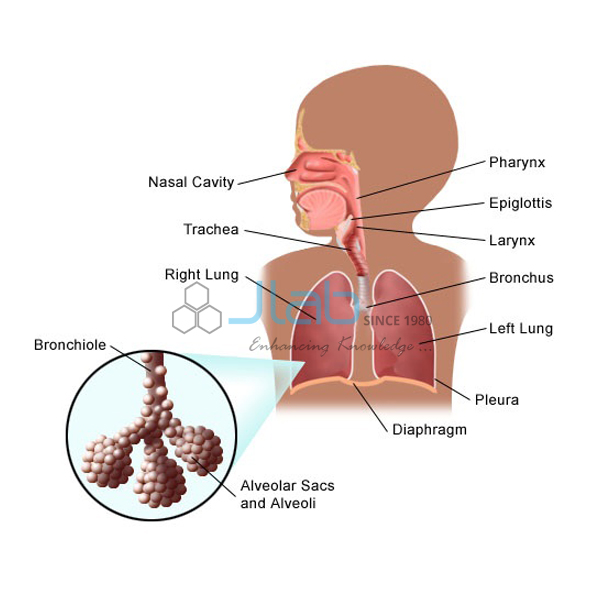
It helps teachers show that where a particle ends up depends mainly on its size. Larger particles cannot follow the bends of the nose and throat and stick there by impaction; medium-sized ones settle out in the bronchi and bronchioles; and the finest particles travel deep into the alveoli, where they can pass close to the blood. The body’s defences match these zones — nasal hairs and mucus trap particles, cilia sweep the mucus up to the throat (the mucociliary escalator), and alveolar macrophages engulf what reaches the air sacs.
The topic connects to class 11 lessons on respiratory disorders, including asthma, emphysema and the lung fibrosis caused by long exposure to dust in industries such as stone grinding, and to class 12 work on particulate air pollution. It can also open discussion of airborne infections such as tuberculosis and of inhaled medicines. The model is for teaching only.
Frequently Asked Questions
Why do fine particles cause more concern than coarse ones?
Fine particles escape the nose and upper airways and reach the alveoli, where clearance is slow, so they can irritate and damage the deepest parts of the lungs.
What parts and labels does the model have?
The listing does not record them, or the size and material; ask JLab for a description and photo.
Who manufactures it?
JLab, the trading name of Jain Laboratory Instruments Pvt Ltd, in its own works in Ambala, Haryana.
OEM Manufacturer
JLab is the trading name of Jain Laboratory Instruments Pvt Ltd, a manufacturer of biology lab equipment and human body teaching models in India, incorporated in 2017 and based on Hargolal Road, Ambala, Haryana. The model is made in JLab’s own works instead of being bought from a trader, so schools, colleges, dealers and importers buy direct from the maker, which also supplies repeat orders. Its company registration is CIN U29309HR2017PTC069123, and it holds MSME Udyam registration UDYAM-HR-01-0003849 as a manufacturing enterprise. JLab exports worldwide and ships to buyers in every region — for example Afghanistan in South Asia, Vanuatu in Oceania, Japan in East Asia, Peru in South America and Guinea in West Africa.
Related Respiratory Models
- Human Respiratory System Model — a labelled airway from nasal cavity to lungs.
- T.B. Infiltration in Lungs Model — lung damage from an airborne infection.
- Mononuclear Phagocyte System Model — the macrophages that clear inhaled particles.
- Lung Cancer Model — a disease linked with inhaled carcinogens.
Find more in the Biology Equipment category of JLab’s Biology Lab Equipment.
Request a Quote
Send quantity (10 units minimum), destination and any tender reference via the contact page, or press Add To Cart, for a quotation direct from the manufacturer.
Last updated: 4 October 2026