Anvil With Stand Manufacturer,Supplier and Exporter in India
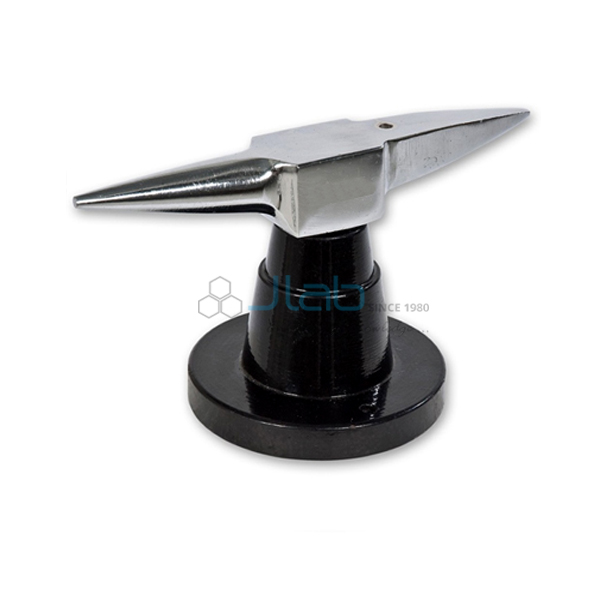
Product Code : EL-CLE-9082
Jlab Export is a leading Anvil With Stand Manufacturer,and suppliers in India
This anvil gives the workshop a solid steel face for hand forging, bending and straightening. It is about 600 mm long, weighs about 50 kg and is of all steel construction. It comes on a heavy cast iron stand, and the base measures 300 mm across overall.
Specifications
| Length | 600 mm |
| Weight | About 50 kg |
| Base width | 300 mm overall |
| Construction | All steel |
| Stand | Heavy cast iron |
| Use | Workshop |
| Minimum order quantity | 10 units |
| Dispatch time | Usually 4–6 working days |
| Manufacturer | JLab (Jain Laboratory Instruments Pvt Ltd), Ambala, India |
Workshop Practice at the Anvil
In an ITI or college smithy, students heat mild steel bar and draw it down to a square point. Other jobs are upsetting the end of a rod and bending a flat strip to a right angle over the anvil edge. Each bend is then checked with an Engineers Square.
Cold work at the anvil includes straightening bent rod and flattening strip with an Engineering Hammer. When a job is finished, students can mark it with a Figure Stamp Set, using the anvil as a firm backing.
Frequently Asked Questions
How heavy is the anvil?
It weighs about 50 kg and is about 600 mm long. A heavy anvil moves less under each blow, so more of the energy of the hammer goes into shaping the work.
What does the cast iron stand do?
The heavy stand raises the anvil off the floor to a working height. Its broad, steady base stops the anvil rocking or creeping when struck.
Can I cut metal on the anvil face with a chisel?
It is better not to. Cutting straight on the face can chip the chisel edge and mark the face. Cut over a scrap mild steel plate placed on the anvil, and keep the face smooth for straightening work. Avoid striking the bare face hard with the hammer too, as two steel faces meeting with nothing between them can chip.
What is the right working height for an anvil?
A common rule puts the anvil face level with the knuckles of the closed fist when the smith stands upright beside it. At that height the hammer lands flat at the bottom of a relaxed swing. A face that is too high tires the shoulder, and one that is too low strains the back.
Other Fitting and Smithy Tools
For a quote, use Add To Cart or send us a message through the contact page.
Last updated: 5 November 2026