e and m By Thomson Bar Magnet Method Manufacturer,Supplier and Exporter in India
Product Code : EL-EMA-1065
Jlab Export is a leading e and m By Thomson Bar Magnet Method Manufacturer,and suppliers in India
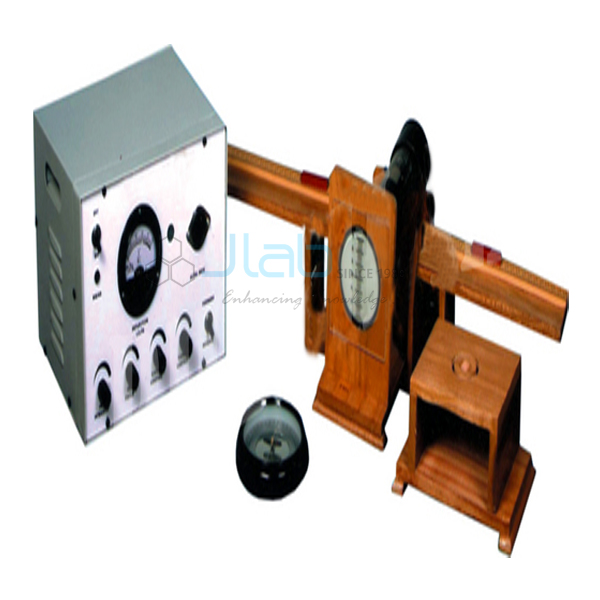
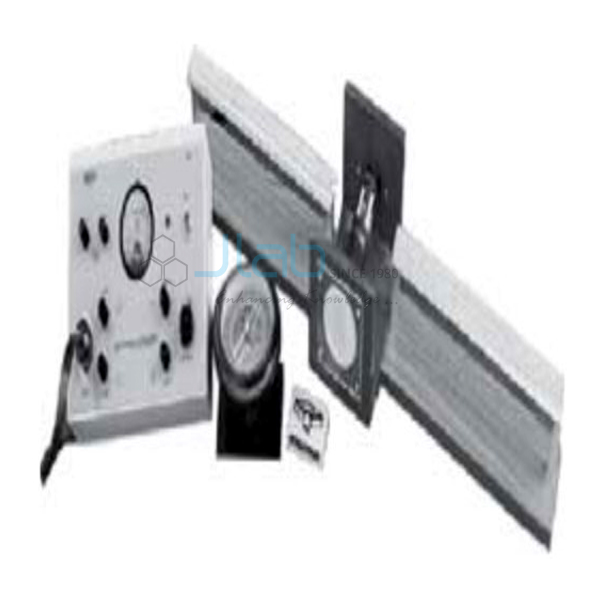
e and m By Thomson Bar Magnet Method (code EL-EMA-1065) is a physics lab apparatus for measuring e/m, the specific charge of the electron, by J. J. Thomson’s method, with a pair of bar magnets providing the magnetic field. A cathode ray tube on a centimetre-scaled wooden frame, an 800 V DC EHT supply and a deflection magnetometer are included. It is made by Jain Laboratory Instruments Pvt Ltd (JLab) at its works in Ambala, India.
Specifications
| Parameter | Detail |
|---|---|
| Experiment | To measure e/m of the electron by Thomson’s method (bar magnet method) |
| Principle demonstrated | Controlled bending of a stream of high-speed electrons in a magnetic field |
| EHT supply | 800 V DC, for the cathode voltage of the cathode ray tube |
| Deflecting supply | 0–100 V DC, applied to either the Y1 or the Y2 plates |
| Meters | Moving coil meters to measure the deflecting voltage |
| Cathode ray tube | Fitted on a wooden frame with a scale divided in centimetres |
| Magnetometer | Deflecting magnetometer with permanent magnetic compass, included |
| Also included | Compass stand and a pair of bar magnets |
| Quality check | Each apparatus is visually inspected before dispatch |
| Pack quantity | Each (sold individually) |
| Minimum order quantity | 10 units |
| Dispatch time | Usually 7–10 working days |
| Product code | EL-EMA-1065 |
| Manufacturer | Jain Laboratory Instruments Pvt Ltd (JLab) — OEM |
| Country of origin | India (made in Ambala, Haryana) |
How Does It Compare with Other JLab e/m Apparatus?
| Model | Magnetic field from | Tube and mounting | Readings provided |
|---|---|---|---|
| This apparatus (EL-EMA-1065) | A pair of bar magnets, measured with the deflecting magnetometer | Cathode ray tube on a wooden frame with centimetre scale | EHT 800 V DC; 0–100 V DC deflecting voltage on moving coil meters |
| e and m by Helical Method Solenoid Method | Standard multi-layer solenoid on a wooden base | Cathode ray tube movable inside the solenoid | High-resistance voltmeter; ammeter for solenoid current, coarse and fine control |
| e and m by Magnetic Focusing Method | Ring-type solenoid that slides over the tube | 3-inch CRT on a teak wood stand | Two meters: acceleration voltage and solenoid current |
| e and m by Short Solenoid Method Magnetron Method | Short solenoid | Magnetron that slides into the solenoid pipe | Two meters: anode voltage and solenoid current |
Choose this model when your practical list names Thomson’s method or the bar magnet method, or when you want students to see the beam bent by an electric field and a magnetic field acting together. The three solenoid-based units take the field from a measured coil current instead of permanent magnets, so they suit syllabi that specify the helical, magnetic focusing or magnetron method.
What Is the Thomson e/m Apparatus Used For?
The ratio of the electron’s charge to its mass, e/m, is one of the classic measurements of modern physics, and this set lets students make it themselves. The EHT supply accelerates electrons along the tube, a voltage on the deflecting plates moves the spot along the centimetre scale, and the two bar magnets, placed on either side of the tube, bend the beam the opposite way. When the magnets are positioned so the two deflections cancel, the electrons’ speed equals the ratio of the electric field to the magnetic field; the deflection produced by the electric field alone, with the plate voltage and tube dimensions, then gives e/m. To find the magnetic field, the tube is replaced by the deflection magnetometer at the same spot, with the magnets left in place, and the compass deflection is compared with the horizontal component of the Earth’s field.
The experiment is a standard specific charge electron experiment in B.Sc. physics practicals and engineering physics labs, and it also makes a strong demonstration of electron deflection when senior secondary classes study J. J. Thomson’s work. Set the frame and magnetometer up in the orientation your practical manual gives relative to the magnetic meridian, keep steel tools, other magnets and the mains supply away from the compass while reading it, and remember that the 800 V EHT output is dangerous: switch off before changing any connection.
What to Specify When Ordering
- Quantity — the minimum order is 10 units; most labs plan one set per bench or per student group.
- Mains supply of your lab — the listing does not state the mains input, so give your voltage and plug type for the quotation to confirm.
- Spare bar magnets or an extra deflection magnetometer — both are separate catalogue items and can go on the same enquiry.
- Other e/m methods — if your syllabus also lists the helical, magnetic focusing or magnetron method, ask for those units together.
Frequently Asked Questions
What does this apparatus measure?
The specific charge of the electron, e/m, by Thomson’s crossed-field method. A pair of bar magnets supplies the magnetic field and the deflecting plates supply the electric field that act on the electron beam in the cathode ray tube.
Which power supplies and meters are built in?
An EHT supply of 800 V DC provides the cathode voltage for the tube, and a 0–100 V DC supply provides the deflecting voltage on either the Y1 or the Y2 plates. Moving coil meters measure the deflecting voltage.
How is the magnetic field of the bar magnets measured?
With the deflecting magnetometer and compass that come with the set. The magnets stay where they balanced the beam, the tube is replaced by the magnetometer, and the field equals the horizontal component of the Earth’s field multiplied by the tangent of the compass deflection.
What result should students compare their value with?
The accepted value of e/m for the electron is about 1.76 × 10¹¹ coulombs per kilogram. How close a class gets depends on careful alignment, reading the spot on the centimetre scale and an accurate value for the Earth’s horizontal field.
How is it different from the solenoid-based e/m apparatus?
This unit bends the beam with permanent bar magnets and measures their field with a magnetometer. The helical, magnetic focusing and short solenoid units, listed separately, produce the field with a solenoid and calculate it from the solenoid current shown on their meters.
What is included with the apparatus?
The listing includes the power supply with its meters, the cathode ray tube on its scaled wooden frame, the deflecting magnetometer with compass, a compass stand and a pair of bar magnets. Additional magnets or magnetometers are separate items.
What should an export quotation request include?
Send the quantity, the destination country and port or city, the delivery terms you prefer (for example FOB or CIF), any packing or labelling requirements, and the tender reference if the purchase is for a tender.
Who manufactures this e/m apparatus?
Jain Laboratory Instruments Pvt Ltd, trading as JLab, builds it at its works in Ambala, Haryana, India, and quotes for it directly as the manufacturer.
OEM Manufacturer
JLab is the trading name of Jain Laboratory Instruments Pvt Ltd, a physics lab instruments manufacturer in India, incorporated in 2017 and based on Hargolal Road, Ambala, Haryana. The Thomson e/m apparatus, from its power supply to its scaled tube frame, is assembled at JLab’s own works rather than bought from a trader, so universities, colleges, dealers and importers buy it factory-direct; every set is visually inspected before dispatch, and repeat orders and replacement parts are handled by the manufacturer. JLab exports worldwide and ships to buyers in every region — for example Estonia in Northern Europe, Senegal in West Africa, Bhutan in South Asia, Laos in Southeast Asia and Costa Rica in Central America and the Caribbean. Departments buying through a tender will find details on the JLab lab tenders page.
Related Electron Physics Apparatus
- Millikan’s Oil Drop Apparatus — measures the charge on the electron, which together with e/m gives the electron’s mass.
- e and m by Magnetic Focusing Method — e/m with a ring-type solenoid sliding over a CRT.
- e and m by Helical Method Solenoid Method — e/m with the tube inside a standard multi-layer solenoid.
- e and m by Short Solenoid Method Magnetron Method — e/m with a magnetron in a solenoid.
- Deflection Magnetometer — a removable compass box on a wooden base with a metre scale, as a spare for field measurements.
- Bar Magnets — sold in pairs with keepers and marked north and south poles.
See every unit in the E M Apparatus range or the wider Scientific Instrument range.
Request a Quote
Quotes come direct from the manufacturer. Use the Add To Cart enquiry button on this page, or send the quantity (minimum 10 units), your mains voltage, any spare magnets or magnetometers you need and the delivery location through the contact page.
Last updated: 9 October 2026