Earth Shakes Manufacturer,Supplier and Exporter in India
Product Code : EL-GE-7276
Jlab Export is a leading Earth Shakes Manufacturer,and suppliers in India
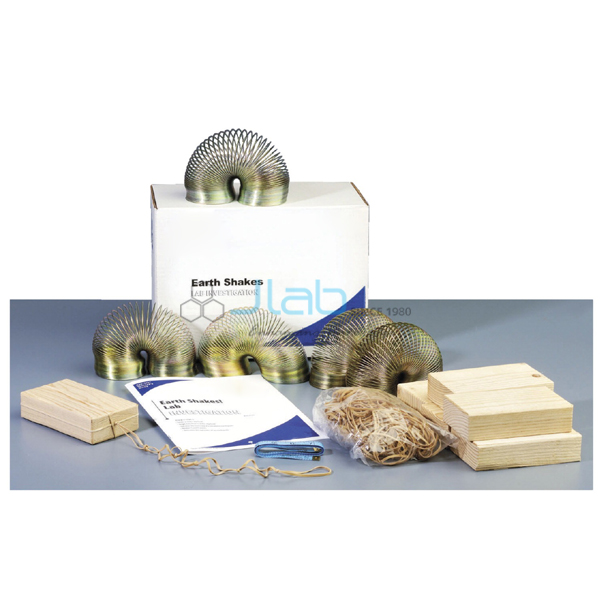
Earth Shakes (code EL-GE-7276) is an interactive earthquake activity set used to simulate and demonstrate the power of an earthquake in school geography and earth science lessons. Students act out P waves and S waves, model a strike-slip fault, and finish with a puzzle in which they locate the epicentre of an earthquake. It is made by Jain Laboratory Instruments Pvt Ltd (JLab) at its works in Ambala, India.
Specifications
| Parameter | Detail |
|---|---|
| Type | Interactive, activity-based earthquake set |
| Purpose | Simulates and demonstrates the power of an earthquake |
| Seismic wave activity | Students demonstrate S waves and P waves, then take the role of a wave in an “earth shake” |
| Fault activity | Students model a strike-slip fault and see its possible destruction as the plate slips to relieve pressure |
| Puzzle | Students use what they have learned to locate the epicentre of an earthquake |
| Learning aim | Understanding the forces that cause earthquakes |
| Quality check | Each set is visually inspected before dispatch |
| Pack quantity | Each (sold individually) |
| Minimum order quantity | 10 units |
| Dispatch time | Usually 7–10 working days |
| Product code | EL-GE-7276 |
| Manufacturer | Jain Laboratory Instruments Pvt Ltd (JLab) — OEM |
| Country of origin | India (made in Ambala, Haryana) |
What Is Earth Shakes Used For?
An earthquake cannot be shown on a bench, so Earth Shakes has students produce the motion themselves. They first demonstrate the two body waves: P (primary) waves are compressional, travel fastest and push the ground back and forth along their path, while S (secondary) waves are shear waves that move the ground at right angles to their path, arrive later and cannot pass through liquids. Each student then becomes a wave in an “earth shake”. The fault activity models a strike-slip fault, where two blocks of crust slide horizontally past each other; stress builds until the plate slips to relieve it, and students see the destruction that slip can cause.
The closing puzzle asks students to locate the epicentre — the point on the surface directly above where the rupture begins. Seismologists do this from recordings: because P waves outrun S waves, the delay between their arrivals tells a station how far away the earthquake was, and the distances from three stations fix the epicentre. Earth Shakes suits earthquake units in middle-school science and geography and the earthquake-waves topic of the class 11 NCERT physical geography book.
What to Specify When Ordering
- Number of sets — the minimum order is 10.
- Contents list — request it before ordering if you need to match the set to a tender or a syllabus.
- Companion aids — fault models, a seismograph model or an earthquake chart can go on the same enquiry.
Frequently Asked Questions
What do students do with Earth Shakes?
They demonstrate S waves and P waves, take the role of a wave in an earth shake, model a strike-slip fault and its possible destruction, and then solve a puzzle to locate the epicentre of an earthquake.
What does the epicentre puzzle teach?
It asks students to apply what they learned about seismic waves and faults to find where an earthquake started at the surface. The epicentre is the point on the ground directly above the place where the rupture begins.
Which components are in the set?
The listing describes the activities but not the components or their quantities. Ask JLab for the contents list when you request a quotation.
Why do P waves arrive before S waves?
P waves are compressional and travel faster through rock; S waves are shear waves, travel more slowly and pass only through solids. The gap between the two arrivals grows with distance from the earthquake.
How does a strike-slip fault produce an earthquake?
The two sides of the fault are pushed horizontally in opposite directions but stay locked by friction. Stress builds until the rock slips suddenly, releasing energy as seismic waves — the slip students model in this set.
What should an export enquiry include?
The quantity, destination country and port or city, delivery terms such as FOB or CIF, any packing or labelling instructions and a tender reference if one applies.
Who manufactures Earth Shakes?
Jain Laboratory Instruments Pvt Ltd, trading as JLab, makes it at its works in Ambala, Haryana, India, and quotes for it directly.
OEM Manufacturer
Earth Shakes comes from Jain Laboratory Instruments Pvt Ltd, trading as JLab — a manufacturer of geography and earth science teaching equipment in India, incorporated in 2017 and located on Hargolal Road, Ambala, Haryana. The sets are produced at JLab’s own works rather than sourced from a trader, so schools, colleges, dealers and importers deal with the maker directly, each set is checked by eye before it ships, and repeat orders stay with the manufacturer. JLab holds MSME Udyam registration UDYAM-HR-01-0003849 as a manufacturing enterprise and exports under Importer-Exporter Code 3317504552. Its export reach covers every region, with buyers in places such as Nepal in South Asia, Oman in the Middle East, Gambia in West Africa, Congo in Central Africa and El Salvador in Central America and the Caribbean. Tender buyers can see the JLab lab tenders page.
Earthquake and Fault Teaching Aids
- Seismograph Model For Earth Science Lab — shows how the intensity of earthquakes is measured.
- Normal Fault Model — the hanging wall moves down relative to the footwall, a fault linked to crustal tension.
- Reverse Fault Model — the hanging wall moves up relative to the footwall under crustal compression.
- Earthquake Chart — a laminated chart in combined English and Hindi.
- Earthquakes Whiteboard Science — a whiteboard lesson on seismic waves, faults, stress and earthquake measurement.
Browse the Geology Equipment range or all Geography Lab Models.
Request a Quote
JLab quotes for Earth Shakes as the manufacturer. Press the Add To Cart enquiry button on this page, or send the number of sets (minimum 10), whether you need the contents list in advance and your delivery location through the contact page.
Last updated: 3 October 2026