Electric Shock Treatment Chart Manufacturer,Supplier and Exporter in India
Product Code : EL-FAC-3080
Jlab Export is a leading Electric Shock Treatment Chart Manufacturer,and suppliers in India
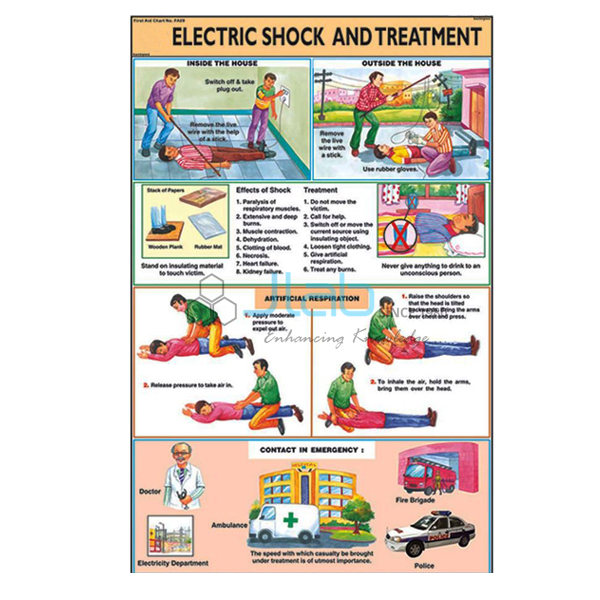
An electric shock treatment chart is a first-aid wall chart that shows what to do when someone gets an electric shock. This one (बिजली के झटके का उपचार चार्ट in Hindi) covers how to free a person from live wires, the treatment to give and whom to contact for help. It measures 50 x 75 cm, is laminated on both sides and hangs from plastic rollers.
Specifications
| Covers | How to remove live wires, treatment and whom to contact |
| Size | 50 x 75 cm |
| Finish | Laminated with thick plastic film on both sides |
| Hanging | Fitted with plastic rollers |
| Editions | English and Hindi combined, or English only |
| Minimum order quantity | 10 units |
| Dispatch time | Usually 4–6 working days |
| Manufacturer | JLab (Jain Laboratory Instruments Pvt Ltd), Ambala, India |
Rescue Drills for Students and Trainees
In an ITI electrician practical, trainees practise safe working on a switched-off training board and then run a rescue drill. One trainee plays the casualty holding a dead wire while another finds the main switch and turns it off. Where the switch is out of reach, the rescuer moves the wire away with a dry wooden stick and touches the casualty only once the wire is clear.
The drill ends with the treatment steps on the chart. Trainees open the First Aid Kit Box to check what it holds and practise chest compressions on a CPR Training Manikin. School science labs can run a shorter version of the same drill beside their main switchboard.
Frequently Asked Questions
Where should the chart be displayed in a workshop or substation?
In plain view near the main switchboard or panel, at eye level, where anyone running to help will see it. Keep it clear of doors that swing across it and cabinets that hide it. On a large site, a second copy at the first-aid point helps.
What should be kept beside the chart?
A stocked first-aid box, the name of a trained first aider on each shift, and local emergency numbers written next to the whom-to-contact part of the chart. A dry wooden stick kept near the main switch also helps, so nobody has to search for one in an emergency.
Why must the supply be switched off before the person is touched?
While current is flowing, the casualty is part of the circuit, so a rescuer who touches them can get a shock as well. Turning off the main switch or pulling out the plug breaks the circuit. Only then is it safe to touch and move the person.
What can be used to move a live wire if the switch cannot be reached?
Use something dry that does not conduct electricity, such as a wooden stick or a plastic pipe, and stand on dry wood or a rubber mat if possible. Never use anything metal or wet. Push the wire away from the person rather than pulling the person off it.
More First-Aid Wall Charts
- Burns and Scalds Chart
- Emergency Resuscitation Chart
- Outline of First Aid and Appliances Chart
- Artificial Respiration Chart
For a quote, use Add To Cart or send us a message through the contact page.
Last updated: 15 November 2026