Electrostatic Kit Manufacturer,Supplier and Exporter in India
Product Code : EL-SLE-5781
Jlab Export is a leading Electrostatic Kit Manufacturer,and suppliers in India
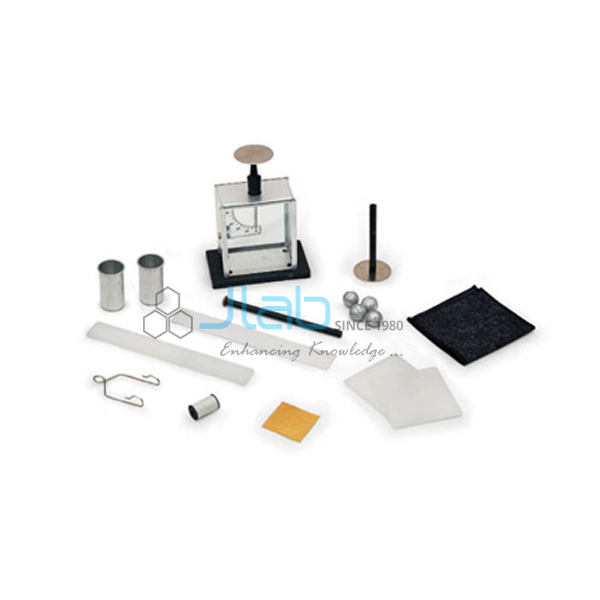
Electrostatic Kit (code EL-SLE-5781) is a set of apparatus for teaching static electricity — charging by rubbing, attraction and repulsion, induction and charge transfer — in school and college physics labs. It combines an electroscope with a packet of metal leaves, an electrophorus, a proof plane, two aluminium cans, charging strips, ten pith balls and an instruction manual. It is made by Jain Laboratory Instruments Pvt Ltd (JLab) at its works in Ambala, India.
Specifications
| Parameter | Detail |
|---|---|
| Electroscope | One |
| Metal leaves | One packet |
| Metalized spheres | 4 |
| Nylon thread | 1 reel |
| Polythene plates | Two, 75 x 75 mm |
| Glass plates | Two, 75 x 75 mm |
| Electrophorus | One electrophorus plate with insulating handle |
| Proof plane | 1 |
| Aluminium cans | Two |
| Charging strips | One cellulose acetate strip and 1 polythene strip |
| Stirrup | One, for suspending strips |
| Flannel rubber | One |
| Wire hook | One |
| Pith balls | 10, of different sizes |
| Instruction manual | Included |
| Quality check | Each kit is visually inspected before dispatch |
| Pack quantity | Each kit (sold individually) |
| Minimum order quantity | 10 units |
| Dispatch time | Usually 7–10 working days |
| Product code | EL-SLE-5781 |
| Manufacturer | Jain Laboratory Instruments Pvt Ltd (JLab) — OEM |
| Country of origin | India (made in Ambala, Haryana) |
How Does It Compare with Other JLab Electrostatic Kits?
| Kit | Electroscopes | Charge sources and conductors | Other listed contents |
|---|---|---|---|
| This kit (EL-SLE-5781) | One electroscope, plus a packet of metal leaves | Electrophorus plate on insulating handle, proof plane, two aluminium cans, polythene and cellulose acetate strips, flannel rubber | Metalized spheres, pith balls of different sizes, nylon thread, polythene and glass plates, stirrup, wire hook, instruction manual |
| Electrostatic Kit (physics lab range) | One electroscope | Electrophorus on handle, proof plane, two aluminium cans, polythene and cellulose acetate strips, rubber cloth | Metalized polystyrene spheres, nylon reel, polythene tiles, wire stirrup, wire hook |
| Electrostatic Kit Complete JLab | Pointer, gold-leaf, silk braid and spin electroscopes | Faraday cage, cylinder, semi-sphere and cone conductors, proof ball, acrylic and polythene rods, nylon and silk cloths | Manual with a theory section and sample demonstrations |
Choose this kit for student practical work on charging by friction and charge transfer when you also want spare metal leaves, pith balls and glass plates in the kit. The physics lab range kit lists a similar core without the leaves, glass plates or pith balls, while the Complete kit is a larger demonstration set with several types of electroscope and shaped conductors.
What Is the Electrostatic Kit Used For?
The kit covers the core experiments of static electricity. Rubbed with the flannel, the polythene strip gains a negative charge and the cellulose acetate strip a positive one; hang one strip in the stirrup and bring the other near to show that unlike charges attract, or use two strips of the same material to show repulsion. The pith balls and metalized spheres hang on the nylon thread for attraction, repulsion and induction tests, and the electroscope shows whether an object is charged. With the electrophorus, a charge is induced on the plate from a charged polythene plate and can be drawn off again and again, while the proof plane carries small samples of charge to the electroscope — with an aluminium can it shows that charge on a hollow conductor sits on its outer surface. These activities support middle-school lessons on charging by rubbing (class 8) and class 12 work on electric charges and fields, as well as college electrostatics practicals.
Static experiments are most reliable in dry air: humidity lets charge leak away, so keep the strips, cloth and plates clean and dry, and warm them gently on damp days. Handle the electrophorus and proof plane only by their insulating handles, and store the metal leaves flat in their packet so they do not crease.
What to Specify When Ordering
- Number of kits — the minimum order is 10 kits.
- Electroscope — the listing does not state its type or size; ask for these details, or a photograph, with your quotation.
- Extra consumables — if you want more metal leaves, pith balls or nylon thread for later classes, list the quantities.
- Additional apparatus — a gold leaf electroscope, friction rods or a proof plane for each bench are separate items and can be added to the same enquiry.
Frequently Asked Questions
What is the electrostatic kit used for?
Teaching static electricity by experiment: charging by rubbing, attraction and repulsion between charges, charging by induction with the electrophorus, and detecting and transferring charge with the electroscope and proof plane.
What does the kit contain?
One electroscope, a packet of metal leaves, 4 metalized spheres, a reel of nylon thread, two polythene and two glass plates (75 x 75 mm), an electrophorus plate with insulating handle, a proof plane, two aluminium cans, cellulose acetate and polythene strips, a stirrup, a flannel rubber, a wire hook, 10 pith balls of different sizes and an instruction manual.
Which type of electroscope is included?
The listing names one electroscope without stating its type or size. Ask JLab to confirm the electroscope model when you request a quotation if your syllabus needs a particular design.
How does it differ from the Electrostatic Kit Complete JLab?
This kit is a compact student set built around one electroscope, an electrophorus and charging strips. The Complete kit is listed with pointer, gold-leaf, silk braid and spin electroscopes, a Faraday cage and shaped conductors for a wider range of demonstrations.
How do the strips show two kinds of charge?
Rub each strip with the flannel: polythene becomes negatively charged and cellulose acetate positively charged. A suspended polythene strip is repelled by another charged polythene strip but attracted by a charged acetate strip.
Why do the experiments fail on humid days?
Moist air and damp surfaces let charge leak away quickly. Dry and slightly warm the strips, cloth and plates, avoid touching the insulating parts with damp hands, and work away from steam or open windows.
What details are needed for an export quotation?
Send the number of kits, the destination country and port or city, delivery terms such as FOB or CIF, packing or labelling needs, and any tender reference.
Who manufactures this electrostatic kit?
JLab — Jain Laboratory Instruments Pvt Ltd — makes it at its Ambala works in Haryana, India, and quotes for it as the manufacturer.
OEM Manufacturer
JLab is the trading name of Jain Laboratory Instruments Pvt Ltd, an Indian manufacturer of physics teaching apparatus and school laboratory equipment, incorporated in 2017 and based on Hargolal Road, Ambala, Haryana. The kit is assembled at JLab’s own works rather than bought in from a trader, so schools, colleges, dealers and importers buy direct from the factory, each kit is visually inspected before dispatch, and repeat orders are handled by the manufacturer. JLab exports worldwide and ships to buyers in every region — for example Mexico in North America, Mali in West Africa, South Africa in Southern Africa, Tonga in Oceania and Malawi in East Africa. Tender buyers can find more on the JLab lab tenders page.
Related Electrostatics Apparatus
- Gold Leaf Electroscope — a rectangular glass-fronted electroscope for detecting charge.
- Electrophorus Strip — a bakelite disc with a brass disc on an insulating handle for producing static charge.
- Pith Ball on Stand — two balls on nylon thread hung from a stand for attraction and repulsion.
- Proof Plane — a plated brass disc on an insulated handle for transferring charge.
- Friction Rod Kit — glass and ebonite rods with silk cloth and a faux fur pad for charging by friction.
Browse the full School Lab Equipment range.
Request a Quote
Quotes come direct from the manufacturer. Use the Add To Cart enquiry button on this page, or send the number of kits (minimum 10 units), any extra leaves, pith balls or apparatus you need, and your delivery location through the contact page.
Last updated: 4 October 2026