Filtration Assembly Manufacturer,Supplier and Exporter in India
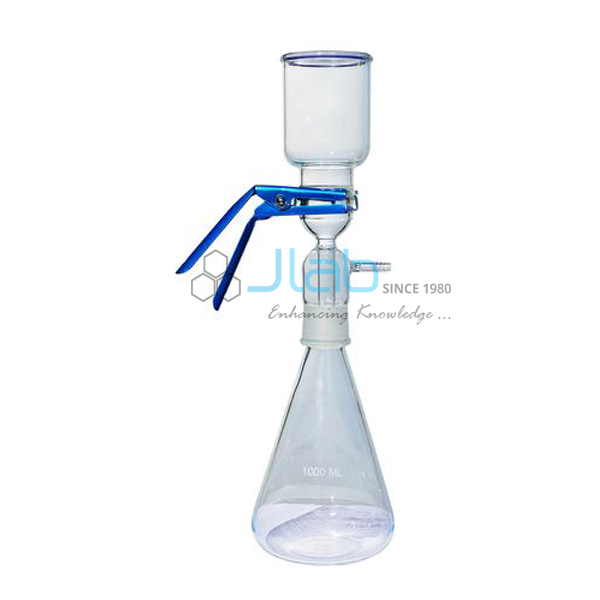
Product Code : EL-PLE-2254
Jlab Export is a leading Filtration Assembly Manufacturer,and suppliers in India
This is a complete, ready-to-use kit for vacuum filtration through a membrane, put together for filtering HPLC solvents and for general lab filtration. It includes a 47 mm all-glass membrane filter holder in borosilicate glass with a sintered support disc and aluminium duck clamp. A compact vacuum pump, 1 m of silicone rubber tubing and a pack of 100 membranes complete the set.
Specifications
| Filter holder | All-glass membrane filter holder, borosilicate glass, 47 mm |
| Membrane support | Sintered disc |
| Clamp | Aluminium duck clamp |
| Vacuum source | Compact vacuum pump |
| Tubing | Silicone rubber tubing, 6 x 9 mm, 1 m |
| Membranes | Pack of 100, 47 mm |
| Membrane options | Cellulose nitrate 0.2 µm or nylon 0.2 µm |
| Minimum order quantity | 10 units |
| Dispatch time | Usually 4–6 working days |
| Manufacturer | JLab (Jain Laboratory Instruments Pvt Ltd), Ambala, India |
Filtration Practicals in Pharmacy and Microbiology
In an instrumental analysis practical, students filter the mobile phase for an HPLC run through a 0.2 µm membrane, so particles do not reach the column. The filtrate collects in the glass flask of the holder. The same set-up serves a membrane filtration exercise in pharmaceutical microbiology, where a solution is passed through the membrane and the membrane is then laid on a culture medium.
Teachers can set the kit beside a Filtering Kit Vacuum Pump with Gauge, which filters through paper in a Buchner funnel. Students then compare a paper filtration with a membrane filtration of the same cloudy liquid. Extra receivers such as Heavy Wall Filter Flasks, Borosilicate Glass let groups collect larger volumes.
Frequently Asked Questions
Should I choose cellulose nitrate or nylon membranes?
Cellulose nitrate suits water-based solutions and microbiology work, but many organic solvents attack it. Nylon takes most organic solvents and water mixtures used as HPLC mobile phases. Check the solvent against the membrane before filtering.
What does the 0.2 µm pore size remove?
It holds back fine particles and most bacteria, which is why it is used both for clearing HPLC solvents and for membrane filtration in microbiology. Finer pores filter more slowly, so the pump has to work harder.
Why is my filtration so slow?
A heavy load of particles or a viscous liquid blinds the membrane quickly. Check that the clamp seals and the tubing is not kinked. For a cloudy liquid, filter first through paper and only then through the membrane.
Why do extra peaks appear after I filter the mobile phase?
A new membrane can release traces of its own material into the first portion of solvent. Pass a little solvent through first and discard it, then filter the batch you will use.
Which side of the membrane goes up?
For gridded microbiology membranes the grid side faces up, toward the sample, so colonies can be counted later. Handle each membrane by its edge with flat forceps and lay it centred on the sintered disc.
Other Filtration Items
- Membrane Filter Holder All Glass (holder only, two sizes)
- Membrane Holder (stainless steel funnel)
- Flasks, Buchner, Filter JLab
For a quote, use Add To Cart or send us a message through the contact page.
Last updated: 12 November 2026