Flat File Manufacturer,Supplier and Exporter in India
Product Code : EL-SWES-8758
Jlab Export is a leading Flat File Manufacturer,and suppliers in India
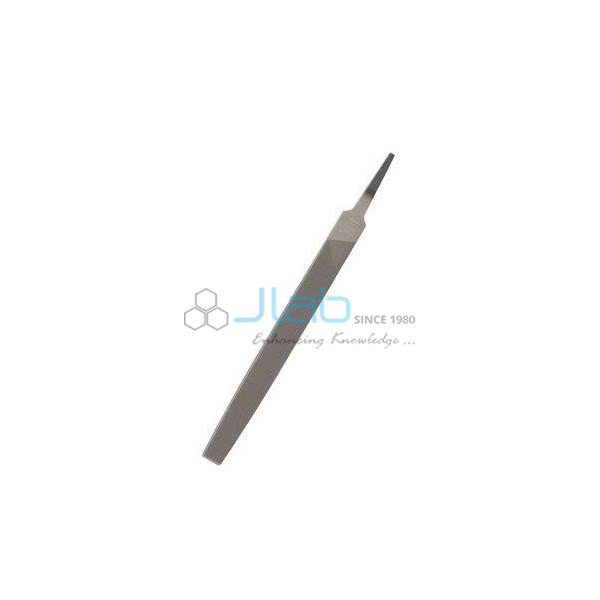
Flat files take metal off flat faces and outside edges, and they are the first file a fitting student picks up. This flat file comes in three grades of cut, rough (bastard), medium (second cut) and smooth. It is made in six lengths from 4 in to 14 in, so one order can stock a whole fitting bench.
Specifications
| Section | Flat |
| Grades of cut | Rough (bastard), medium (second cut), smooth |
| Lengths | 4, 6, 8, 10, 12 and 14 in |
| Minimum order quantity | 10 units |
| Dispatch time | Usually 4–6 working days |
| Manufacturer | JLab (Jain Laboratory Instruments Pvt Ltd), Ambala, India |
Fitting Shop Practicals with Flat Files
The standard ITI fitter job is to file a mild steel block flat and square to a scribed line. The block sits low in the jaws of a Bench Vice. The student starts with the bastard cut to remove metal fast, then changes to second cut and smooth to bring the surface down to the line. Flatness and squareness are checked against the light with an Engineers Square, and sizes are read off a Steel Rule.
Students also learn that a file cuts on the push stroke only. Pressure goes on during the forward stroke and comes off on the return. Cross filing removes stock quickly, and draw filing with the smooth file gives the final finish. Clogged teeth are cleared with a Wire Brush For Cleaning Files.
Frequently Asked Questions
What is the difference between bastard, second cut and smooth files?
They differ in tooth spacing. A bastard file has the coarsest teeth and removes metal fastest, a second cut file is medium, and a smooth file has fine teeth for finishing. Fitters rough out with the bastard and finish with second cut or smooth.
Which length of flat file should I choose?
Match the file to the job. The 4 in and 6 in files suit small parts and fine work, and 8 in and 10 in are general bench sizes. The 12 in and 14 in files take metal off larger surfaces. For the same grade, a longer file also has coarser teeth.
Does the file need a handle?
Yes. Fit a wooden or plastic handle firmly onto the tang before use. A file used without a handle can drive the pointed tang into the palm if it catches, and the handle also gives better control of the stroke.
Why does a file stop cutting, and how is it cleaned?
Small particles of metal lodge between the teeth, which is called pinning, and they scratch the work. Clear them with a file brush or file card, brushing along the rows of teeth. Rubbing chalk into a smooth file before filing soft metal reduces pinning.
Other Files for the Fitting Bench
- Flat File (machinist pattern, bastard cut)
- Engineers Flat Files (sets with handles)
- Half Round File
- Triangular File
For a quote, use Add To Cart or send us a message through the contact page.
Last updated: 6 November 2026