Fluid Friction Measurement Manufacturer,Supplier and Exporter in India

Product Code : EL-HAP-8913
Jlab Export is a leading Fluid Friction Measurement Manufacturer,and suppliers in India
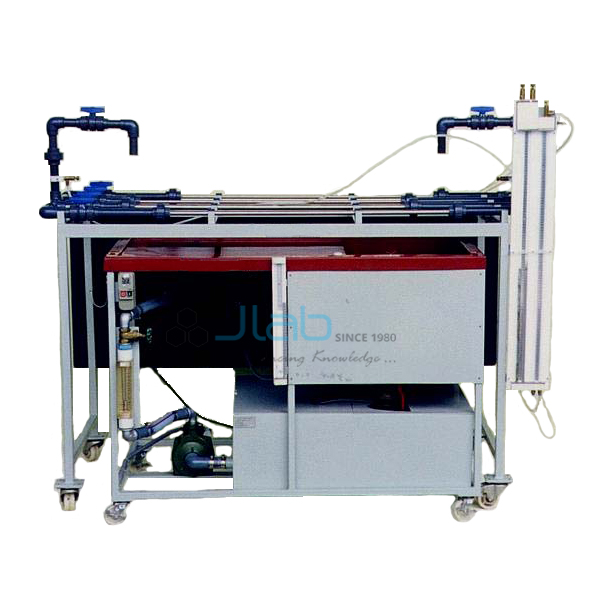
Head loss in pipes, valves and fittings is measured on this vertical panel, which takes its water from a hydraulics bench. Pressure differential transmitters read the drops, a venturi tube and an orifice plate give the flow, and a J type thermocouple reads the water temperature. A roughened pipe lets students follow the friction factor from laminar into turbulent flow.
Specifications
| Mounting | Vertical panel, used with a gravimetric or volumetric hydraulic bench |
| Test pipes | Pipes for friction loss, including an artificially roughened pipe |
| Valves and fittings | Tee, elbow, Y junction, gate valve and globe valve |
| Flow meters | Venturi tube and orifice plate |
| Velocity profile | Traversing Pitot-static tube |
| Pressure measurement | Pressure differential transmitters |
| Temperature | J type thermocouple |
| Software | Program for Reynolds number, friction factor, velocity, losses, flow rate and K factors |
| Documentation | User guide |
| Minimum order quantity | 1 unit |
| Dispatch time | Usually 14–18 working days |
| Manufacturer | JLab (Jain Laboratory Instruments Pvt Ltd), Ambala, India |
Pipe Friction Practicals for Students
The panel stands on the Hydraulics Bench, which supplies the water and checks the flow by timed collection in its measuring tank. Students raise the flow in steps and record the pressure drop along a pipe at each step. From the Darcy-Weisbach equation, hf = f L v²/(2gD), they work out f and plot it against Reynolds number on log scales.
Their laminar points should follow f = 64/Re. The roughened pipe results are then compared with the Moody chart and with Nikuradse’s results. Other exercises find the K factor of each fitting, compare the venturi and orifice readings, and traverse the Pitot tube across the pipe to draw a velocity profile. Colleges can set the results beside those from the two-pipe Friction in Pipe Lines Apparatus.
Frequently Asked Questions
How is the friction factor worked out from a reading?
Take the head loss between two tappings a length L apart, and the mean velocity v from the measured flow and the pipe diameter D. Rearranging the Darcy-Weisbach equation gives f. The software does the same sum from the transmitter readings and the flow rate.
Why does the friction factor change with Reynolds number?
In laminar flow f depends only on Reynolds number, so it falls steeply as the flow rises. Past the transition the flow turns turbulent and f levels off, depending more on how rough the pipe wall is. The roughened pipe shows this levelling, as the Moody chart predicts.
What is the K factor of a fitting?
It is the head lost across a valve or fitting divided by the velocity head, so the minor loss is K v²/(2g). Students find K for the tee, elbow, Y junction, gate valve and globe valve. A fully open globe valve usually loses far more than a gate valve.
Why does the panel measure water temperature?
Reynolds number uses the viscosity of the water, which changes noticeably with temperature. The J type thermocouple reading lets the program use the right viscosity, so runs on a cold morning and a warm afternoon can be compared fairly.
What goes wrong most often in student readings?
Air trapped in the tapping lines gives unsteady or wrong pressure drops, so bleed them before starting. Other common errors are reading before the flow settles and using the wrong pipe diameter when working out velocity.
Other Pipe Loss and Flow Apparatus
For a quote, use Add To Cart or send us a message through the contact page.
Last updated: 6 November 2026