Multi Pump Test Rig Manufacturer,Supplier and Exporter in India
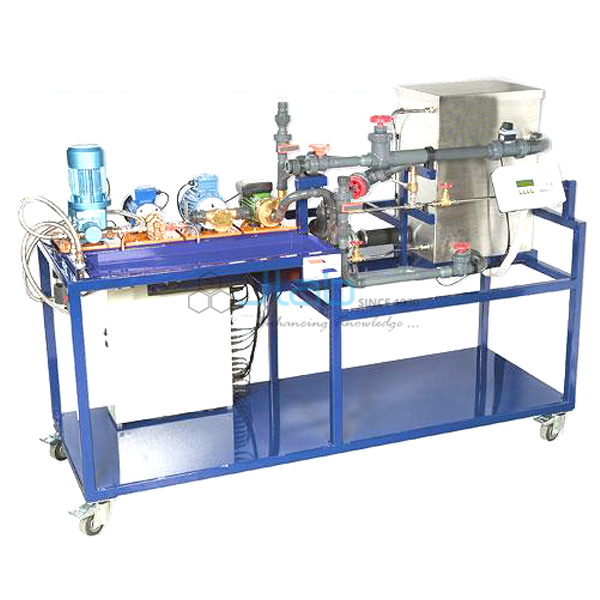
Product Code : EL-HAP-8924
Jlab Export is a leading Multi Pump Test Rig Manufacturer,and suppliers in India
Up to eight kinds of pump can be tested on this mobile rig, each at different speeds. It has five pump positions, four of them active at once, and comes with a centrifugal pump and a gear pump. Flow, pressure head, suction head and motor torque are measured electronically and logged by the supplied software.
Specifications
| Pumps tested | Up to eight types, at different speeds |
| Pump positions | Five, four active at the same time |
| Pumps supplied | Centrifugal pump and gear pump |
| Optional pumps | Axial, flexible impeller, turbine, diaphragm, plunger and a second centrifugal pump |
| Measurements | Electronic: flow, pressure head, suction head and motor torque |
| Suction control | Control valve upstream of each pump except the axial pump |
| Speed setting | From a PC provided by the user |
| Software | Data logging and educational software with mimic diagram |
| Option | Volumetric flow measurement system for reciprocating pumps |
| Minimum order quantity | 1 unit |
| Dispatch time | Usually 14–18 working days |
| Manufacturer | JLab (Jain Laboratory Instruments Pvt Ltd), Ambala, India |
Pump Test Practicals
For the centrifugal pump, students open the delivery from shut-off to full flow at a set speed. They log head, flow and torque at each step, then plot head, power absorbed and efficiency against flow. Repeating at other speeds shows the curves moving as the affinity laws predict. Colleges with the single-pump Centrifugal Pump Test Rig can compare its stepped-pulley speeds with this rig.
The gear pump gives a very different picture: flow stays nearly level as pressure head rises, and volumetric efficiency falls as slip grows. With the second centrifugal pump fitted, students run two pumps in series and then in parallel. Closing a suction control valve shows performance falling as inlet pressure drops, which leads into the Cavitation Demonstration.
Frequently Asked Questions
What happens when two centrifugal pumps run in series or in parallel?
In series the same flow passes both pumps and their heads add, so the combined curve is taller. In parallel both pumps work against the same head and their flows add, so the curve is wider. The rig shows both once the second centrifugal pump is fitted.
Why are centrifugal and gear pump curves plotted differently?
A centrifugal pump’s flow depends strongly on the head it works against, so head, power and efficiency are plotted against flow. A gear pump moves a nearly fixed volume each turn, so flow, power and volumetric efficiency are plotted against pressure head instead.
Can the delivery be shut off fully on the gear pump?
No. A positive displacement pump keeps pushing the same volume each turn, so a closed outlet makes the pressure climb very fast. Raise its head in steps instead. A centrifugal pump can run for a short time against a closed valve, at its shut-off head.
What does the suction control valve show?
Closing the valve upstream of a pump adds loss on the suction side, so the inlet pressure falls. As it nears the vapour pressure of the water, head and flow drop away and the pump gets noisy. That is the start of cavitation, which a pump avoids only with enough suction head.
What does the user need to provide?
A PC, which sets the speed of the pumps on test and runs the supplied data logging and educational software. The mimic diagram on screen shows the measured and calculated values for the selected pumps.
Other Pump Test Rigs
- Gear Oil Pump Test Rig
- Axial Flow Pump Test Rig
- Reciprocating Pump Test Rig
- Multistage Centrifugal Pump Test Rig
For a quote, use Add To Cart or send us a message through the contact page.
Last updated: 6 November 2026