Cavitation Demonstration Manufacturer,Supplier and Exporter in India
Product Code : EL-HAP-8930
Jlab Export is a leading Cavitation Demonstration Manufacturer,and suppliers in India
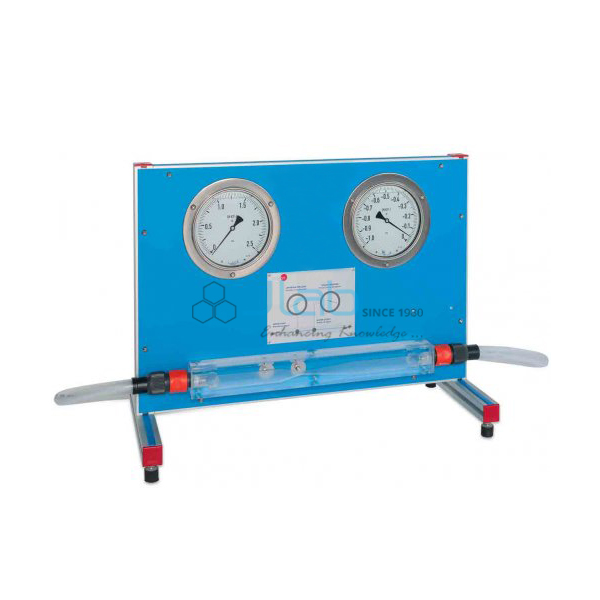
Water speeds up through the throat of a clear acrylic venturi on this small unit until the pressure there falls to the vapour pressure and bubbles appear. Three Bourdon gauges read the pressure before the contraction, in the throat and after the expansion. It runs from a hydraulics bench through a quick release fitting, or from cold mains water for viewing only.
Specifications
| Test section | Circular venturi-shaped section, clear acrylic |
| Upstream gauge | Bourdon type, 63 mm dia, 0 to 1 bar |
| Throat gauge | Vacuum gauge, 100 mm dia, -1 to 0 bar |
| Downstream gauge | Bourdon type, 63 mm dia, 0 to 1 bar |
| Flow control | Valves upstream and downstream of the test section |
| Connection | Quick release fitting to a hydraulics bench |
| Mains water option | Visualisation only, with cold water at 0.4 litres/sec and 2 bar gauge |
| Software | Educational software as an option |
| Minimum order quantity | 1 unit |
| Dispatch time | Usually 14–18 working days |
| Manufacturer | JLab (Jain Laboratory Instruments Pvt Ltd), Ambala, India |
Cavitation Demonstrations for Students
The unit connects by its quick release fitting to the Hydraulics Bench, which also gives the flow by timed collection. Students open the upstream valve in small steps and watch the throat gauge fall toward full vacuum. At first a few bubbles flicker at the throat. As flow rises they grow into a cloud that collapses with a crackling sound a little way downstream.
Students note the throat pressure at which bubbles first appear and compare it with the vapour pressure of water at the water temperature. They read that temperature with a Digital Stem Thermometer. A second run holds the flow and closes the downstream valve, which raises the throat pressure and makes the bubbles vanish.
Frequently Asked Questions
When does cavitation start in the venturi?
As the flow rises, the water speeds up in the throat and its pressure falls. When the throat pressure drops to the vapour pressure of the water, small vapour bubbles form there. The throat vacuum gauge, which reads from -1 to 0 bar, shows the pressure falling toward that point.
Why do the bubbles disappear after the throat?
Past the throat the section widens, the water slows and its pressure recovers. The vapour bubbles then collapse suddenly. In pumps and valves these collapses happen against metal surfaces and pit them over time.
Why are there two flow control valves?
The upstream valve sets the flow into the test section and the downstream valve sets the back pressure. The same flow can then be run with or without cavitation, which shows that the local pressure in the throat decides it, not the flow alone.
Can the unit be used without a hydraulics bench?
Yes, for visualisation only, from a cold water mains supply giving 0.4 litres/sec at 2 bar gauge. On the bench it also gets a measured flow from the bench tank, which the pressure readings need for a full analysis.
How does this relate to the NPSH of a pump?
A pump inlet behaves like the venturi throat. If suction pressure is too low, water turns to vapour at the impeller eye. Net positive suction head is the margin of inlet pressure above vapour pressure, and a pump needs enough of it to run without cavitating.
Other Cavitation and Flow Apparatus
- Cavitation Apparatus (self-contained closed-circuit rig)
- Flow Meter Demonstration
- Bernoulli Theorem Apparatus
- Multi Pump Test Rig
For a quote, use Add To Cart or send us a message through the contact page.
Last updated: 6 November 2026