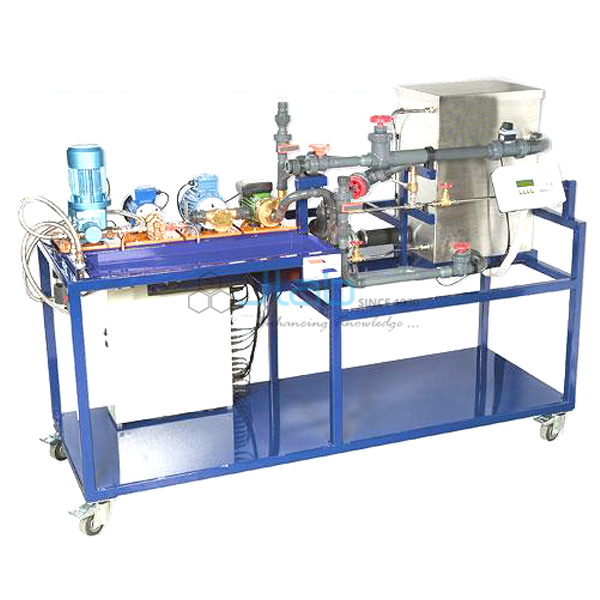
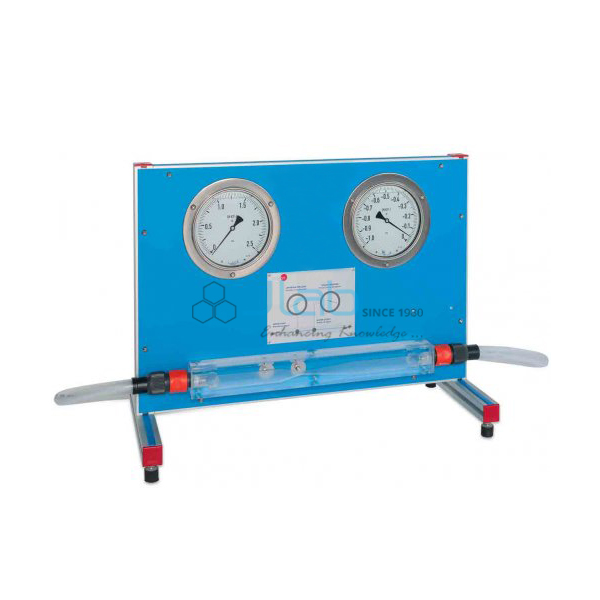
Pipe Network Apparatus Manufacturer,Supplier and Exporter in India
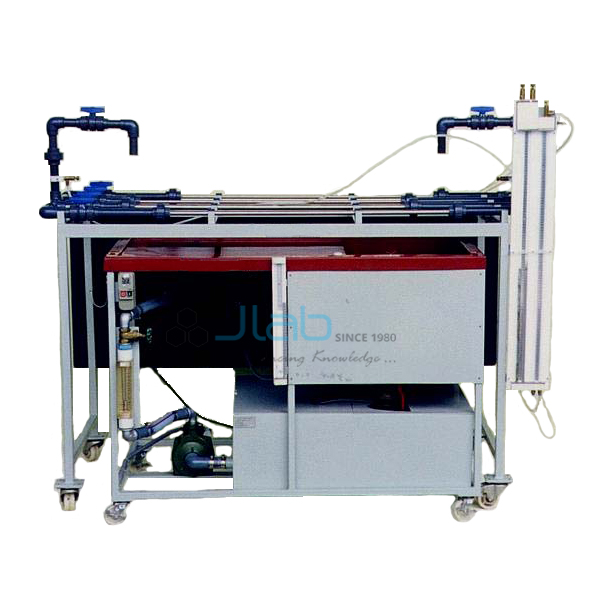
Product Code : EL-HAP-8921
Jlab Export is a leading Pipe Network Apparatus Manufacturer,and suppliers in India
On this apparatus students join five short test pipes of three bore sizes into single, series, parallel and ring main layouts. They then measure how the flow divides and where head is lost. A bench base with a 0.55 kW centrifugal pump and a volumetric tank supplies and measures the water, and two differential manometers read the pressure drops.
Specifications
| Test pipes | 5 pipes, common length 0.7 m: 1 of 22.5 mm ID, 2 of 17.5 mm ID, 2 of 13.0 mm ID |
| Layouts | Individual pipes, series, parallel and ring main |
| Connections | Screwed couplings with O rings, quick-connect pressure tappings |
| Differential pressure | 1 m pressurised water manometer and 1 m mercury manometer |
| Water supply | Self-contained bench base with 0.55 kW (0.75 HP) centrifugal pump |
| Flow measurement | Volumetric, ranges 0–6 litres and 0–40 litres, remote sight gauge |
| Power supply | 220 V, 50 Hz |
| Mobility | Mobile, on its hydraulics bench base |
| Minimum order quantity | 1 unit |
| Dispatch time | Usually 14–18 working days |
| Manufacturer | JLab (Jain Laboratory Instruments Pvt Ltd), Ambala, India |
Pipe Network Experiments
Students first calibrate each pipe alone, plotting head loss against discharge. They time each volumetric reading with a Digital Stop Watch against the sight gauge. Many classes find the pipe friction factor beforehand on the Fluid Friction Measurement panel, so the calibration curves can be checked against theory.
Next they couple pipes in series and in parallel and compare the measured flows and losses with values predicted from the single-pipe curves. In the ring main exercise water enters and leaves a loop of pipes at chosen junctions. Students check that flow balances at each node and that head losses round the loop add to zero. They then compare the result with a Hardy Cross calculation done by hand.
Frequently Asked Questions
What rules does a pipe network follow?
At every junction the flow in equals the flow out. Round every closed loop the head losses, counted with their direction, add up to zero. The Hardy Cross method applies both rules again and again, correcting the flow in each loop until both hold.
How do series and parallel pipes differ?
In series the same flow passes each pipe and the head losses add up. In parallel every branch has the same head loss between the shared junctions, and the branch flows add up to the total. The 22.5, 17.5 and 13.0 mm pipes show how bore decides the share each branch takes.
What does doubling a pipe mean?
It means laying a second pipe beside part of an existing line and joining the two at both ends. That stretch then carries the same flow with less head loss. Students measure how much more water the doubled line passes for the same head.
When should I use the mercury manometer instead of the water one?
Use the pressurised water manometer for small pressure drops, where the lighter liquid gives a bigger reading. Change to the mercury manometer when a drop would run off the 1 m water scale, as in the narrow pipes at high flow. Keep the mercury sealed and handle it with care.
Why are there two volumetric ranges?
The 0–6 litre range times small flows quickly, such as those in one narrow branch. The 0–40 litre range suits the full flow of a series or ring main layout. Both are read from the level on the remote sight gauge.
Other Pipe Flow and Bench Apparatus
For a quote, use Add To Cart or send us a message through the contact page.
Last updated: 6 November 2026