Flow Meter Demonstration Manufacturer,Supplier and Exporter in India

Product Code : EL-HAP-8918
Jlab Export is a leading Flow Meter Demonstration Manufacturer,and suppliers in India
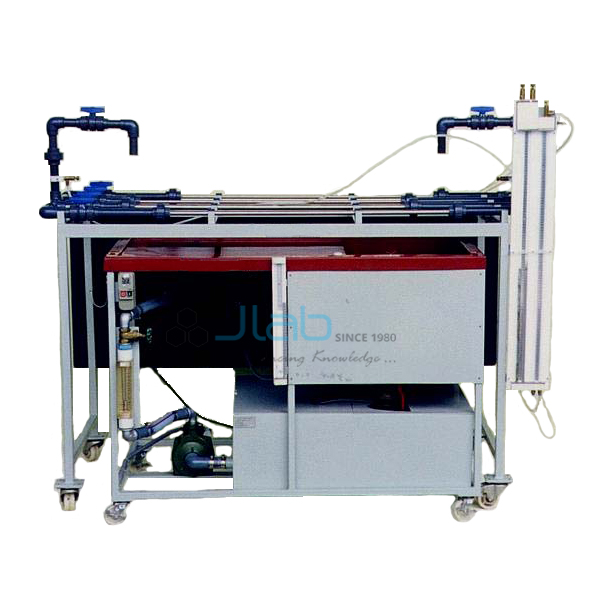
Three flow meters sit in series on this frame, so the same water passes a venturi meter, a variable area meter and an orifice plate in turn. Tappings on each meter lead to an eight tube manometer bank. The frame stands on the working top of a hydraulics bench, whose measuring tank gives the true flow for calibration.
Specifications
| Flow meters | Venturi meter, variable area meter and orifice plate, in series |
| Flow setting | Flow control valve |
| Pressure readings | Eight tube manometer bank with manifold and air bleed valve |
| Manometer pressurising | Hand pump |
| Mounting | Support frame that stands on the working top of a hydraulics bench |
| Calibration | Volumetric, using the measuring tank of the bench |
| Minimum order quantity | 1 unit |
| Dispatch time | Usually 14–18 working days |
| Manufacturer | JLab (Jain Laboratory Instruments Pvt Ltd), Ambala, India |
Flow Meter Calibration Practicals
The unit is set up on the Hydraulics Bench, which supplies the water. Students bleed the manometer tubes, set a flow with the control valve and read every tube once the levels settle. They then take a timed collection in the bench measuring tank. Repeating this at six or more flows gives enough points to plot each meter.
From the results they find the discharge coefficient of the venturi and the orifice plate and draw a calibration curve for the variable area meter. They also compare the overall head loss across each meter. A further lesson can bring in the turbine meter and rotameter on the Study of Flow Measurement Devices bench.
Frequently Asked Questions
Why are the three meters fitted in series?
In series the same flow passes every meter at the same moment. Any difference in their readings then comes from the meters themselves, not from a change in flow. One timed collection on the bench calibrates all three at once.
Which meter loses the most head?
The orifice plate. The jet leaving the sharp-edged hole breaks up into eddies, so little of its pressure drop is recovered downstream. The gently widening outlet of the venturi recovers most of it. Comparing tappings upstream and downstream of each meter shows the difference.
How do I work out the discharge coefficient?
Take the actual flow from the bench measuring tank, and the theoretical flow from the manometer head difference and the areas at the pipe and the throat. The discharge coefficient is actual flow divided by theoretical flow. A venturi usually comes close to one, an orifice plate much lower.
What is the hand pump for?
It raises the air pressure above the water in the manometer tubes through the manifold. That pushes all the levels down together, so the readings stay on the scale at higher pipe pressures. The differences between tubes do not change. The air bleed valve lets the air out again.
How does the variable area meter show the flow?
A float rises in a tapered tube until the drag of the water passing it balances its weight. A bigger flow lifts it into a wider part of the tube. Students read the float position and check it against flows measured with the bench tank.
Other Flow Measurement Apparatus
- Venturi and Orifice Meter Apparatus
- Venturimeter and Orificemeter Calibration Set-Up
- Fluid Friction Measurement
For a quote, use Add To Cart or send us a message through the contact page.
Last updated: 6 November 2026