Forced Commutated Circuits Manufacturer,Supplier and Exporter in India

Product Code : EL-PET-1438
Jlab Export is a leading Forced Commutated Circuits Manufacturer,and suppliers in India
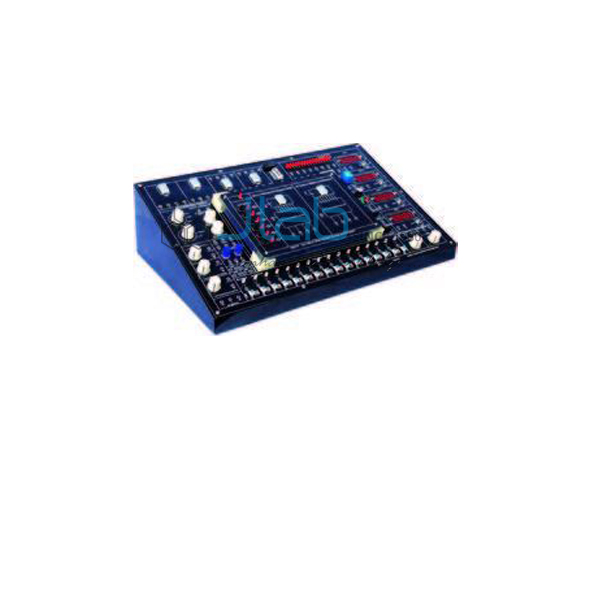
Forced Commutated Circuits (code EL-PET-1438) is a power electronics training board for studying the ways a conducting SCR can be turned off, covering five commutation classes, A to E, on one panel. Its built-in parts include 30 V and 5 V fixed DC supplies, a 5 Hz square-wave oscillator, a UJT triggering circuit for the SCRs and a capacitor bank. JLab (Jain Laboratory Instruments Pvt Ltd) makes the board at its works in Ambala, India.
Specifications
| Parameter | Detail |
|---|---|
| Object | To study forced commutated circuits, classes A, B, C, D and E |
| DC supplies | 30 V DC at 150 mA, fixed; 5 V DC at 50 mA, fixed |
| Oscillator | 5 Hz square-wave oscillator |
| Triggering | UJT triggering circuit for the SCRs |
| Switches | Two push-to-ON switches |
| Other circuit parts | NPN transistor, inductor, diode and LED, capacitor bank |
| Other components | Adequate number of other electronic components |
| Mains controls | Mains ON/OFF switch, fuse and jewel light |
| Mains supply | 230 V ±10% at 50 Hz AC |
| Patch cords | Adequate number, stackable 4 mm spring-loaded plugs, ½ metre long |
| Terminals | Terminals and sockets at appropriate places on the panel for connections and waveform observation |
| Operating instructions | Detailed, with object, theory, design procedures, report suggestions and book references |
| Weight | 3 kg (approx.) |
| Dimensions | W 340 × H 110 × D 210 |
| Other apparatus required | Dual trace cathode ray oscilloscope, 20 MHz (unearthed) |
| Quality check | Each board is visually inspected before dispatch |
| Pack quantity | Each (sold individually) |
| Minimum order quantity | 10 units |
| Dispatch time | Usually 7–10 working days |
| Product code | EL-PET-1438 |
| Manufacturer | Jain Laboratory Instruments Pvt Ltd (JLab) — OEM |
| Country of origin | India (made in Ambala, Haryana) |
Which Commutation Classes Does the Board Cover?
| Class | Commutation method | How the SCR is turned off |
|---|---|---|
| Class A | Self commutation by resonating the load | The load forms an underdamped resonant circuit, so the SCR current falls to zero by itself |
| Class B | Self commutation by an LC circuit | An LC circuit across the SCR charges and then oscillates, driving a current that cancels the forward current in the SCR |
| Class C | Charged capacitor switched by another load-carrying SCR | Firing the second SCR places the charged capacitor across the first and reverse-biases it; the two SCRs then alternate |
| Class D | Charged capacitor switched by an auxiliary SCR | An auxiliary SCR, which carries no load current, switches the charged capacitor across the main SCR |
| Class E | External pulse source | A pulse from a separate source applies a reverse voltage to the conducting SCR |
What Is the Forced Commutated Circuits Board Used For?
Choppers, inverters and many other DC-fed thyristor circuits depend on commutation, because a thyristor stays on until something outside it brings its current down and holds it reverse-biased for long enough. This board lets science and engineering students set up each of the five classes in turn and compare them, watching the waveforms of each power electronics circuit on an oscilloscope at the panel terminals.
What to Specify When Ordering
- Number of boards required.
- Oscilloscope — say whether one should be quoted too.
- Companion trainers — chopper, inverter or SCR characteristic boards that the same course uses.
Frequently Asked Questions
Why can’t an SCR on a DC supply turn off by itself?
Once triggered, an SCR keeps conducting as long as its current stays above the holding current, and removing the gate signal does not stop it. On AC the current passes through zero every half cycle, but on DC it does not, so a commutation circuit has to force the current down and reverse-bias the device.
Why must the reverse bias last longer than the turn-off time?
After the current reaches zero, the SCR needs a short time for the charge stored in its junctions to recombine. If forward voltage returns before that turn-off time has passed, the thyristor switches on again without a gate pulse, so a commutation circuit is designed to keep it reverse-biased for longer.
How do class C and class D commutation differ?
Both use a charged capacitor. In class C it is switched by a second SCR that also carries load current, so the two main SCRs turn each other off; in class D the switching device is an auxiliary SCR that only serves to commutate the main one.
What else is needed to run the experiments?
A dual trace cathode ray oscilloscope of 20 MHz bandwidth, used unearthed. JLab’s Dual Trace Oscilloscope is listed as a separate item and can be quoted on the same enquiry.
What should an export enquiry include?
Quantity, destination country and port or city, delivery terms (FOB, CIF or similar), packing or labelling requirements and the tender reference if the purchase is through a tender.
Who manufactures the Forced Commutated Circuits board?
JLab, the trading name of Jain Laboratory Instruments Pvt Ltd, at its works in Ambala, Haryana, India.
OEM Manufacturer
JLab is the trading name of Jain Laboratory Instruments Pvt Ltd, a manufacturer of power electronics trainers and other engineering lab equipment in India. It was incorporated in 2017 and operates from Hargolal Road, Ambala, Haryana. JLab builds this commutation board in its own works instead of reselling a trader’s stock, so colleges, institutes, dealers and importers order straight from the manufacturer; every unit is visually inspected before dispatch and repeat orders are made at the same works. JLab exports worldwide and ships to buyers in every region — for example Indonesia in Southeast Asia, Switzerland in Western Europe, Tajikistan in Central Asia, Cameroon in Central Africa and Afghanistan in South Asia. Institutions buying through tenders can see the JLab lab tenders page.
Related Thyristor and Commutation Trainers
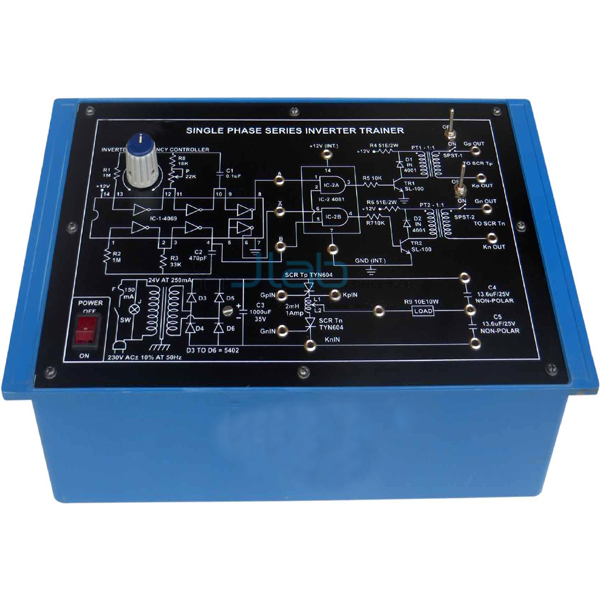
- Single Phase Series Inverter — a series inverter board built around two SCRs and a centre-tapped inductor.
- Voltage Commutated Thyristorised Chopper — a step-down thyristor chopper board with two SCRs, a UJT relaxation oscillator and a freewheeling diode.
- UJT Relaxation Oscillator — a board for the UJT relaxation oscillator and its use as an SCR trigger circuit.
- DV and DT Limitation of SCRS — a board for testing the dv/dt capability of an SCR, including RC and transistor snubber circuits.
- Dual Trace Oscilloscope — a 20 MHz dual-channel cathode ray oscilloscope sold separately by JLab.
Other boards are in the Power Electronics Trainers range, within Electronics Lab Equipments.
Request a Quote
Send your enquiry with the Add To Cart button on this page or through the contact page; mention how many boards you need, the delivery location and any companion trainers or test instruments to include.
Last updated: 22 October 2026