Instantaneous Gas Heater Manufacturer,Supplier and Exporter in India
Product Code : EL-ELA-5446
Jlab Export is a leading Instantaneous Gas Heater Manufacturer,and suppliers in India
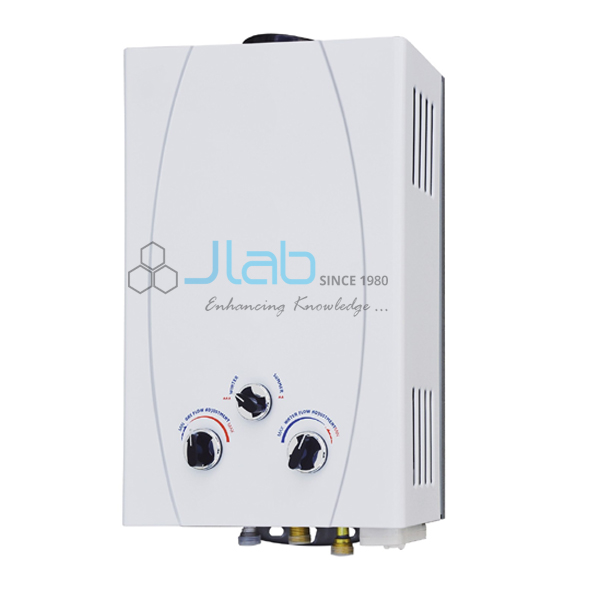
Instantaneous Gas Heater (code EL-ELA-5446) is a fault-finding trainer built from an instantaneous gas water heater, used to teach how such heaters work and how their safety functions behave. For safety it runs on air, not gas: the heat exchanger has been removed to expose the internal parts, an array of LEDs simulates the burner flames, and a PLC reproduces the safety functions and 12 different faults. It is made by Jain Laboratory Instruments Pvt Ltd (JLab) at its works in Ambala, India.
Specifications
| Parameter | Detail |
|---|---|
| Type | Instantaneous gas heater trainer, operated with air for safety |
| Construction | Heat exchanger of the instantaneous heater removed to clearly show the internal components |
| Air supply | Diaphragm air pump with pressure regulator, giving compressed air at the correct admission pressure |
| Simulated safety functions | Lighting the pilot, thermocouple flame safeguard and temperature cut-out, simulated electronically by a PLC |
| Fault simulation | PLC programmed to simulate 12 different faults |
| Burner flames | Simulated by an array of LEDs |
| Services required | A supply of water |
| Quality check | Each trainer is visually inspected before dispatch |
| Pack quantity | Each (sold individually) |
| Minimum order quantity | 10 units |
| Dispatch time | Usually 7–10 working days |
| Product code | EL-ELA-5446 |
| Manufacturer | Jain Laboratory Instruments Pvt Ltd (JLab) — OEM |
| Country of origin | India (made in Ambala, Haryana) |
What Is the Instantaneous Gas Heater Trainer Used For?
An instantaneous gas water heater has no storage tank: it fires its burner only while hot water is drawn and heats the water as it passes through the heat exchanger. Its safety depends on a short chain of devices — the pilot flame that lights the main burner, a thermocouple flame safeguard that keeps the gas valve open only while the pilot heats the thermocouple, and a temperature cut-out that shuts the heater down if it overheats. With the heat exchanger taken off, trainees can see where each of these parts sits, while the PLC and the LED flames show how the heater responds as the pilot lights, the burner fires and a safety device trips.
The main use is diagnosis practice. Because the PLC can call up 12 different faults, an instructor can set a fault and let trainees trace it methodically, as they would on a customer’s heater, without any gas or open flame in the room. That makes the trainer a good fit for gas-fitter and plumbing trades in ITIs and TVET centres, appliance-service courses and building services diplomas. The pressure regulator on the diaphragm pump keeps the air at the correct admission pressure, and a water supply is needed during use.
What to Specify When Ordering
- Quantity — the minimum order is 10 units; plan enough trainers for groups to work on separate faults.
- Site services — the water supply and the electrical supply (voltage and plug type) for the pump and PLC.
- Related trainers — the gas burner and gas heater panels listed below, if you are equipping a complete gas-appliance workshop.
Frequently Asked Questions
Is any gas used in this trainer?
No. For safety reasons it is operated with air, supplied by a diaphragm pump with a pressure regulator, and the burner flames are shown by an array of LEDs.
Which safety functions can trainees study?
Lighting the pilot, the thermocouple flame safeguard and the temperature cut-out. All three are simulated electronically by the PLC.
How many faults can be simulated?
Twelve different faults are programmed into the PLC, giving instructors a range of fault-finding exercises.
Why has the heat exchanger been removed?
To clearly show the internal components of the instantaneous heater, which a heat exchanger would otherwise hide.
What services does it need?
A supply of water is required for operation, plus mains power for the pump and PLC; give your local supply details in the enquiry.
What details does an export quotation need?
The quantity, destination country and port or city, delivery terms such as FOB or CIF, any packing or labelling requirements and a tender reference if applicable.
Who manufactures this trainer?
Jain Laboratory Instruments Pvt Ltd (JLab), at its works in Ambala, Haryana, India.
OEM Manufacturer
JLab is the trading name of Jain Laboratory Instruments Pvt Ltd, an Ambala-based manufacturer of vocational trainers and laboratory equipment, incorporated in 2017, with its works on Hargolal Road, Ambala, Haryana, India. The gas heater trainer is produced in-house rather than bought from a trader, so ITIs, colleges, dealers and importers deal with the manufacturer directly, every unit is visually inspected before dispatch, and spares and repeat units are handled by JLab itself. JLab exports worldwide and ships to buyers in every region — for example Uzbekistan in Central Asia, South Korea in East Asia, Panama in Central America and the Caribbean, Iceland in Northern Europe and Spain in Southern Europe. Tender information is on the JLab lab tenders page.
Related Gas Appliance Trainers
- Training Panel Function of Gas Heater — a propane-fired combination water heater on a panel, with a sight glass, thermometers and flow meters.
- Forced Air Gas Burner Training Panel — another air-operated trainer, simulating a forced-air gas burner with manometers and a flame safeguard.
- Demo Unit Gas Burner — a natural-gas burner model with fault switches in a lockable box.
- Safety Devices Training Panel — safety devices that trip on an electrically heated pressure vessel.
- Domestic Gas Supply Training Panel — gas pipes, gas meters and leak finding.
See the full Educational Laboratory Apparatus range or browse all Laboratory Apparatus.
Request a Quote
You get the quotation straight from the manufacturer. Use the Add To Cart enquiry button on this page, or send the quantity (minimum 10 units), your water and electrical supply details and the delivery location through the contact page.
Last updated: 9 October 2026