Solar Cell Manufacturer,Supplier and Exporter in India
Product Code : EL-ELA-5364
Jlab Export is a leading Solar Cell Manufacturer,and suppliers in India
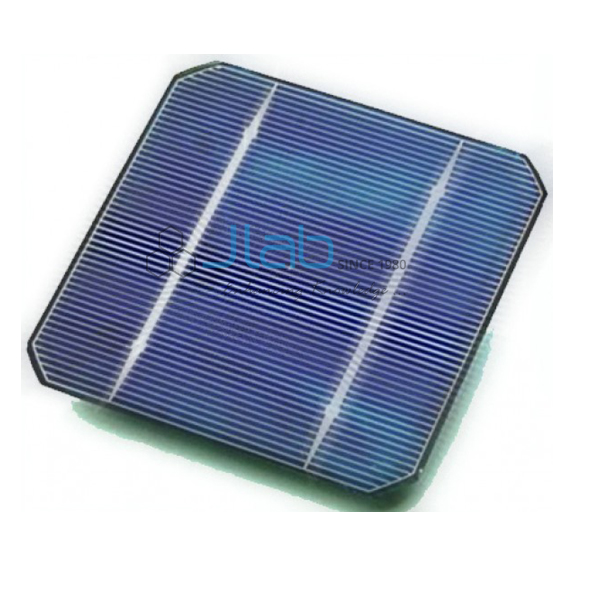
The Solar Cell is a model designed for studying the fundamentals of solar cells, which turn light directly into electricity. It is an encapsulated silicon cell of about 50 × 50 mm on a labelled base with two terminals, which students connect to a meter. It is dispatched well packed, since solar cells are fragile. Its nominal output is 0.5 V and 100 mA at maximum power, under 1000 W/m² of light at a cell temperature of 25 °C. The Solar Cell Mounted, which gives 1 V at 200 mA, is listed separately.
Specifications
| Type | Encapsulated silicon solar cell on a labelled teaching base |
| Active area | About 50 × 50 mm |
| Output (nominal) | 0.5 V and 100 mA at maximum power, at 1000 W/m² and 25 °C cell temperature |
| Connections | Two terminals |
| Purpose | Studying the fundamentals of solar cells |
| Principle | Converts light energy into electrical energy |
| Packing | Well packed for transport |
| Suits | School physics and energy lessons, college physics labs |
| Pack quantity | Each (sold individually) |
| Minimum order quantity | 10 units |
| Dispatch time | Usually 4–6 working days |
| Manufacturer | JLab (Jain Laboratory Instruments Pvt Ltd), Ambala, India |
How a Solar Cell Works
A solar cell is usually made from silicon, with a junction between two layers of semiconductor. Light absorbed near the junction frees charges, and the junction drives them round an outside circuit as a current.
The current depends strongly on how much light falls on the cell. The voltage changes far less, so a brighter light mostly gives more current.
A Simple Light Experiment
- Connect the two terminals of the cell to a voltmeter or a current meter with leads.
- Set a lamp at a measured distance from the cell and note the reading.
- Move the lamp back in equal steps and take a reading at each distance.
- Repeat the run and work out the mean for each distance.
- Plot the readings against distance and describe the pattern.
- Let the lamp cool before moving it, as the bulb gets hot.
Frequently Asked Questions
What should a school order with the solar cell?
Each set needs a voltmeter or multimeter, connecting leads and a lamp on a stand. A metre rule lets students measure the lamp distance. Our Digital Multimeter (19 Ranges) can read both voltage and current.
What output does the solar cell give?
Its nominal output is 0.5 V and 100 mA at maximum power, under 1000 W/m² of light at a cell temperature of 25 °C. Classroom lamps give far less light than this, so expect lower readings indoors. For 1 V at 200 mA, see the Solar Cell Mounted.
How should solar cells be stored between lessons?
Keep each cell in its packing, face up, in a dry cupboard with nothing resting on it. Clean the face with a soft, dry cloth, since dust and fingerprints cut the light reaching it. Hold the cell by its edges.
How does light intensity affect the output of a solar cell?
Brighter light frees more charges, so the current rises almost in step with the light. The voltage rises only a little. As a result, the power output grows as the light gets stronger.
Why does the reading fall when the cell is tilted away from the lamp?
Tilting spreads the same light over a larger area, so less light falls on each part of the cell. Fewer charges are freed and the current drops. The reading is greatest when the light strikes the face straight on.
What is a common mistake in a solar cell experiment?
Light from windows and room lamps adds to the lamp under test and spoils the results. Work in a dim room or shade the cell, and keep the lamp aimed straight at it. Measure each distance to the same point on the lamp.
Other Solar Energy Items
- Solar Cell Mounted (1 V at 200 mA)
- Solar Cell Demonstrator (four cells on a motor-driven disc)
- Solar Cell Characteristics Apparatus
- Basic Solar Energy Trainer
For a quote, use Add To Cart or send us a message through the contact page.
Last updated: 26 November 2026