Leclanche Cell Manufacturer,Supplier and Exporter in India
Product Code : EL-MI-4869
Jlab Export is a leading Leclanche Cell Manufacturer,and suppliers in India
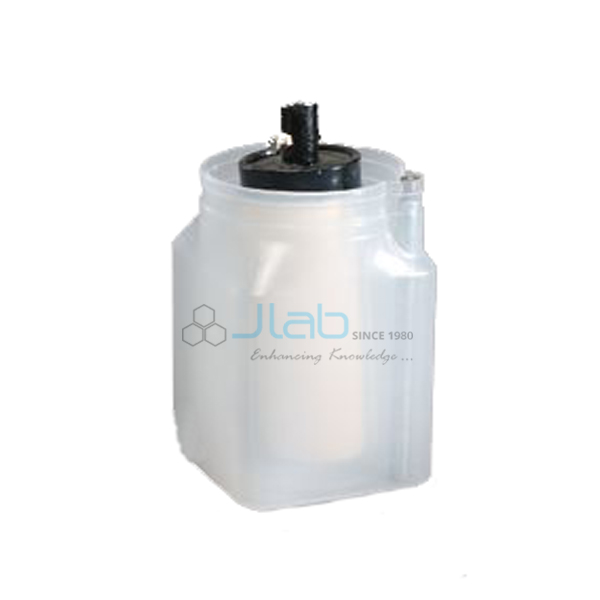
Leclanche Cell (code EL-MI-4869) is a primary cell for teaching how a chemical reaction produces an electric current in school and college chemistry and physics labs. It pairs a zinc anode with a carbon cathode, uses manganese dioxide as the depolarizer and a conducting solution of ammonium chloride as the electrolyte — the design patented by Georges Leclanché in 1866. It is made by Jain Laboratory Instruments Pvt Ltd (JLab) at its works in Ambala, India.
Specifications
| Parameter | Detail |
|---|---|
| Type | Leclanché cell (primary cell) |
| Anode (negative electrode) | Zinc |
| Cathode (positive electrode) | Carbon |
| Depolarizer | Manganese dioxide |
| Electrolyte | Conducting solution of ammonium chloride |
| Quality check | Each cell is visually inspected before dispatch |
| Pack quantity | Each (sold individually) |
| Minimum order quantity | 10 units |
| Dispatch time | Usually 7–10 working days |
| Product code | EL-MI-4869 |
| Manufacturer | Jain Laboratory Instruments Pvt Ltd (JLab) — OEM |
| Country of origin | India (made in Ambala, Haryana) |
What Is the Leclanche Cell Used For?
The cell shows the working of a primary (non-rechargeable) cell. When it is connected to an outside circuit, zinc atoms at the anode lose electrons — oxidation — and those electrons flow through the external wire to the carbon cathode, where manganese dioxide is reduced. Inside the cell the ammonium chloride solution carries the charge between the electrodes as ions. Because the manganese dioxide takes part in the reaction at the cathode, it stops hydrogen from building up on the carbon and blocking it; this is why it is called the depolarizer.
The familiar zinc–carbon dry cell is a development of this design with the electrolyte made into a paste, and the CBSE class 12 chemistry chapter on electrochemistry describes the dry cell as the Leclanché cell. Students use the cell to identify the electrodes, measure its output with a voltmeter, light a small bulb, and compare it with a Daniell cell. The cell suits short bursts of current and recovers when rested, so switch the circuit off between readings.
What to Specify When Ordering
- Construction — ask JLab to confirm the container, size and terminals supplied under this code.
- Quantity — the minimum order is 10 cells.
- Companion items — add a Daniell cell or spare cell pots to the same enquiry for comparison work.
Frequently Asked Questions
What is a Leclanche cell and who invented it?
It is a primary cell with a zinc anode, a carbon cathode, manganese dioxide as depolarizer and ammonium chloride solution as electrolyte. Georges Leclanché, a French scientist, invented and patented it in 1866.
Is it the same as a dry cell?
Closely related. The ordinary zinc–carbon dry cell uses the same chemistry with the electrolyte as a paste instead of a solution, which is why textbooks call the dry cell a Leclanché cell.
How does this listing differ from the Leclanche Cell (Standard Size)?
This listing describes the cell’s chemistry but not its container or size. The Standard Size model is listed with a plastic container, a filled porous pot holding the carbon electrode and depolarizer, a zinc rod and brass terminals. Ask JLab which construction you need.
Who manufactures the cell?
Jain Laboratory Instruments Pvt Ltd, trading as JLab, makes it at its works in Ambala, Haryana, India, and quotes for it directly.
OEM Manufacturer
JLab is the trading name of Jain Laboratory Instruments Pvt Ltd, a physics and chemistry lab equipment manufacturer in India, incorporated in 2017 with its base on Hargolal Road, Ambala, Haryana. The Leclanché cell is assembled at JLab’s own works rather than bought from a trader, so schools, colleges, dealers and importers order factory-direct, each cell is checked by eye before dispatch, and repeat orders go back to the same maker. JLab exports worldwide and ships to buyers in every region — for example New Zealand in Oceania, Tunisia in North Africa, Vietnam in Southeast Asia, Serbia in Southern Europe and Uruguay in South America. Tender information is on the JLab lab tenders page.
Cells and Cell Parts
- Leclanche Cell (Standard Size) — a complete cell with plastic container, filled porous pot, zinc rod and brass terminals.
- Leclanche Cell Physics JLab — a charged porous pot and zinc rod in a rectangular inert plastic jar.
- Leclanche Cell Pot — a blown polypropylene pot for making up a Leclanché cell.
- Daniell Cell — a zinc rod in a porous pot inside a copper container, for comparison with the Leclanché cell.
See the Measuring Instruments and Indian Instruments ranges.
Request a Quote
Quotes come direct from the manufacturer. Use the Add To Cart enquiry button on this page, or send the quantity (minimum 10 units), the construction you need and your delivery location through the contact page.
Last updated: 9 October 2026