Metal Cubes Manufacturer,Supplier and Exporter in India
Product Code : EL-SLE-4644
Jlab Export is a leading Metal Cubes Manufacturer,and suppliers in India
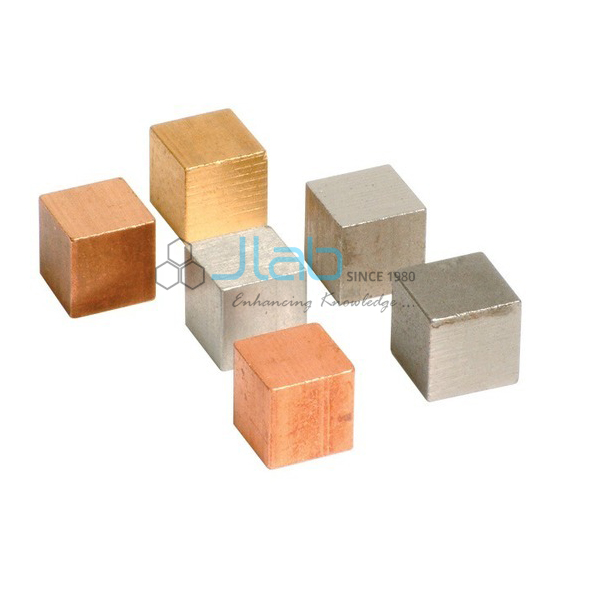
Metal Cubes (code EL-SLE-4644) are a well-finished set of six solid cubes in aluminium, brass, copper, iron, zinc and lead, used for measuring density and specific gravity in school and college physics practicals. The cubes are also available with hooks, and other sizes and materials, including wood and plastic, can be made to order. They are made by Jain Laboratory Instruments Pvt Ltd (JLab) at its works in Ambala, India.
Specifications
| Parameter | Detail |
|---|---|
| Contents | Set of six solid cubes |
| Materials | Aluminium, brass, copper, iron, zinc and lead |
| Finish | Well finished |
| Use | Measurement of density and specific gravity |
| Options | Available with hook; custom sizes and materials, including non-metals such as wood and plastic |
| Quality check | Each set is visually inspected before dispatch |
| Pack quantity | One set of six cubes |
| Minimum order quantity | 10 units (sets) |
| Dispatch time | Usually 7–10 working days |
| Product code | EL-SLE-4644 |
| Manufacturer | Jain Laboratory Instruments Pvt Ltd (JLab) — OEM |
| Country of origin | India (made in Ambala, Haryana) |
How Does It Compare with Other JLab Density Cube Sets?
| Model | Cubes | Materials |
|---|---|---|
| This set (EL-SLE-4644) | Six solid cubes; hook option | Aluminium, brass, copper, iron, zinc, lead |
| Metal Cubes (second listing) | Six solid cubes; hook option | The same six metals |
| Density Cube Set | Twelve 20 mm cubes | Hardwood, softwood, brass, tin, zinc, copper, aluminium, iron, marble, granite, lead, Perspex |
Choose this set when the practical is about metals only, or when you want cubes with hooks for weighing in water. The twelve-cube set adds woods, stones, tin and Perspex for comparing a wider range of densities, including materials that float.
What Are Metal Cubes Used For?
Density is mass divided by volume, and a cube makes both easy to find: measure the side with vernier calipers, cube it to get the volume, weigh the cube on a balance, and divide. Repeating this for all six cubes lets students rank the metals and see why, at the same size, an aluminium cube feels light and a lead cube heavy — aluminium is the least dense and lead the most dense of the six. Specific gravity, or relative density, compares a material with water. Hang the cube by its hook from a spring balance, weigh it in air and then fully under water; the loss in weight equals the weight of water displaced (Archimedes’ principle), and the weight in air divided by that loss gives the relative density. These are the class 9 ideas of density, relative density and buoyancy, and the vernier measurement is a standard class 11 practical.
All six metals sink in water. Dry the cubes after use so the iron cube does not rust, and wash hands after handling the lead cube.
What to Specify When Ordering
- Cube size — the listing does not state a standard size, so give the size you need.
- Hooks — plain cubes, or cubes with hooks for weighing in water.
- Extra materials — wood, plastic or other materials made to order.
- Quantity — the minimum order is 10 sets.
Frequently Asked Questions
Which metals are in the set?
Aluminium, brass, copper, iron, zinc and lead — six solid cubes in all.
What size are the cubes?
The size is not stated in this listing, and custom sizes are available. Tell JLab the size you need, or ask for the current standard size, before ordering.
Why choose cubes with hooks?
A hook lets each cube hang from a spring balance or a beam balance, so it can be weighed in air and then under water to find its specific gravity by Archimedes’ principle.
How do you find the density of a cube?
Measure one side with vernier calipers, cube the reading to get the volume, weigh the cube, and divide the mass by the volume. Measuring several sides and averaging improves the result.
Can you supply non-metal cubes?
Yes. Custom materials, including non-metals such as wood and plastic, are available; list them in your enquiry with the size.
What information is needed for an export quotation?
The number of sets, cube size and options, the destination country and port or city, your delivery terms (for example FOB or CIF), any packing or labelling needs and, for tenders, the tender reference.
Who manufactures these metal cubes?
Jain Laboratory Instruments Pvt Ltd (JLab) makes them at its works in Ambala, Haryana, India, and quotes for them directly.
OEM Manufacturer
JLab is the trading name of Jain Laboratory Instruments Pvt Ltd, a school physics lab equipment manufacturer in India, incorporated in 2017 and based on Hargolal Road, Ambala, Haryana. The cube sets are produced at JLab’s own works and are not bought in from a trader, so schools, colleges, dealers and importers buy factory-direct, every set is inspected by eye before dispatch, and custom sizes and repeat orders are handled by the maker. JLab holds CIN U29309HR2017PTC069123 and is a manufacturing enterprise under MSME Udyam registration UDYAM-HR-01-0003849. JLab exports worldwide and ships to buyers in every region — for example Bangladesh in South Asia, Bulgaria in Eastern Europe, Bahrain in the Middle East, Switzerland in Western Europe and the Dominican Republic in Central America and the Caribbean. Tender buyers can see the JLab lab tenders page.
Density and Buoyancy Apparatus
- Vernier Calliper — a chrome-plated steel calliper with depth gauge, for measuring the side of each cube.
- Spring Balance — for weighing the hooked cubes in air and in water.
- Eureka Can (Overflow Cans Plastic) — measures displaced water to find volume or check Archimedes’ principle.
See more physics apparatus in the School Lab Equipment range.
Request a Quote
Quotes come direct from the manufacturer. Use the Add To Cart enquiry button on this page, or send the number of sets (minimum 10), the cube size, whether you need hooks or extra materials, and your delivery location through the contact page.
Last updated: 4 October 2026