

Microprocessor Dissolved Oxygen Meter Manufacturer,Supplier and Exporter in India
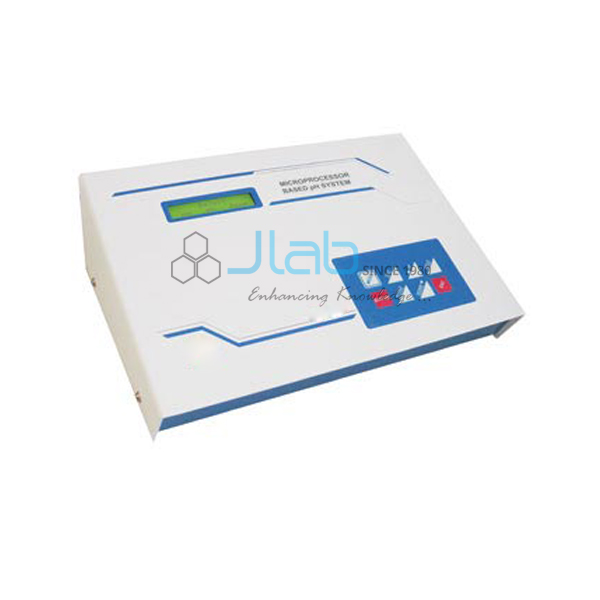
Product Code : EL-DOM-2201
Jlab Export is a leading Microprocessor Dissolved Oxygen Meter Manufacturer,and suppliers in India
Built for the bench, this microprocessor meter measures dissolved oxygen from 0 to 20 ppm and sample temperature from 0 to 100 °C. A backlit two-line LCD prompts each step, eight membrane keys run it, and up to 90 results stay in memory after switch-off. Stored readings can be printed on a dot-matrix printer. A stirrer and magnetic capsule come with the DO and temperature probes.
Specifications
| Range | DO 0–20 ppm, temperature 0–100 °C |
| Resolution | DO 0.1 ppm, temperature 0.1 °C |
| Accuracy | DO ±0.2 ppm, temperature ±0.2 °C |
| Temperature compensation | 0–50 °C, automatic or manual |
| Calibration | Automatic or manual |
| Display | 16x2 line alphanumeric LCD with backlight |
| Keys and memory | 8 soft-touch membrane keys, storage for up to 90 samples |
| Printer output | Any dot-matrix printer with Centronics interface |
| Power, size and weight | 230 V ±10% AC, 50 Hz, 275 x 180 x 80 mm, 2.5 kg (approx.) |
| Supplied with | DO probe, temperature probe, DO membranes, stirrer, magnetic capsule, mains lead, dust cover and operation manual |
| Minimum order quantity | 1 unit |
| Dispatch time | Usually 7–10 working days |
| Manufacturer | JLab (Jain Laboratory Instruments Pvt Ltd), Ambala, India |
Dissolved Oxygen Practicals in Water Analysis
Environmental science classes often start by comparing tap water, pond water and water that has been shaken with air. Students then warm one sample in a Beaker 250 ml and read it at several temperatures. The falling DO values show that warm water holds less oxygen than cold water.
The meter also serves the BOD test. Students read the DO of a diluted sample on the first day, keep the sealed bottles dark in a B.O.D. Incubator for the set period, then read them again. The drop in DO is the oxygen used by microbes, and the 90-sample memory keeps every reading for the report.
Frequently Asked Questions
Why does the sample need stirring during a reading?
A membrane DO probe uses up a little oxygen at its surface, so still water next to the membrane soon runs low and the reading falls. The supplied stirrer and magnetic capsule keep fresh sample moving past the membrane. Stir steadily, without pulling air bubbles into the water.
How is the meter calibrated?
It offers automatic and manual calibration, with prompts on the LCD. A usual method is to calibrate in water-saturated air or air-saturated water, close to the sample temperature. Calibrate again after fitting a new membrane.
When should the probe membrane be changed?
Change it when it is torn, wrinkled or fouled, when an air bubble is trapped under it, or when readings drift and will not calibrate. Spare DO membranes come with the meter, and the operation manual shows how to fit them.
Why does temperature matter for DO readings?
Cold water holds more dissolved oxygen than warm water, and the probe signal also changes with temperature. The meter reads temperature through its own probe and compensates from 0 to 50 °C, either automatically or from a value set by hand.
Can results from a survey be stored and printed?
Yes. Up to 90 sample results stay in memory even when the meter is switched off. Any stored result can be printed on a dot-matrix printer with a Centronics parallel interface connected to the printer port.
Other Meters for Water Analysis
- Dissolved Oxygen Meter (hand-held, battery powered)
- Portable Dissolved Oxygen Meter
- Digital Turbidity Meter
For a quote, use Add To Cart or send us a message through the contact page.
Last updated: 6 November 2026
