Molecular Model Manufacturer,Supplier and Exporter in India
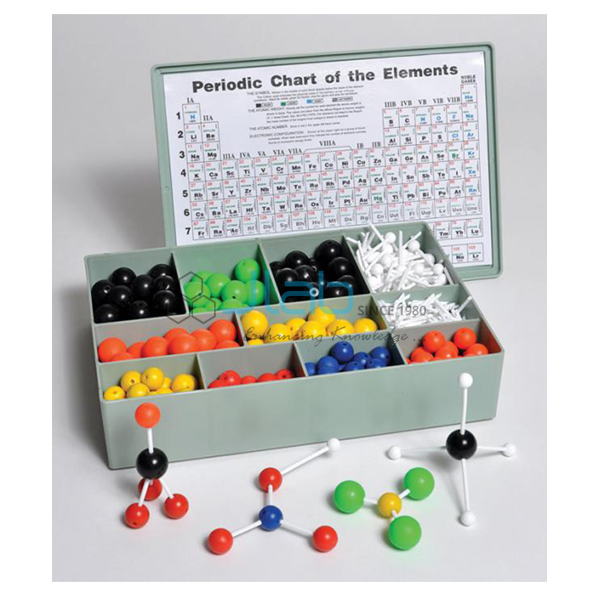
Product Code : EL-SLE-4662
Jlab Export is a leading Molecular Model Manufacturer,and suppliers in India
Molecular Model (code EL-SLE-4662) is a model-building set of jacks and connectors, supplied in the suggested numbers for assembling the crystal structures of diamond, graphite and sodium chloride. Teachers use it for lab and classroom demonstrations of how atoms and ions are arranged in these solids, from secondary-school chemistry to college classes. It is made by Jain Laboratory Instruments Pvt Ltd (JLab) at its works in Ambala, India.
Specifications
| Parameter | Detail |
|---|---|
| Contents | Jacks and connectors in suggested numbers |
| Structures it builds | Diamond, graphite and sodium chloride (listed as molecular structures) |
| Use | Lab demonstrations |
| Quality check | Each set is visually inspected before dispatch |
| Pack quantity | Each (one set) |
| Minimum order quantity | 10 units |
| Dispatch time | Usually 7–10 working days |
| Product code | EL-SLE-4662 |
| Manufacturer | Jain Laboratory Instruments Pvt Ltd (JLab) — OEM |
| Country of origin | India (made in Ambala, Haryana) |
How Does It Compare with Other JLab Structure Models?
| Listing | Structures | Listed details |
|---|---|---|
| This molecular model (EL-SLE-4662) | Diamond, graphite, sodium chloride | Jacks and connectors in suggested numbers |
| Crystal Model Set | Diamond, graphite, sodium chloride | Red, black and white jacks; long and short connectors |
| Graphite Structure (Molecular Model Set) | Diamond, graphite, sodium chloride | Same listed description as this set |
| Graphite Structure | Graphite only | Three layers of 15 carbon atoms each; atom parts 14.5–15 mm |
| Diamond Structure | Diamond only | 30 carbon atom parts and 40 links; atom parts 14.5–15 mm |
Choose this set, or the Crystal Model Set, when one kit should cover all three classic structures. The single-structure Graphite Structure and Diamond Structure listings state their atom counts and part sizes, which helps when a tender or lesson plan needs a fixed specification.
What Is the Molecular Model Used For?
Diamond, graphite and sodium chloride are the standard examples used to explain how structure decides properties. In diamond every carbon atom is bonded to four others in a rigid three-dimensional network, which is why it is so hard. In graphite each carbon is bonded to three others in flat hexagonal layers held together only weakly, so the layers slide over one another and the loosely held electrons let graphite conduct electricity. Sodium chloride is a giant ionic lattice in which each sodium ion is surrounded by six chloride ions and each chloride ion by six sodium ions. Building these from jacks and connectors lets students see and handle the arrangements during lessons on allotropes of carbon, ionic bonding and crystal structures in school and college chemistry labs.
Strictly, these three are giant structures rather than separate molecules, and the models are a useful way to show that difference. Sort the pieces before the lesson, follow the suggested numbers for each structure, and dismantle and count the parts back into the box afterwards so the set stays complete.
What to Specify When Ordering
- Number of sets — the minimum order is 10 sets; one per group of students is a common plan for practical lessons.
- Contents — ask JLab to list the piece counts and colours if your tender or syllabus specifies them.
- Alternatives — name the Crystal Model Set or a single-structure model instead if you prefer their listed details.
- Wall charts — add the sodium chloride or crystal lattice charts to the same enquiry.
Frequently Asked Questions
Which structures can be built with this set?
Diamond, graphite and sodium chloride. The jacks and connectors come in the suggested numbers for these three.
Can all three structures be built at the same time?
The listing does not say. Ask JLab whether the set holds enough parts for all three together or is meant to be rebuilt from one to the next.
How many pieces are in the set, and what colours are they?
Piece counts and colours are not given in this listing. JLab will list the contents in the quotation; the Crystal Model Set listing, for comparison, states red, black and white jacks with long and short connectors.
Are diamond, graphite and sodium chloride really molecules?
Not in the strict sense. Diamond and graphite are giant covalent structures and sodium chloride is a giant ionic lattice, which is exactly what these models help students to understand.
What is needed for an export quotation?
The number of sets, the destination country and port or city, delivery terms such as FOB or CIF, any packing or labelling requirements and the tender reference, if you have one.
Who manufactures this molecular model set?
Jain Laboratory Instruments Pvt Ltd, trading as JLab, makes it at its works in Ambala, Haryana, India, and supplies it directly as the manufacturer.
OEM Manufacturer
JLab is the trading name of Jain Laboratory Instruments Pvt Ltd, a manufacturer of chemistry teaching aids and school laboratory equipment in India, incorporated in 2017 and based on Hargolal Road, Ambala, Haryana. The model sets are made at JLab’s own works rather than bought from a trader, so schools, colleges, dealers and importers buy factory-direct, each set is visually inspected before dispatch, and repeat orders and replacement parts are handled by the manufacturer. JLab exports worldwide and ships to buyers in every region — for example DR Congo in Central Africa, Sweden in Northern Europe, Tanzania in East Africa, Egypt in North Africa and Peru in South America. Tender buyers can refer to the JLab lab tenders page.
Related Chemistry Models and Charts
- Sodium Chloride Crystal — a wall chart of the rock-salt structure to display beside the model.
- Crystal Lattices — a wall chart on crystal lattices and unit cells.
- Molecular Models Sets — coloured spheres and linking rods for building organic and inorganic molecules.
- Molecular Models Beads — brightly coloured solid spheres and linking rods in bulk.
See the full School Lab Equipment range.
Request a Quote
Quotes come direct from the manufacturer. Use the Add To Cart enquiry button on this page, or send the number of sets (minimum 10), any content requirements and your delivery location through the contact page.
Last updated: 4 October 2026