Photoelectric Relay Apparatus Manufacturer,Supplier and Exporter in India
Product Code : EL-OED-1054
Jlab Export is a leading Photoelectric Relay Apparatus Manufacturer,and suppliers in India
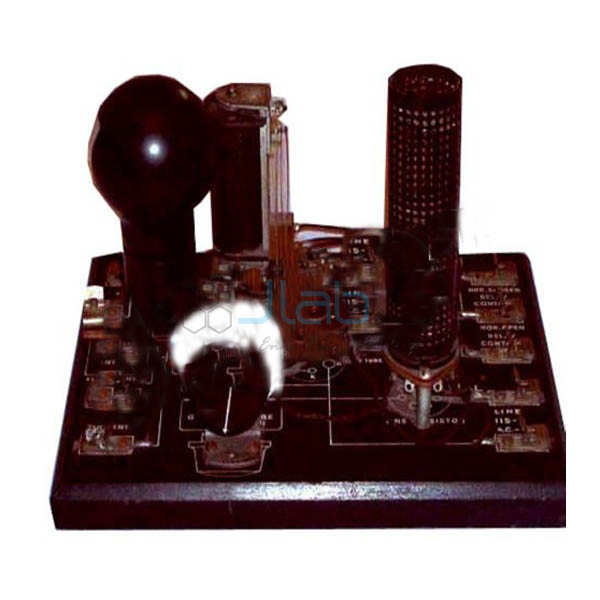
Photoelectric Relay Apparatus (code EL-OED-1054) is a demonstration unit for studying how a light-dependent resistor (LDR) operates a relay — the principle behind many light-operated switches. One relay, an LDR on the front panel and a lamp holder with a 10 W bulb are mounted with a power supply, and bulbs show the relay’s switching action. It is made by Jain Laboratory Instruments Pvt Ltd (JLab) at its works in Ambala, India.
Specifications
| Parameter | Detail |
|---|---|
| Experiment | To study the operation of an LDR by relay |
| Relay | One relay |
| Light sensor | LDR mounted on the front panel |
| Lamp | Lamp holder with 10 W bulb |
| Power supply | Included; the lamp holder and bulb are mounted with it |
| Indication | The effect of the relay is demonstrated by bulbs |
| Dimensions | 8 x 6 x 5 in (about 20 x 15 x 13 cm) |
| Quality check | Each apparatus is visually inspected before dispatch |
| Pack quantity | Each (sold individually) |
| Minimum order quantity | 10 units |
| Dispatch time | Usually 7–10 working days |
| Product code | EL-OED-1054 |
| Manufacturer | Jain Laboratory Instruments Pvt Ltd (JLab) — OEM |
| Country of origin | India (made in Ambala, Haryana) |
What Is the Photoelectric Relay Apparatus Used For?
It shows students how a change in light can switch an electrical load. An LDR’s resistance falls sharply when light reaches it and rises in the dark. In a photoelectric relay circuit that change sets the current through the relay coil: when the light level crosses the circuit’s set point the relay changes over, and when the light changes back the relay returns. On this unit the result is easy to see, because bulbs light up or go out as the relay switches, so a class can follow cause and effect from the light on the LDR to the load.
The apparatus suits senior secondary physics and electronics projects, B.Sc. electronics practicals and ITI and polytechnic courses where sensors and control circuits are introduced. It explains everyday systems such as automatic street lights, burglar alarms that trip when a beam is broken, and counters on production lines. Let the relay settle between readings, shade the LDR from room lighting when testing the dark condition, and switch off the supply before touching the lamp holder or changing a bulb, as the bulb gets hot in use.
What to Specify When Ordering
- Quantity — the minimum order is 10 units; it pairs well with the LDR characteristics apparatus for a complete sensor practical.
- Mains supply — the listing does not state the mains input, so give your voltage and plug type for the quotation to confirm.
- Spare bulbs — ask for spare bulbs in the same enquiry if your lab keeps them in stock.
- Delivery details — destination country, port or city and preferred delivery terms for export orders.
Frequently Asked Questions
What does the photoelectric relay apparatus demonstrate?
The operation of an LDR by relay: light falling on the LDR switches a relay, and bulbs show the relay’s effect. It is a working model of a light-operated switch.
What is mounted on the unit?
One relay, an LDR on the front panel and a lamp holder with a 10 W bulb, all mounted with a power supply. The listed dimensions are 8 x 6 x 5 inches.
How does light make the relay switch?
Light lowers the LDR’s resistance, which changes the current in the relay circuit. Once that current crosses the relay’s operating point, the contacts change over and switch the bulbs; covering the LDR reverses the action.
How is it different from the LDR characteristics apparatus?
The characteristics apparatus, listed separately, measures the LDR’s current against light intensity with a regulated supply and two meters. This unit applies the LDR in a switching circuit, so students see what the measured behaviour is used for.
What should an export quotation request include?
The quantity, destination country and port or city, delivery terms such as FOB or CIF, packing or labelling instructions, and the tender reference if the order is for a tender.
Who manufactures this apparatus?
Jain Laboratory Instruments Pvt Ltd (JLab) builds it at its works in Ambala, Haryana, India, and quotes for it directly as the manufacturer.
OEM Manufacturer
JLab is the trading name of Jain Laboratory Instruments Pvt Ltd, a maker of electronics and physics teaching equipment in India, incorporated in 2017 and based on Hargolal Road, Ambala, Haryana. This relay unit is wired and assembled at JLab’s own works, not bought from a trader, so schools, colleges, dealers and importers deal directly with the manufacturer; each unit is visually inspected before dispatch, and repeat orders and spares are handled by the same team. JLab exports worldwide and ships to buyers in every region — for example Mongolia in East Asia, Estonia in Northern Europe, Morocco in North Africa, Kuwait in the Middle East and Slovenia in Southern Europe. Tender buyers can find details on the JLab lab tenders page.
Related Sensor and Opto-Electronics Apparatus
- LDR Characteristics Apparatus — plots the LDR’s current against light intensity at different voltages.
- Photo Transistor Characteristics Apparatus — the same light-response study for a phototransistor.
- Photodiode Characteristics Apparatus — current against light intensity for a photodiode.
- Characteristics of Opto Electronic Devices Kit — V–I characteristics of a phototransistor, photodiode and LED on one panel.
See the full OPTO Electronic Devices range or the wider Scientific Instrument range.
Request a Quote
Quotes come direct from the manufacturer. Use the Add To Cart enquiry button on this page, or send the quantity (minimum 10 units), your mains voltage, any spare bulbs you need and the delivery location through the contact page.
Last updated: 9 October 2026