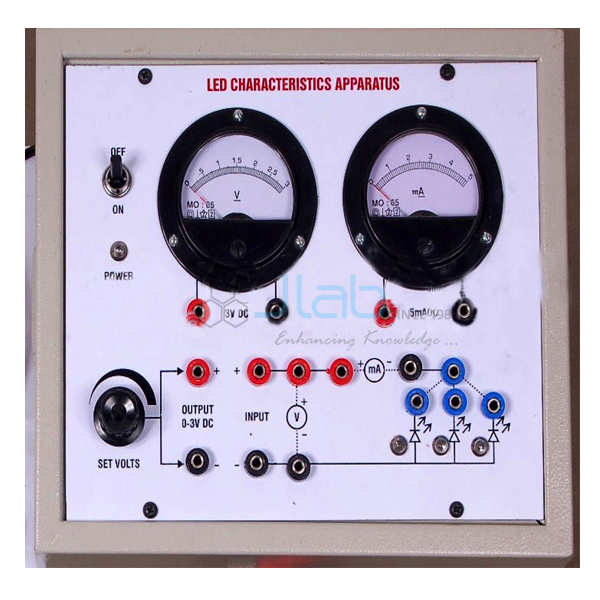
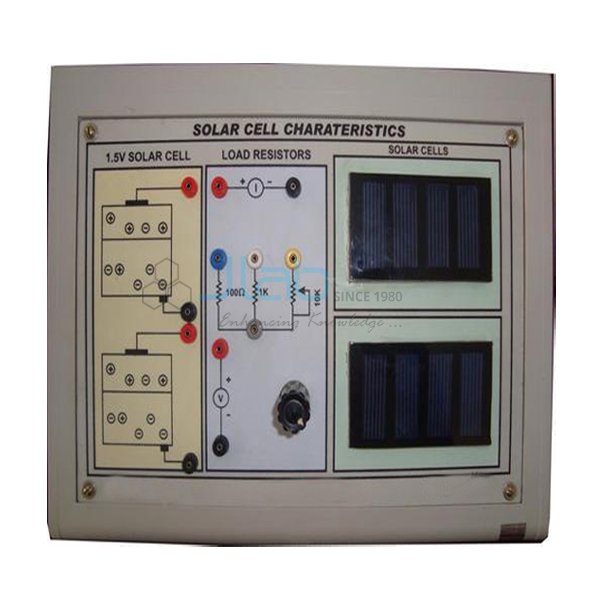
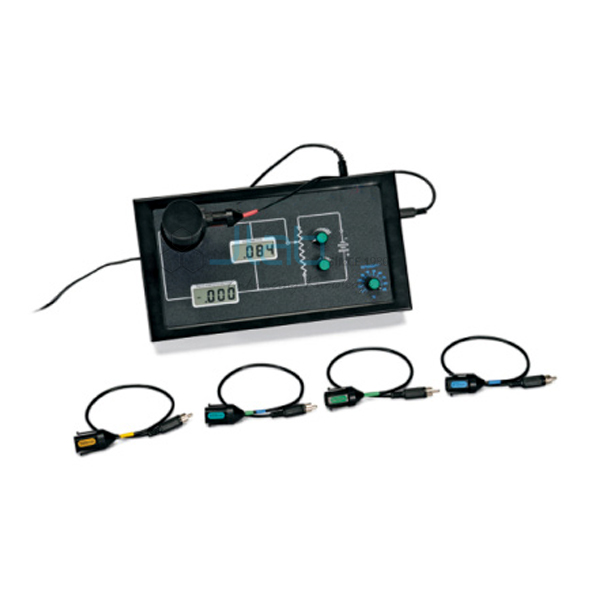
App. to determine Inverse Square Law in Photo Cell Manufacturer,Supplier and Exporter in India
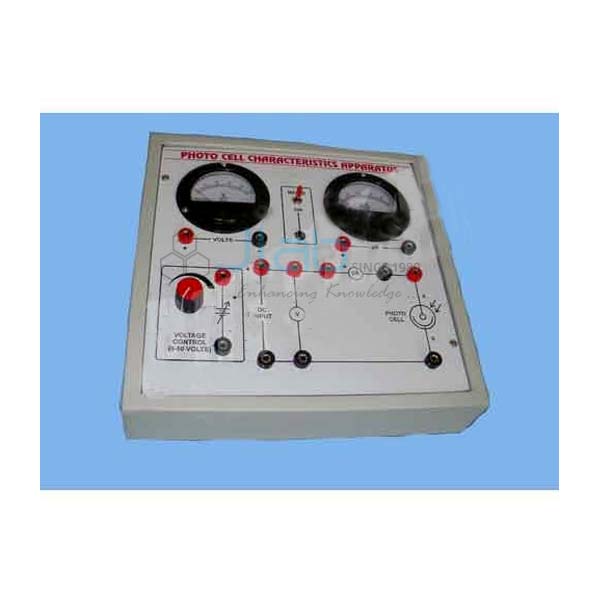
Product Code : EL-OED-1052
Jlab Export is a leading App. to determine Inverse Square Law in Photo Cell Manufacturer,and suppliers in India
App. to determine Inverse Square Law in Photo Cell (code EL-OED-1052) is a physics lab apparatus for drawing the characteristic between distance and light intensity, the classic test of the inverse square law. A mounted photovoltaic cell and a lamp house sit on a double-rod optical bench, with a power supply with meters and connection leads to complete the set. It is made by Jain Laboratory Instruments Pvt Ltd (JLab) at its works in Ambala, India.
Get a quote: use the Add To Cart enquiry button below, or send your quantity and destination through the contact page.
Specifications
| Parameter | Detail |
|---|---|
| Experiment | To draw the characteristic between distance and intensity of light |
| Detector | Photovoltaic cell, mounted |
| Light source | Lamp house for illumination |
| Optical bench | Double-rod optical bench |
| Power supply | Power supply with meters |
| Connections | Connection leads included |
| Quality check | Each apparatus is visually inspected before dispatch |
| Pack quantity | Each (one set as listed) |
| Minimum order quantity | 10 units |
| Dispatch time | Usually 7–10 working days |
| Product code | EL-OED-1052 |
| Manufacturer | Jain Laboratory Instruments Pvt Ltd (JLab) — OEM |
| Country of origin | India (made in Ambala, Haryana) |
What Is the Inverse Square Law Apparatus Used For?
The inverse square law says that the illumination from a small source falls off as the square of the distance: double the distance and the light reaching each square centimetre drops to a quarter. With this set, students move the photovoltaic cell and the lamp house apart along the optical bench in steps, read the cell’s output on the meters at each distance, and plot it first against distance and then against one over the distance squared. The second graph should be a straight line, which confirms the law and shows how a photocell can be used as a simple light meter.
The experiment suits senior secondary and undergraduate physics practicals on photometry and opto-electronics, and it connects naturally to solar cell work, since the same cell turns light into electrical output. Darken the room so only the lamp reaches the cell, keep the cell facing the lamp squarely at every position, and expect the points taken very close to the lamp house to stray from the line, because the source is not a true point there.
What to Specify When Ordering
- Quantity — the minimum order is 10 sets, typically one per student group.
- Meter ranges and lamp — the listing does not state the meter ranges or the lamp rating, so ask for them to be confirmed in the quotation.
- Mains supply — give your lab’s voltage and plug type for the power supply and lamp house.
- Spare cells — mounted solar cells are also listed separately if you want spares.
Frequently Asked Questions
What does this apparatus demonstrate?
That light intensity from a source falls with the square of the distance. Students draw the characteristic between distance and intensity of light and test it against the inverse square law.
What is included in the set?
A mounted photovoltaic cell, a lamp house for illumination, a double-rod optical bench, connection leads and a power supply with meters.
How is the light intensity measured?
By the photovoltaic cell, whose electrical output rises with the light falling on it. Reading that output on the meters at each distance gives a relative measure of intensity, which is all the inverse square test needs.
Why is a double-rod optical bench used?
It keeps the lamp house and the cell in line while the distance between them is changed, so each reading is taken with the cell facing the lamp in the same way.
What is the minimum order and dispatch time?
The minimum order is 10 sets, and dispatch is usually within 7–10 working days. Each set is visually inspected before it leaves the works; export transit time depends on the destination and shipping method.
What should an export quotation request include?
The quantity, destination country and port or city, delivery terms such as FOB or CIF, any packing or labelling requirements, and a tender reference if applicable.
Who manufactures this apparatus?
Jain Laboratory Instruments Pvt Ltd, trading as JLab, at its works in Ambala, Haryana, India; quotations come straight from the manufacturer.
OEM Manufacturer
JLab is the trading name of Jain Laboratory Instruments Pvt Ltd, a physics and opto-electronic lab equipment manufacturer in India, incorporated in 2017 and based on Hargolal Road, Ambala, Haryana. The optical bench, lamp house, cell mount and power supply are made at JLab’s own works rather than bought in from a trader, so schools, colleges, dealers and importers order factory-direct, every set is visually inspected before dispatch, and spares and repeat orders are handled by the same maker. JLab is registered under GSTIN 06AADCJ9848D1ZE and identified internationally by Legal Entity Identifier 549300DTGS77DGYD6N03. JLab exports worldwide and ships to buyers in every region — for example Madagascar in East Africa, Tonga in Oceania, El Salvador in Central America and the Caribbean, Mexico in North America and South Korea in East Asia. Tender information is on the JLab lab tenders page.
Related Light and Photocell Apparatus
- Solar Cell Characteristics Apparatus — draws the V–I characteristics of a solar cell with its own lamp house and meters.
- Solar Cell Mounted — a silicon solar cell on a mount with sockets, as a spare or for extra benches.
- Mercury Vapour Lamp Hg for use with above Photo Voltaic Cell — a mercury vapour lamp with choke, listed as a light source for photovoltaic cell experiments.
- Planck’s Constant Apparatus — a photoelectric-effect set built on a lamp house and double-rod optical bench.
- LDR Characteristics Apparatus — plots current against light intensity for a light-dependent resistor.
See the full OPTO Electronic Devices range or the wider Scientific Instrument range.
Request a Quote
Quotes come direct from the manufacturer. Use the Add To Cart enquiry button on this page, or send the quantity (minimum 10 sets), your mains voltage, any spare cells you want and the delivery location through the contact page.
Last updated: 9 October 2026