Port Timing Diagram Manufacturer,Supplier and Exporter in India

Product Code : EL-AELE-9424
Jlab Export is a leading Port Timing Diagram Manufacturer,and suppliers in India
In a two-stroke petrol engine the moving piston uncovers and covers the ports in the cylinder wall. The port timing diagram shows those events against crank angle. Automobile and IC engine labs use it to teach two-stroke timing.
Specifications
| Topic | Port timing of a two-stroke engine |
| Lab use | IC engine and automobile engineering teaching |
| Minimum order quantity | 1 unit |
| Dispatch time | Usually 14–18 working days |
| Manufacturer | JLab (Jain Laboratory Instruments Pvt Ltd), Ambala, India |
Exhaust, Transfer and Inlet Port Events
On the downstroke the piston first uncovers the exhaust port (EPO), and the burnt gas starts to blow down. A little later it uncovers the transfer port (TPO), and fresh charge from the crankcase flows in and pushes the remaining exhaust out. On the upstroke the transfer port closes (TPC) before the exhaust port (EPC).
Where the crankcase inlet is also piston-controlled, it opens and closes either side of TDC. Because the piston covers and uncovers each port at the same height, piston-ported timing is symmetrical about the dead centres. The time when the transfer and exhaust ports are both open is the scavenging period.
Port Timing Practical for Students
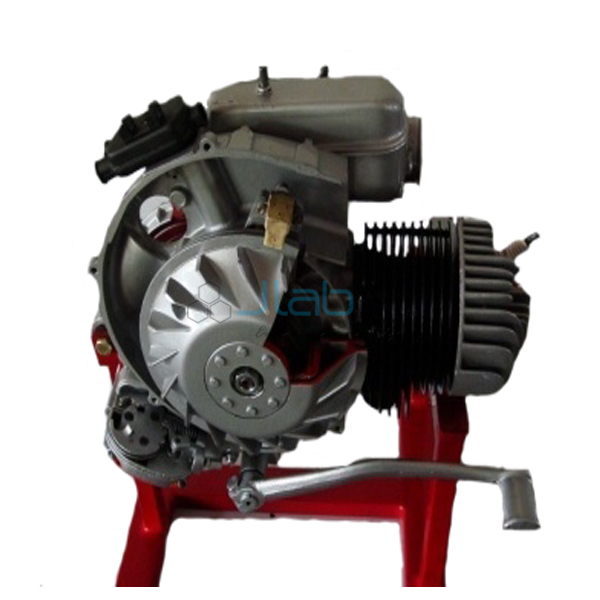
Drawing the port timing diagram of a two-stroke engine is the usual practical. On the 2 Stroke 1 Cylinder Petrol Engine Manual Driven, students mark TDC and BDC on the flywheel. They then turn the crank slowly and mark where the piston edge just opens and closes each port.
Each arc is measured from its dead centre, converted to degrees and plotted, and the blow-down and scavenging periods are worked out. The Cut Section Model of Two Stroke Single Cylinder Engine (Working), worked by its kicker lever, shows the piston moving in the cylinder.
Frequently Asked Questions
What are EPO, TPO, TPC and EPC?
Exhaust port opens, transfer port opens, transfer port closes and exhaust port closes. They are the four main events on a two-stroke port timing diagram, each marked as a crank angle from a dead centre.
Why does the exhaust port open before the transfer port?
The burnt gas is still above crankcase pressure when the piston comes down. Opening the exhaust first lets that pressure fall, so the fresh charge can flow in through the transfer port instead of being pushed back.
Why is a two-stroke port timing diagram symmetrical?
The piston opens a port at a fixed height in the cylinder wall and closes it at the same height on the return stroke. Each port therefore opens and closes at equal crank angles either side of the dead centre.
What is scavenging in a two-stroke engine?
Scavenging is the clearing of burnt gas from the cylinder by the incoming fresh charge. It happens while the transfer and exhaust ports are both open, and some fresh charge can escape with the exhaust.
Other Items for Engine Timing Practicals
For a quote, use Add To Cart or send us a message through the contact page.
Last updated: 5 November 2026