Sand Gauge Chart Manufacturer,Supplier and Exporter in India
Product Code : EL-SM-8882
Jlab Export is a leading Sand Gauge Chart Manufacturer,and suppliers in India
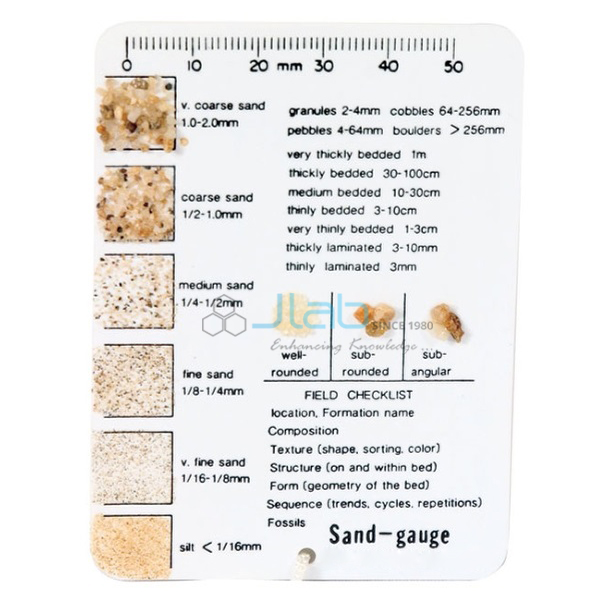
Sand grains are judged for both size and roundness on this 89 x 64 mm (3.5 x 2.5 in) water-resistant plastic card. Nine granule patches are fixed to it, covering sizes from 2 mm very coarse sand down to 1/16 mm silt, with shape panels from angular to rounded. A field checklist comes with it, and the back carries geologic age and carbonate tables.
Specifications
| Card | Water-resistant plastic, 89 x 64 mm (3.5 x 2.5 in) |
| Granule patches | 9, firmly attached |
| Size range | 2 mm very coarse sand to 1/16 mm silt |
| Sample panels | Very coarse, coarse, medium, fine, very fine, silt |
| Particle shape panels | Angular, sub-angular, sub-rounded, rounded |
| Checklist | For field notes and bed thickness |
| Reverse side | Tables of geologic age and carbonate classification |
| Minimum order quantity | 10 units |
| Dispatch time | Usually 4–6 working days |
| Manufacturer | JLab (Jain Laboratory Instruments Pvt Ltd), Ambala, India |
Sand Description Lab Exercises
Students compare sands from a river bed, a beach and a dune. Under a Hand Magnifier they place each sample in a size panel and a shape panel, then discuss why wind-blown grains tend to be finer and rounder. Sieving the same sands through a Test Sieve stack shows how well the eye estimates agree.
In a school class, pupils first sort soils and rocks with the Rocks and Soils Science Kit. They then use the card to describe the sandy samples. On an outcrop visit, older students log each bed with the checklist, noting grain size, roundness and bed thickness.
Frequently Asked Questions
How do I judge grain roundness with the card?
Look at the corners and edges of the grains, not their overall length. Angular grains have sharp corners, while rounded grains have smooth outlines. Check a good number of grains against the four shape panels and record the most common class.
What does roundness tell us about a sand?
Grains lose their corners as water or wind moves them, so rounded grains have usually travelled further or been worked for longer. Angular grains often lie close to the rock they came from.
Why does the size range stop at 1/16 mm?
That is the boundary between very fine sand and silt on the Wentworth scale. Finer grains are too small to judge by eye or with a hand lens, so the card ends with a single silt panel.
What is the checklist for?
It sets out what to record at each bed, including bed thickness, in the same order every time. Logs made by different students then line up and can be compared on one section drawing.
How is it different from the Grain Size Chart?
The Grain Size Chart deals only with grain size, using sieved grains set in die-cut cavities. This card also rates roundness and adds a checklist plus reference tables on its back.
Other Geology and Soil Aids
For a quote, use Add To Cart or send us a message through the contact page.
Last updated: 6 November 2026