Motorised CBR Machine Manufacturer,Supplier and Exporter in India
Product Code : EL-SM-8875
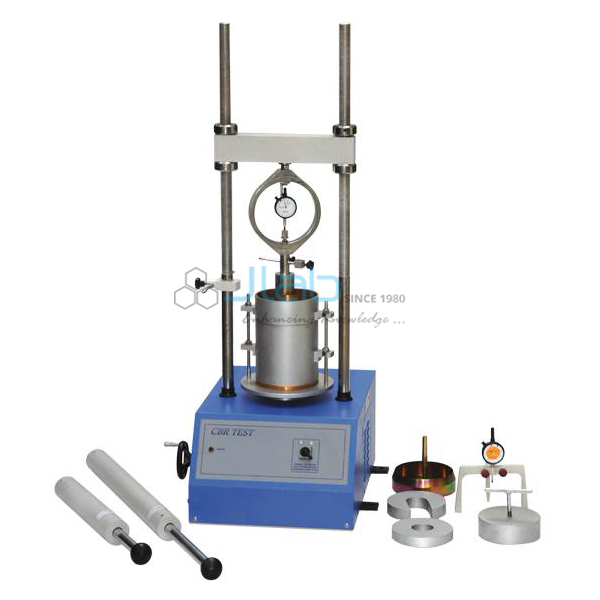
Jlab Export is a leading Motorised CBR Machine Manufacturer,and suppliers in India
On this twin column load frame a motor raises the platen at a selectable 1.27 or 1.0 mm per minute. The CBR plunger therefore enters the soil at an even rate. The frame is rated at 50 kN. It gives 800 mm of vertical and 255 mm of horizontal clearance, with a 133 mm platen and 105 mm of platen travel.
Specifications
| Frame | Twin column, motorised drive |
| Capacity | 50 kN |
| Load speeds | Selectable, 1.27 mm or 1.0 mm per minute |
| Horizontal clearance | 255 mm (10 in) |
| Vertical clearance | 800 mm (31.5 in) maximum |
| Platen | 133 mm (5.24 in) dia |
| Platen travel | 105 mm (4.13 in) |
| Minimum order quantity | 1 unit |
| Dispatch time | Usually 14–18 working days |
| Manufacturer | JLab (Jain Laboratory Instruments Pvt Ltd), Ambala, India |
CBR Test Practicals
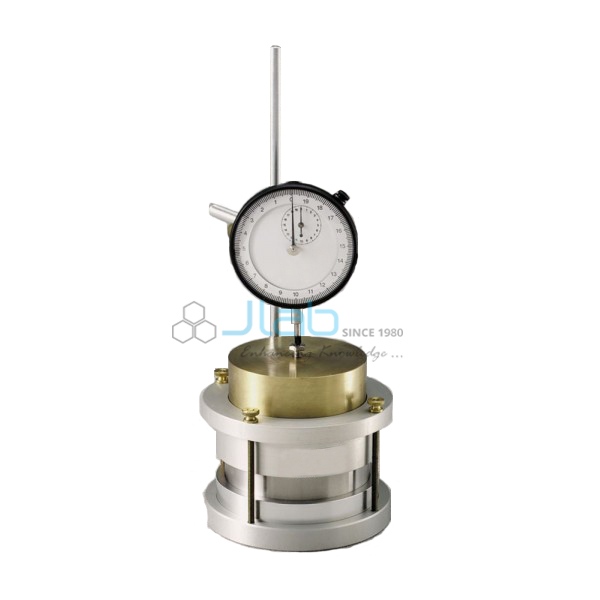
Students compact soil in a CBR mould, often with the Automatic Mechanical Soil Compactor, and add surcharge weights. With the mould on the platen, they seat the plunger with a small load and zero both gauges. The load comes from Proving Rings and the penetration from a Dial Gauge, read at set intervals.
The class plots load against penetration and corrects the start of the curve if needed. Dividing the plunger load at a chosen penetration by the standard load for that same penetration gives the CBR value as a percentage. Testing one soil soaked and unsoaked shows how much strength it loses when wet.
Frequently Asked Questions
Why does a motorised drive help in a CBR test?
The load needed to push the plunger depends on how fast it moves. The motor holds the chosen speed for the whole test, while a hand cranked frame depends on the operator keeping pace with a timer. Use 1.27 mm per minute unless your method calls for 1.0 mm.
How is the CBR value worked out?
Read the plunger load at each set penetration from the corrected curve. Divide it by the standard load for that penetration and give the result as a percentage. Your test method states which penetration gives the reported value.
What if the load curve bends upward at the start?
That concave start comes from an uneven surface or poor seating of the plunger. Draw a tangent along the steepest straight part of the curve and move the zero to where it meets the penetration axis. Read all loads from that new zero.
Should the specimen be soaked before testing?
Soaking under the surcharge weights, usually for four days, models the wettest state a road subgrade is likely to reach, and most pavement designs use that value. An unsoaked test is quicker and shows the strength at the moisture content as compacted.
How is this different from the hand operated CBR machine?
Both test the same moulded specimens. On the CBR Test Machine Hand Operated the load screw is turned by hand. This machine drives the platen by motor at a selected speed, which keeps the rate steady.
Other CBR and Bearing Test Equipment
- Field CBR Equipment (jack and proving rings for tests in place)
- Plate Bearing Test
- Compaction Mould
For a quote, use Add To Cart or send us a message through the contact page.
Last updated: 6 November 2026