Plate Bearing Test Manufacturer,Supplier and Exporter in India

Product Code : EL-SM-8871
Jlab Export is a leading Plate Bearing Test Manufacturer,and suppliers in India
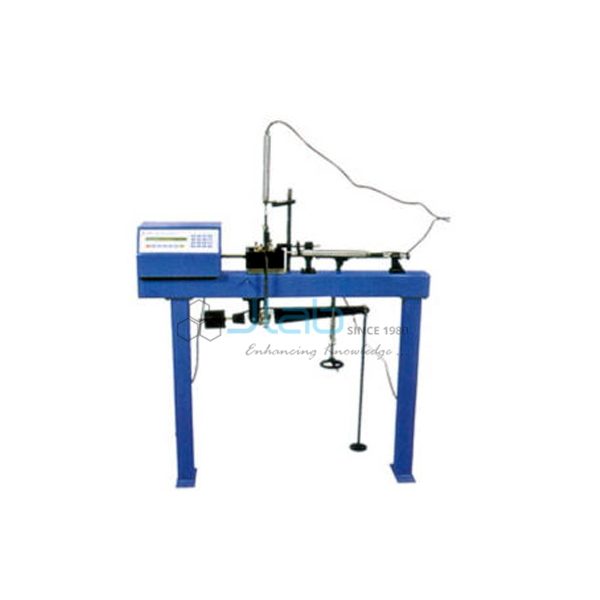
A plate bearing test loads a steel plate resting on the ground in steps and records how far it settles under each load. This set has a 0–500 kN hydraulic jack, square mild steel plates, a 5 m bridge support and four 0.01 mm dial gauges. Engineers use it to estimate the bearing capacity of shallow foundations and to design flexible pavements.
Specifications
| Hydraulic jack | Fixed pumping unit, 0–500 kN x 0.5 kN |
| Pressure line | Pressure gauge with 5 m flexible metal pipe (1 m rubber pipe optional) |
| Jack seating | Ball and socket between jack and bearing plate |
| Settlement dials | 4 dial gauges, 0.01 mm x 25 mm |
| Dial supports | 16 extension rods 12 mm dia x 25 cm, 4 magnetic bases, 4 top end plates 50 mm dia |
| Columns | 2 of 15 cm dia x 25 cm and 1 of 15 cm x 50 cm, flanged, with bolts and nuts |
| Bridge support | Welded steel angle, 5 m span, about 30 cm high, 2 quick release clamps and dial bracket |
| Bearing plates | Plain mild steel, 60 x 60, 45 x 45 and 30 x 30 cm, 25 mm thick |
| Optional plates | Plain mild steel 75 cm and 50 cm; grooved mild steel 30 x 30 to 75 x 75 cm; all 25 mm thick |
| Minimum order quantity | 1 unit |
| Dispatch time | Usually 14–18 working days |
| Manufacturer | JLab (Jain Laboratory Instruments Pvt Ltd), Ambala, India |
Plate Load Test Practicals
In a civil engineering field practical, students level the floor of a test pit and bed the plate firmly. The jack stands on the ball and socket over the plate and pushes up against a reaction load. The class raises the load in steps, reads the four dials during each step and plots load against settlement.
From that curve they find the bearing pressure at a chosen settlement, or the modulus of subgrade reaction for a pavement. On the same subgrade they can run a test with the Field CBR Equipment and measure the in-place density with a Sand Pouring Cylinder. Moisture samples are dried in a Laboratory Bench Oven.
Frequently Asked Questions
How is the modulus of subgrade reaction worked out?
Read the bearing pressure off the load and settlement curve at the settlement your design method names, then divide that pressure by the settlement. The pressure is the jack load divided by the area of the plate in use, so always record which plate was tested.
Why does the set include three plate sizes?
The plain plates are 30, 45 and 60 cm square. A larger plate stresses the soil to a greater depth, so the settlement under a given pressure changes with plate size. Testing with two sizes shows that effect before the results are applied to a wider footing.
Why are there four dial gauges?
The dials are clamped to the bridge support and read the plate at four points. Their average gives the settlement, and a large difference between them shows that the plate is tilting. Each dial reads to 0.01 mm over 25 mm of travel.
What does the jack push against?
The jack needs a heavy reaction above it, such as a loaded truck or a weighted beam across the pit. The reaction must outweigh the top load planned for the test. The long bridge keeps the dial supports away from the ground that moves as the plate settles.
How long should each load step be held?
Hold each load until the settlement has almost stopped, then add the next step. A common student mistake is adding load too soon, which makes the soil look stiffer than it is. Note the dial readings at fixed times within each step.
Other Soil Field Test Equipment
- Core Cutter
- Sand Replacement Equipment
- Dial Gauge (spare dial on a magnetic base)
For a quote, use Add To Cart or send us a message through the contact page.
Last updated: 6 November 2026